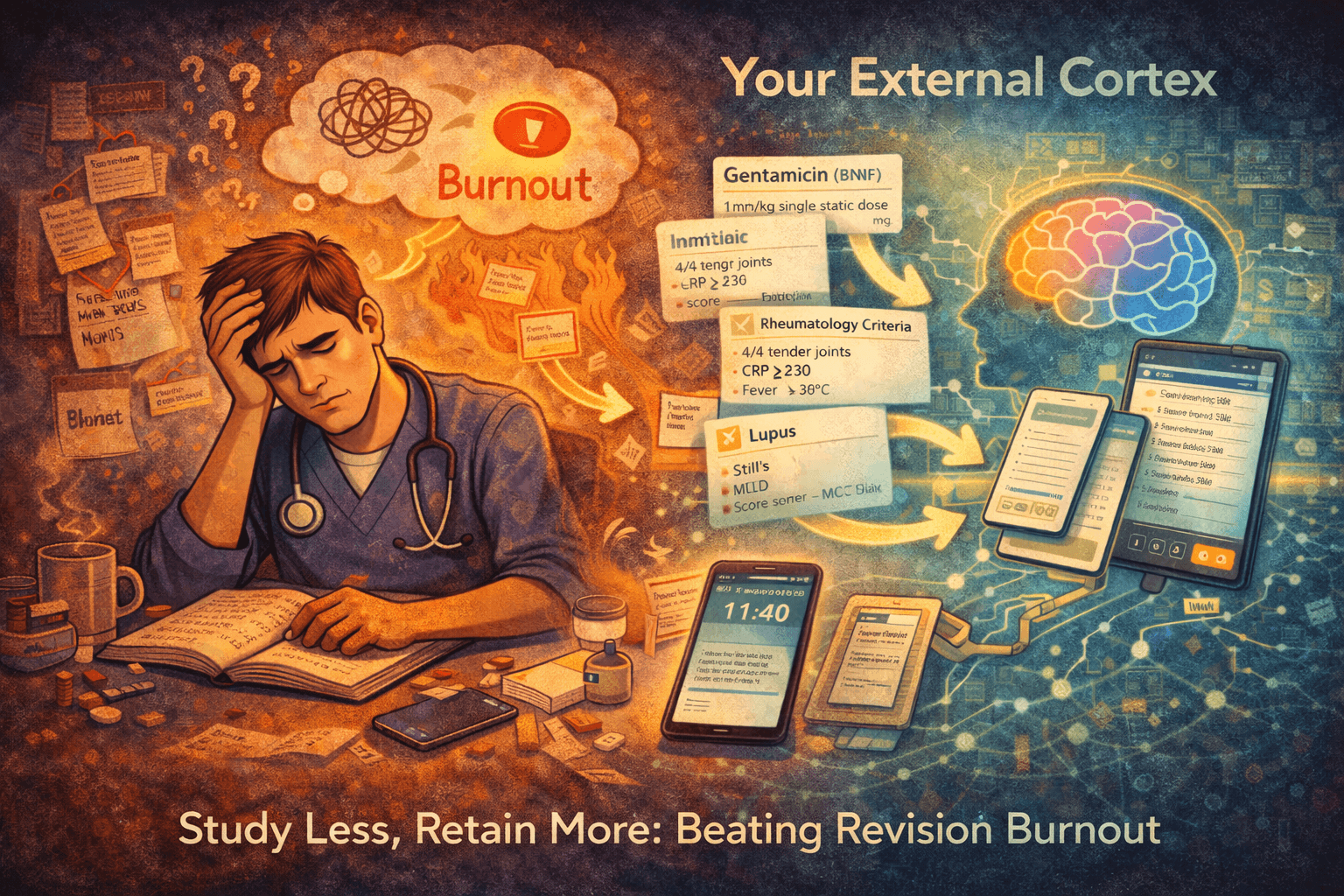
Introduction
It’s 23:40. You are trying to memorise the precise dosing for a third-line antibiotic and the niche scoring criteria for a rare rheumatological condition. You can feel the "fatigue spiral" setting in: your attention fragments, your error rate rises, and you start passively re-reading notes rather than actively learning.
The problem isn't your motivation. The problem is working-memory overload. Revision has become a low-value memorisation contest rather than an optimisation exercise. This article introduces a new strategy: using "external cortex" tools and cognitive offloading to study less, retain more, and beat burnout.
The problem: why revision burnout happens
Learning is constrained by a finite resource: your working memory. When you try to hold too many details in your head at once, your performance and retention drop off a cliff. This is known as cognitive load.
- Intrinsic load: The difficulty of the subject matter itself.
- Extraneous load: The unnecessary mental effort spent on poor study methods or trying to memorise low-value data (edtechbooks.org).
Burnout and exhaustion are genuinely common among medical learners, linked directly to this cognitive overload and the pressure of exams (PMC).
The core concept: cognitive offloading
Cognitive offloading is the act of using external aids—notes, apps, systems—to reduce the mental processing requirements of a task (PMC). It works because it frees up your limited working memory for higher-value reasoning and schema building.
The key is to offload facts, not judgement.
The strategy: tiered knowledge architecture
The most efficient way to revise is to split your knowledge into two tiers.
- Tier 1 — Memorise (High-Stakes, Time-Critical): Emergency algorithms (ALS, sepsis), red flags, "can't miss" presentations, and first-line management steps. These are needed under time pressure where look-up friction is unsafe.
- Tier 2 — Offload (High-Precision, Lookup-Appropriate): Drug interactions, rare syndromes, precise dosing rules, and niche guideline nuances. These are best handled by fast retrieval and verification rather than rote memorisation.
The role of iatroX: your “Tier-2 cortex”
The iatroX adaptive Q-bank is designed to function as your external cortex. It uses an "External Cortex Loop" to optimize your learning:
- Attempt (Retrieval): You answer questions to force active recall.
- Diagnose (Adaptive): The system detects your weak spots (errors, near-misses).
- Rebuild: You get a scaffolded explanation to fix the gap.
- Resurface (Spacing): The system schedules targeted reviews of weak topics to prevent decay (PMC).
Crucially, iatroX helps you handle Tier 2 knowledge without encouraging laziness. It provides precision-on-demand cards for dosing and criteria after you commit to an answer, preventing the "look-up reflex." It helps you learn the "index"—knowing what to look up and when—rather than forcing you to memorise the entire paragraph.
Guardrails: cognitive offloading vs cognitive atrophy
Offloading is powerful, but it has risks.
- At-risk behaviours: Checking answers before attempting retrieval, memorising only trivia, or copying explanations without re-testing.
- Safe behaviours: Always answering first (retrieval-first design), using confidence ratings to steer your adaptive review, and interleaving near-neighbour topics (e.g., PE vs pneumonia) to build discrimination skills (jacr.org, PMC).
Practical protocol: “Study less, retain more”
Daily (20–40 minutes):
- Do 20 mixed questions (retrieval-first).
- Review only the incorrect answers and the ones you were "correct but unsure" about.
- Convert each weak area into a Tier-1 takeaway (one-liner) and a Tier-2 lookup cue (what resource/table/rule to check).
Every 3rd Day:
- Do a "weakness sprint": 10 questions exclusively from your weak topics (adaptive resurfacing) (PMC).
Weekly (30 minutes):
- Perform an "index audit": list your top 10 Tier-2 lookups. If you are repeatedly missing a specific fact, promote that trigger into your Tier-1 memorisation list.
Closing takeaway
The aim isn’t to store the entire textbook in your head. It’s to hard-wire the high-stakes patterns (Tier 1) and build a trusted retrieval cortex (Tier 2). A good adaptive Q-bank makes you calmer, sharper, and more consistent—because your brain is doing the right work.
Try iatroX as your Tier-2 cortex