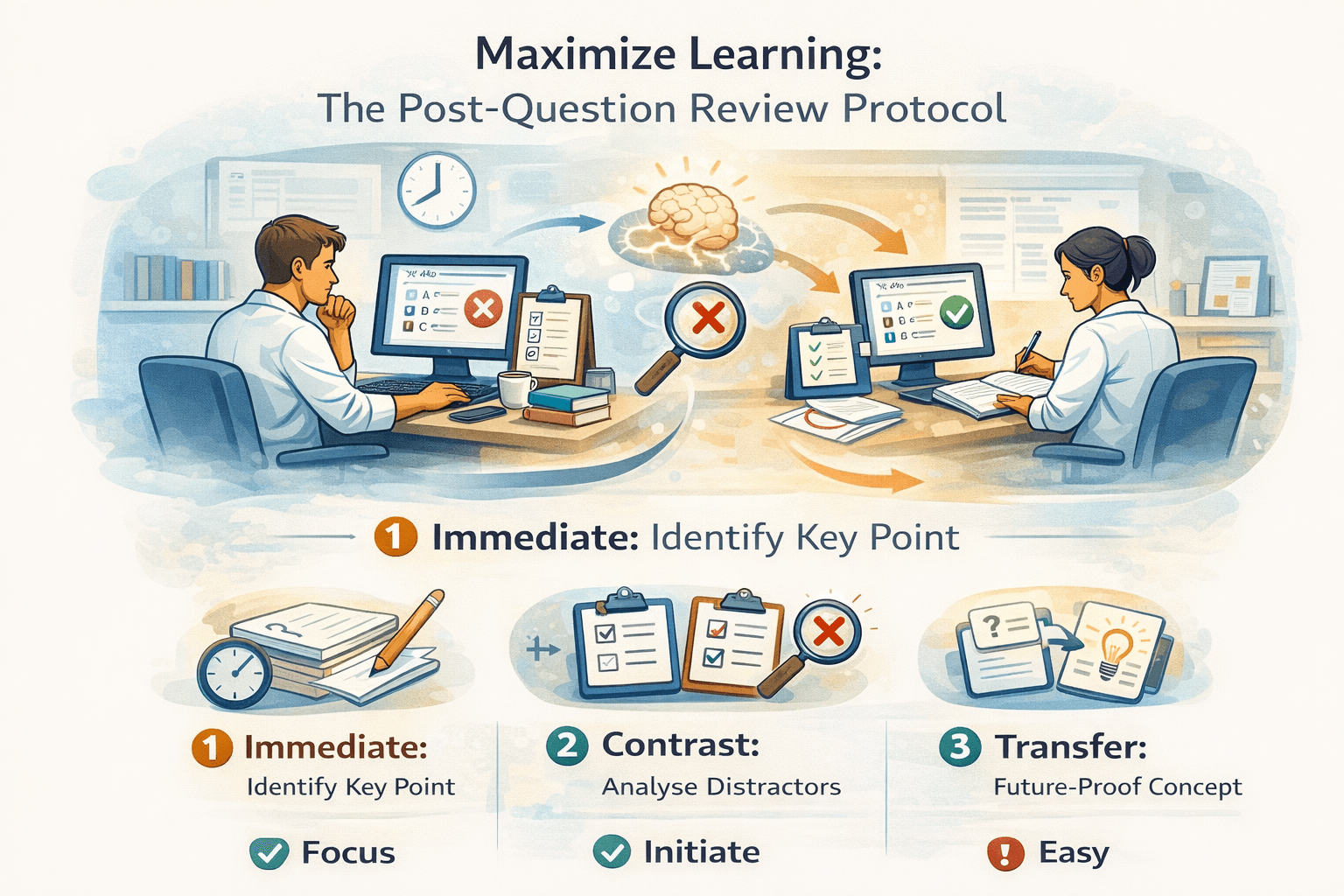
Most candidates operate on a simple but flawed equation: "more questions = higher score."
They churn through 3,000 items, read the explanations passively, and then wonder why their mock scores have plateaued at 65%. The reality is that doing questions assesses your knowledge, but reviewing questions is where the actual learning happens.
If you are spending 1 minute answering a question and only 30 seconds reviewing it, you are wasting the resource. This guide outlines the Post-Question Review Protocol—a systematic method to extract maximum value from every single error.
Why review matters more than volume
The cognitive science is clear: retrieval practice (the act of testing yourself) is superior to re-reading notes. However, retrieval practice without high-quality feedback is significantly less effective.
To move a concept from "short-term working memory" to "long-term exam retrieval," you must close the loop immediately after the error. Simply seeing the green tick or red cross is not enough; you must interrogate why the neural pathway failed. PubMed
The 3-pass review method
Stop reading the entire explanation text for every question. It is passive and inefficient. Instead, apply the "3-Pass Method" to every incorrect answer or guessed correct answer.
Pass 1: Immediate (The "One-Liner")
- Goal: Identify the core truth.
- Action: Write down why the correct answer is correct in one single sentence.
- Example: "In hyperkalaemia with ECG changes, calcium gluconate is always the first line to stabilise the myocardium, regardless of the cause."
Pass 2: Contrast (The "Distractor Analysis")
- Goal: Understand the trap.
- Action: Identify why the second-best answer (the one you likely picked) is wrong.
- Example: "Insulin/dextrose lowers potassium but does not stabilise the membrane; it is the second step, not the first."
Pass 3: Transfer (The "Next Time" Projection)
- Goal: Future-proof your knowledge.
- Action: Ask yourself, "How will the examiners rewrite this question to make the other answer correct next time?"
- Example: "If the stem said 'ECG is normal', then insulin/dextrose would have been the correct first step."
Four error types (and what to do for each)
Do not just write "silly mistake" in your notes. Be specific. Categorise every error into one of these four buckets to find your pattern.
1. Knowledge gap
- Definition: You simply did not know the fact.
- Fix: Create 1 flashcard: Rule + Example. Do not read the whole textbook chapter; just fill the specific hole.
2. Misread
- Definition: You knew the medicine, but you missed a key word (e.g., "NOT", "most likely", "first step").
- Fix: Implement a "stem parsing rule." For the next 50 questions, force yourself to highlight the age, sex, and the "instruction word" before reading the options.
3. Timing
- Definition: You rushed and panicked because the clock was red.
- Fix: Build pacing triggers. If you are stuck on a calculation for >90 seconds, flag and move on.
4. Distractor trap
- Definition: You narrowed it down to two and picked the wrong one.
- Fix: Write a "discriminator note." What is the one specific detail (e.g., patient age, side effect profile) that separates these two similar diseases?
“Correct but slow” is a wrong answer in disguise
In a high-pressure exam like the AKT or MSRA, time is marks. If you answer a question correctly but it takes you 3 minutes, you have "failed" that question because you have stolen time from two future questions.
The Rule: If a question takes >90 seconds (even if you get it right), it goes into your review queue. You need to find a way to get to that answer faster next time—usually by identifying a "keyword association" rather than working it out from first principles.
The weekly audit
Once a week (e.g., Sunday evening), look at your error log data. Do not just look at the percentage. Look for the metadata.
- Top 10 repeated mistakes: Are you consistently failing cardiology murmurs? That needs a dedicated study block, not just more random questions.
- Top 5 “easy marks” given away: Look at the "Misread" category. These are free marks you are throwing in the bin.
- One system change: Decide on one process change for next week. (e.g., "I will stop doing questions after 9 pm because my fatigue causes errors.")
Where iatroX fits
The commercial question banks are excellent for testing, but they are often poor at specific retention loops. This is where iatroX fits into your protocol.
iatroX functions as a free adaptive + spaced repetition engine. Use it to run your "weak-area loops." If your weekly audit shows you are weak on "Paediatric rashes," you can set iatroX to target that specific domain, ensuring you see those patterns repeatedly until the error rate drops to zero. It automates the "Pass 3" of the review method by serving you the transfer concepts at the optimal time.