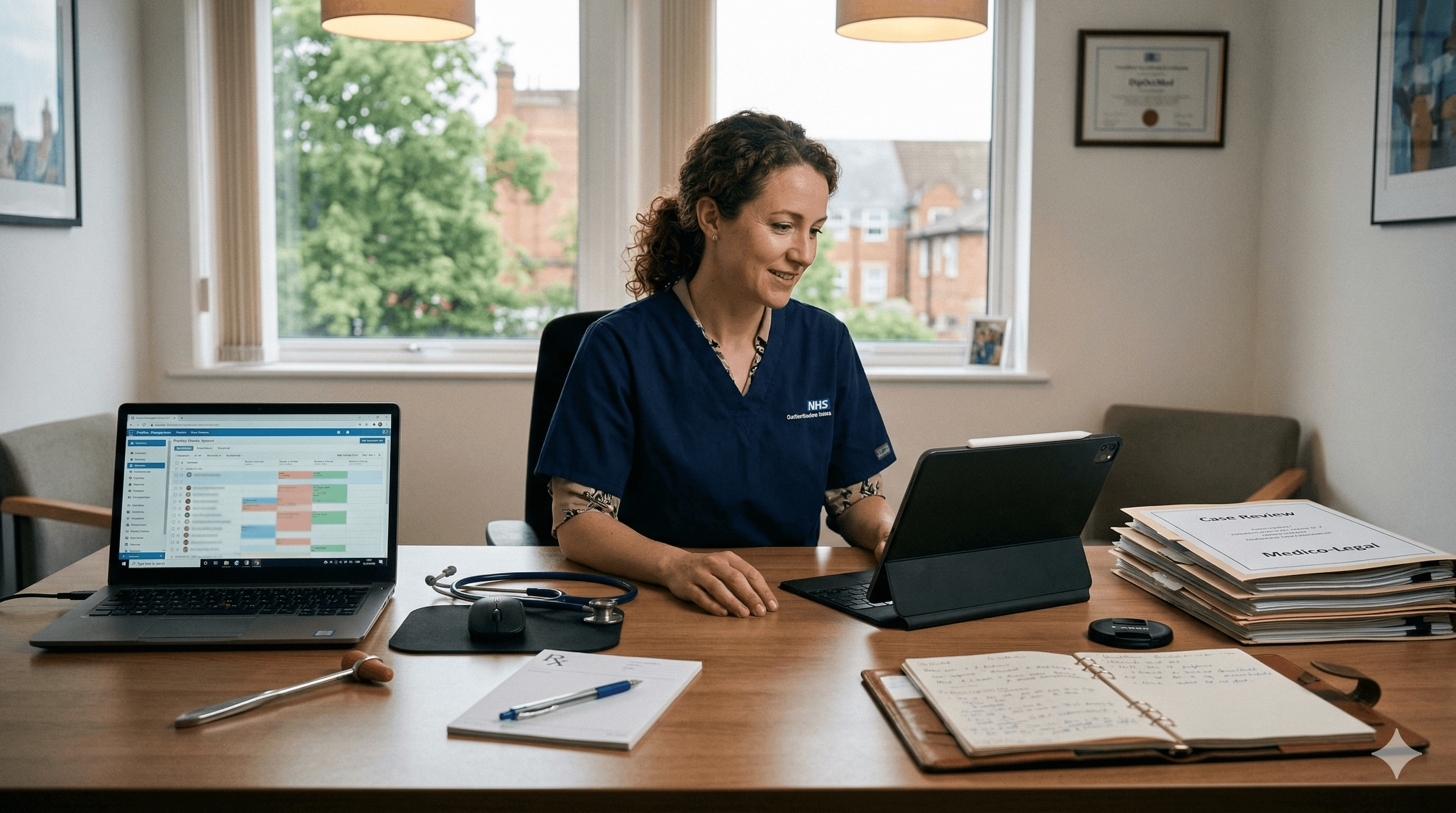
Portfolio careers are no longer the exception in UK general practice — they are increasingly the norm. The traditional model (full-time partner, one practice, 30 years) is giving way to a more flexible approach: 4-6 clinical sessions per week combined with non-clinical income from education, medico-legal work, digital health advisory, occupational health, or clinical special interests.
Defining Portfolio Career
A portfolio GP divides their working week between clinical practice (salaried sessions, locum sessions, or partnership sessions) and one or more non-clinical activities that generate income, professional development, or career satisfaction. The proportions vary — some portfolio GPs do 80% clinical and 20% non-clinical. Others do 50/50. A few do 20% clinical and 80% non-clinical (typically in education, leadership, or digital health roles).
Clinical Sessions: Options and Rates
Salaried sessions: £10,000-13,000 per session per annum. Stable, predictable, pensionable. Typically 3-4 sessions per week for portfolio GPs. Benefits: NHS pension, sick pay, annual leave. Locum sessions: £550-800 per day (in-hours). Flexible, higher gross income per session. No pension, no leave, no sick pay. Indemnity self-funded (~£6,000-8,000/year). Partnership sessions: Profit share. Higher earning potential but management responsibility. Some portfolio GPs hold a small partnership share (e.g., 2-3 sessions) while pursuing non-clinical work alongside.
Non-Clinical Income Streams
Medical education: GP Training Programme Director (£60,000-80,000 FTE for 4-6 PA sessions). Clinical teaching for medical schools (£200-400/session). Exam question writing for Royal Colleges. Medico-legal: Expert witness reports (£150-300/hour, £500-2,000 per report). Personal injury assessments. Court attendance. Requires specific training (Cardiff University Bond Solon, Expert Witness Institute). Occupational health: Occupational health physician roles (requires DipOccMed or equivalent). Corporate health assessments. Workplace health advisory. Digital health: Clinical advisory roles for health tech companies. Content creation. Medical AI clinical governance roles. Aesthetic medicine: Botox, dermal fillers, skin treatments (requires specific training). Growing market. Expedition and event medicine: DipIMC qualification opens doors (see DipIMC guide). Expedition doctor for travel companies, event medical officer for festivals and sporting events.
Tax and Business Structure
Sole trader: Simple. No company formation required. Income taxed at personal tax rates (20%, 40%, 45% depending on earnings). Expenses deductible against taxable income. Suitable for low non-clinical income alongside salaried clinical work.
Limited company: More tax-efficient at higher earnings (corporation tax 25% on profits, then dividend extraction at lower rates). Allows income splitting if you have a spouse as a shareholder/employee. Requires company accounts, annual returns, and typically a medical accountant (£1,500-3,000/year). Suitable for locum work and substantial non-clinical income.
Professional Indemnity
Indemnity requirements differ by activity. NHS clinical work: covered by the CNSGP (Clinical Negligence Scheme for General Practice) for salaried GPs and partners. Locum work: self-funded through a medical defence organisation (MDU, MPS, MDDUS — £6,000-8,000/year). Non-clinical work: check specific indemnity requirements. Medico-legal work typically requires separate indemnity cover. Educational roles may be covered by the employing institution.
Pension Implications
The NHS pension is extremely valuable (defined benefit, employer contributions ~14.38%). Portfolio GPs doing salaried or partnership sessions can contribute to the NHS pension from those earnings. Locum and non-clinical income typically requires a SIPP or other private pension arrangement. Some portfolio GPs maintain a small salaried contract specifically to preserve NHS pension access — even if the majority of their income comes from locum or non-clinical work.