Introduction
The Physician Associate National Exam (PANE) — sometimes referred to as the Physician Associate Registration Assessment (PARA) in older contexts — is the definitive hurdle between you and a career as a PA. With the GMC regulation of Physician Associates commencing in December 2024, passing this two-part assessment is now the mandatory gateway to joining the register and practising legally in the UK.
This guide provides a structured, evidence-based toolkit to help you pass. We break down the exam anatomy, provide 8-week and 12-week study plans, and curate the best free and low-cost resources — from OSCE checklists to the iatroX adaptive quiz — to build your knowledge without breaking the bank.
What the registration assessment is (and why it matters now)
The landscape has changed. Since the GMC took over regulation, the stakes for the national exam are higher. It is no longer just about "qualifying"; it is about meeting the statutory standard for registration. You cannot apply to join the register until you have passed both components of the PANE (GMC UK).
Exam anatomy
The exam consists of two distinct parts, and you must pass both:
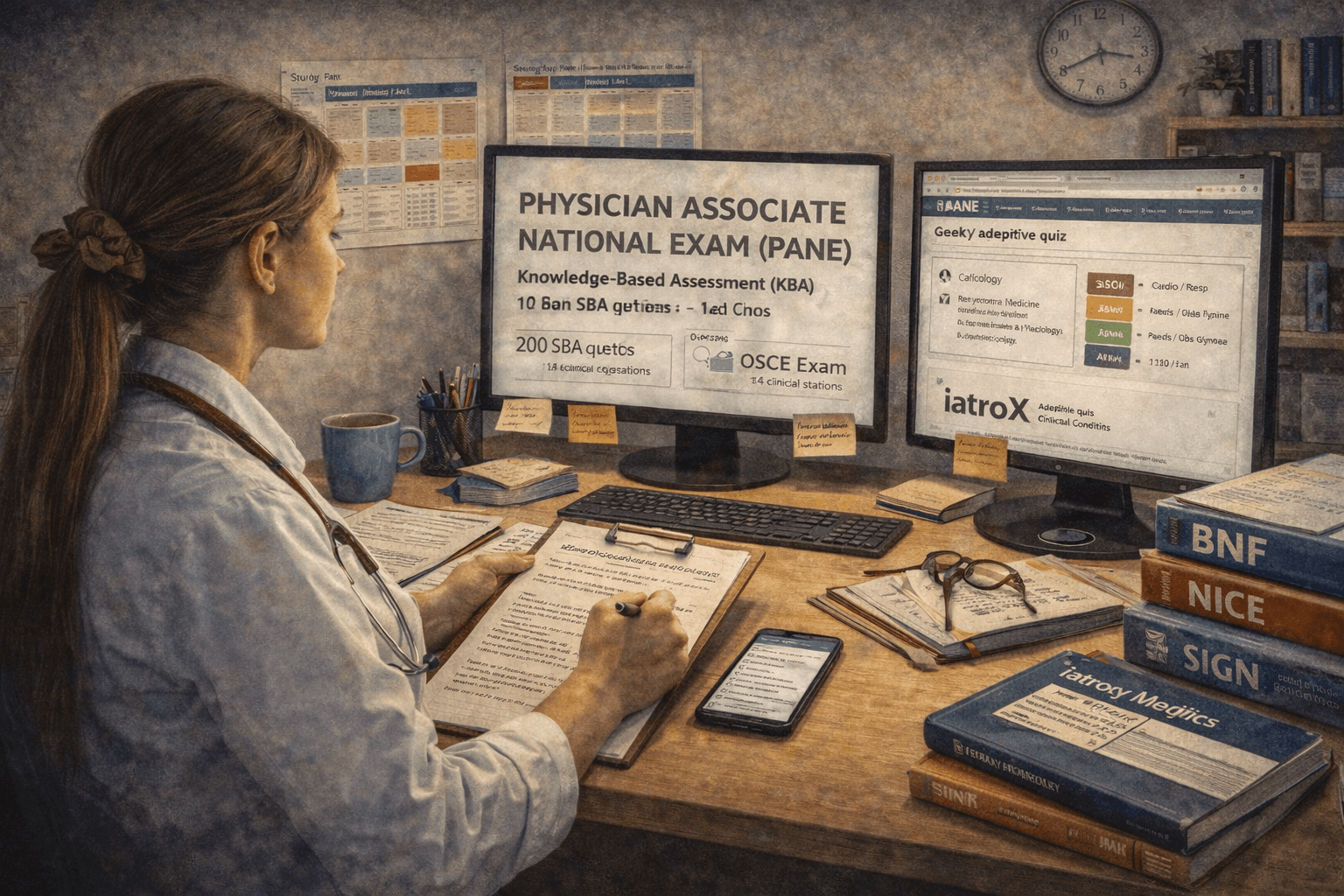
- The Knowledge Based Assessment (KBA): A written exam consisting of 200 Single Best Answer (SBA) questions, typically sat over two papers. It tests broad generalist medical knowledge.
- The OSCE (Objective Structured Clinical Examination): A practical exam, usually 14 stations, testing your history taking, examination, communication, and procedural skills.
Key difference: You revise for the KBA with volume (question banks). You revise for the OSCE with repetition (acting out stations).
8-week and 12-week study plans
The 12-week "Standard" Plan
- Weeks 1-4 (Systems): Cover 2 major body systems per week (e.g., Cardio/Resp). Read the core theory, then do 50 relevant SBAs.
- Weeks 5-8 (Specialties): Paediatrics, Obs & Gynae, Psychiatry, Emergency Medicine. Start practising 2 OSCE stations per evening with a partner.
- Weeks 9-10 (Integration): Mixed timed SBA blocks to simulate exam pressure. Full 14-station mock OSCE circuits on weekends.
- Weeks 11-12 (Taper): Focus only on your weakest areas (use your error log). Review ethics, law, and prescribing data.
The 8-week "Sprint" Plan
- Daily: 50-75 mixed SBAs. No pure reading; learn from the explanations.
- Weekly: One full mock OSCE (find a study group).
- Focus: Prioritise high-yield "red flag" topics (chest pain, acute abdomen, sepsis) and communication skills (breaking bad news, ethics).
How to use question banks efficiently
Don't just click through questions. Use a system:
- Error Log: Every time you get a question wrong, log the topic (e.g., "Asthma management").
- Weakness Queues: Focus your next study session only on the topics in your error log.
- Spaced Retest: Re-attempt the questions you got wrong 3 days later. If you get it right, move on. If you get it wrong again, re-read the guideline.
Free/cheap study stack
You don't need expensive courses. Use these high-value tools:
- iatroX Quiz: A free, adaptive learning engine. If you are covering PA exam tags, it uses spaced repetition (like Anki) to surface questions on your weak topics automatically. It’s perfect for the KBA.
- Anki: The gold standard for flashcards. Download a shared medical deck or make your own for pharmacology rules.
- Geeky Medics (Free): Their free OSCE guides and checklists are the industry standard for station practice.
- Official RCP/FPA Documents: The "Matrix of Core Clinical Conditions" is your syllabus. Download it for free and use it as a checklist.
OSCE tactics that actually shift outcomes
Examiners aren't just looking for the right diagnosis; they are looking for a safe clinician.
- Structure: Have a rigid structure for every history (SOCRATES, JAM THREADS). It saves you when you panic.
- Safety Netting: Always explicitly state when the patient should return and what signs to look for. This marks you out as a safe practitioner.
- Escalation Language: In the exam, you are a PA, not a consultant. Know the phrase: "I would like to discuss this case with my supervising GP/Registrar immediately."
- Explaining Uncertainty: If you don't know, say so. "I am not sure of the exact cause, but I have ruled out the dangerous possibilities X and Y, and I will now seek senior advice."
FAQ
Do I need to pass the KBA before the OSCE? Typically, yes, or they are sat in close succession. Check the specific sitting rules for your cohort on the RCP website.
Is the PA exam the same as the medical student UKMLA? They cover similar "generalist" medical content, but the PANE is specific to the PA curriculum and scope of practice defined by the Faculty of Physician Associates.
Can I use medical student question banks? Yes, banks like PassMedicine (Medical Student finals) are very close in level and content to the PA KBA and are a cost-effective resource.