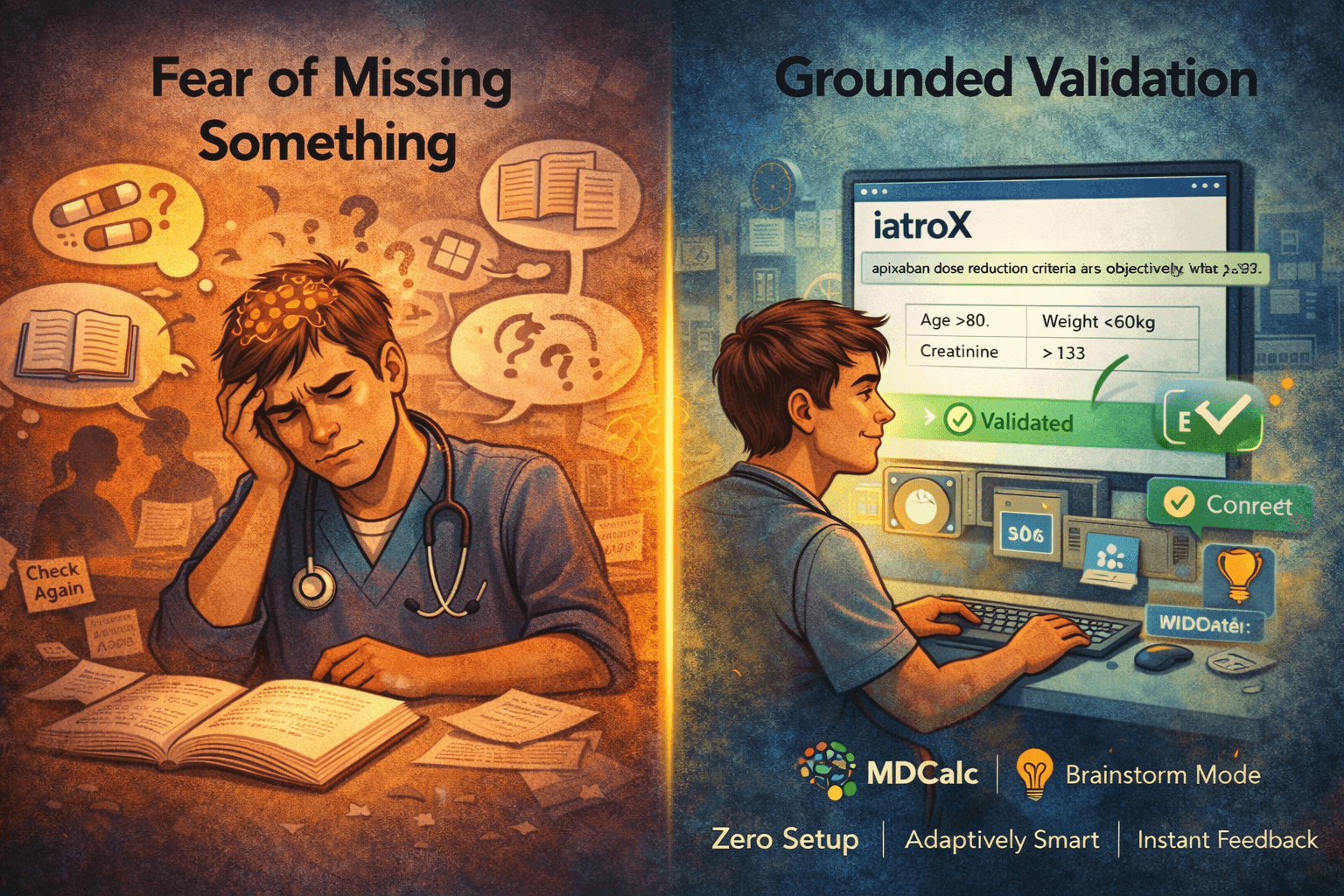
The problem: "the fear of missing something"
For many clinicians, especially those who are neurodivergent (ASD/ADHD) or prone to anxiety, clinical decision-making is not just a cognitive process; it is an emotional gauntlet. The driving force is often a perfectionist fear: "What if I missed something?"
This anxiety leads to "analysis paralysis." You find yourself double-checking a drug dose you already know. You re-read a guideline three times to ensure you haven't misiniterpreted a nuance. You delay a discharge because you need "just one more check." This excessive checking is a safety mechanism, but it comes at a high cost: it slows down your workflow, increases your cognitive load, and fuels a cycle of imposter syndrome and burnout.
The solution is not to "worry less." It is to use tools that provide "grounded" validation—an objective, external safety net that allows you to trust your decisions and move on.
The solution: "grounded" validation
The second opinion: iatroX
Anxiety thrives in ambiguity. The most powerful way to kill anxiety is with a definitive fact.
- The Angle: Don't just use iatroX to find answers you don't know. Use it to validate what you do know.
- The Workflow: You have a plan (e.g., "Start apixaban 5mg BD"). But the doubt creeps in ("Is it renal adjusted? Did I check the weight?"). Instead of spiralling, ask iatroX: "What are the criteria for dose reduction of apixaban in AF according to the SmPC/emc?"
- The Win: In 5 seconds, you see the criteria (Age >80, Weight <60kg, Creatinine >133). You check your patient. You confirm they don't meet them. You have objectively validated your decision. You can sign the prescription and close the mental tab.
Safety net for lateral thinking: Brainstorm Mode
For clinicians with ASD, "grey areas" or vague presentations can be particularly stressful. The pressure to think laterally and generate a broad differential diagnosis on the spot can feel overwhelming.
- The Tool: iatroX Brainstorm Mode.
- The Win: You input the symptoms ("Fatigue, hyponatraemia, low BP"). iatroX generates a structured, logical list of differentials, from the common (medication effect) to the "don't miss" (Addison's disease). It acts as a cognitive checklist, providing a safety net for your lateral thinking and reassurance that you haven't missed a critical possibility.
Objective scoring: MDCalc
Mental math is a common struggle, especially for those with dyscalculia or ADHD. But even without specific learning differences, calculating risk scores in your head is a recipe for anxiety-induced error.
- The Tool: MDCalc.
- The Win: It removes the cognitive load of calculation entirely. More importantly, it provides an objective "score" to back up your decision. You aren't sending a patient home because you "think" they are low risk; you are discharging them because they have a "PERC score of 0." That objective number is a powerful shield against the anxiety of uncertainty.
Conclusion: trust through verification
You don't need to change who you are as a clinician. Your conscientiousness is a superpower. But you do need to protect yourself from the paralysis it can cause. By building a tech stack that offers instant, objective validation, you can transform your anxiety from a brake that slows you down into a safety system that keeps you—and your patients—safe.