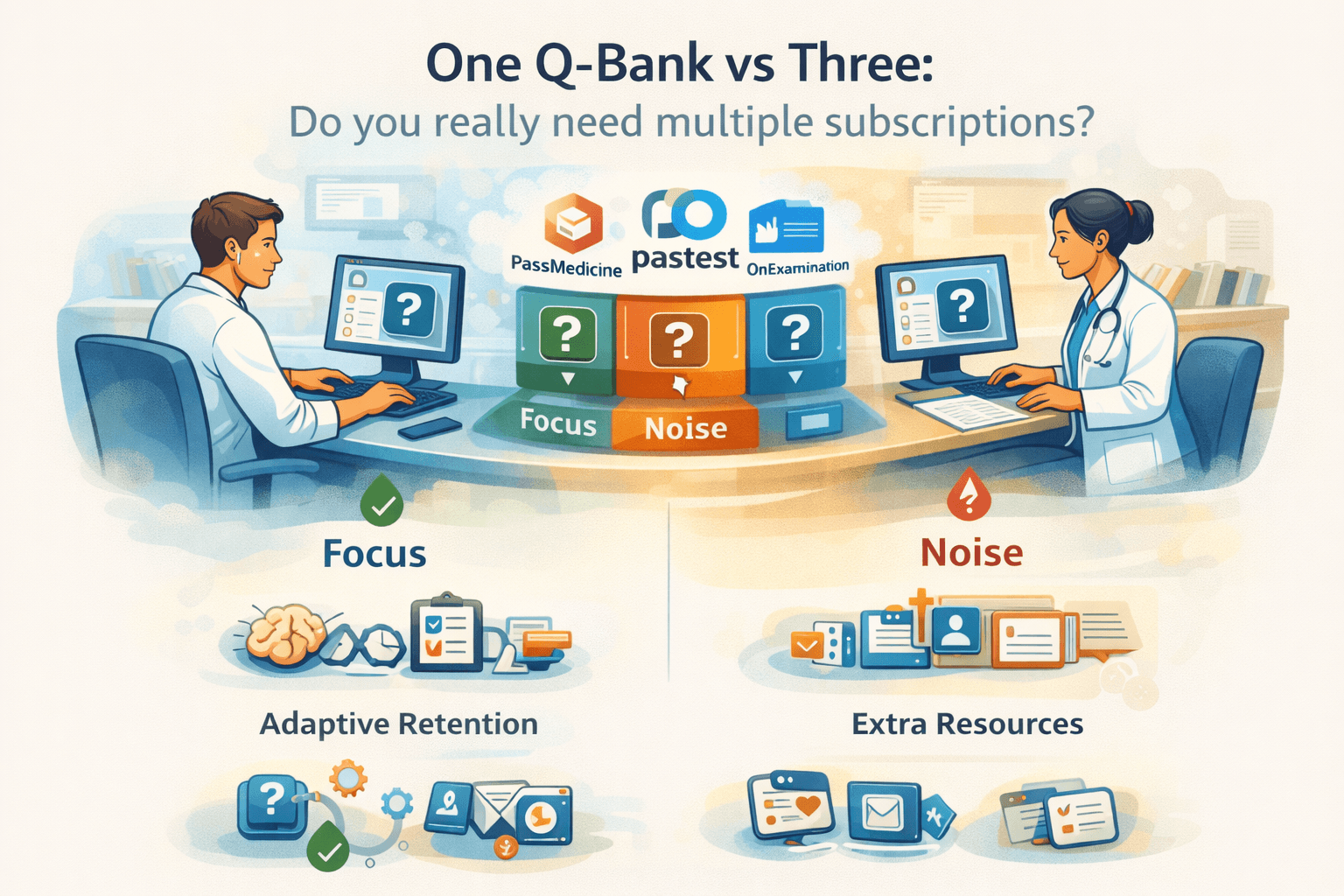
The most common anxiety in postgraduate medical revision is "coverage." The fear that one question bank might miss a specific guideline or question style drives thousands of trainees to purchase two or even three subscriptions (e.g., PassMedicine + Pastest + BMJ OnExam).
This approach often stems from insecurity rather than strategy. Buying more resources does not automatically equal better coverage; often, it just equals more noise.
This guide provides a decision framework to decide if you actually need a second bank, based on budget, learning science, and cognitive load theory.
The three problems a q-bank is meant to solve
Before opening your wallet, define exactly what "problem" you are hiring the tool to solve. A question bank serves three distinct functions:
- Coverage: Has it shown me the full blueprint of the exam?
- Mastery: Can I answer these questions accurately under time pressure?
- Retention: Will I actually remember this fact in 6–12 weeks when I sit the exam?
Most candidates buy a second bank to solve problem #1 (Coverage), but they neglect problem #3 (Retention), which is usually the real cause of exam failure.
The learning science in 90 seconds (no fluff)
To pass high-stakes UK exams (MRCP, AKT, MSRA), you need to leverage two specific psychological principles:
- The testing effect: Testing is not just a way to measure what you know; it is a way to learn. Active retrieval (pulling information out of your brain) strengthens neural pathways far more effectively than passive re-reading. PubMed
- Distributed practice: Spacing your revision out over time is consistently rated as a "high-utility" technique. Cramming works for tomorrow, but spaced repetition works for next month. PubMed
Cognitive load: why more resources can reduce scores
It is intuitive to think "more data = better," but the brain has a finite working memory limit. This is defined by Cognitive Load Theory.
Every time you switch platforms, adjust to a new user interface, or filter through duplicate explanations, you are generating extraneous cognitive load. This is mental effort wasted on the process of studying rather than the content itself.
The Cognitive Load Equation
- Intrinsic Load: The difficulty of the medicine itself (e.g., understanding renal physiology).
- Extraneous Load: The effort required to navigate your tools (switching tabs, managing two logins, filtering duplicates).
- Germane Load: The effort used to actually store the schema in long-term memory.
If you have two question banks, you drastically increase extraneous load. You burn mental energy deciding "which bank should I do today?" rather than actually learning. ScienceDirect
The “Two-tool rule”
For 95% of candidates, the optimal setup is not two random banks. It is one primary bank and one retention engine.
- Tool 1: Primary Q-bank. This is for volume and exam simulation. It must have a massive database and accurate "exam-style" questions (e.g., PassMedicine or Pastest).
- Tool 2: Retention engine. This is for adaptive targeting. It captures your errors and feeds them back to you using spaced repetition (e.g., Anki or iatroX).
Only add a third tool if you have a specific, diagnosed performance gap (e.g., you are failing the SCA/OSCE components specifically and need a video roleplay platform).
Decision framework
Do not guess. Use this checklist to decide if you need a second paid subscription.
✅ Stick to ONE bank if:
- You are scoring ≥70–75% on mixed blocks.
- Your errors are mostly "careless" or timing-based, not knowledge gaps.
- You have completed at least 2 full timed mock papers.
- You already have a "retention loop" (you are reviewing your weak topics systematically).
⚠️ Buy a SECOND bank only if:
- Coverage mismatch: You feel your current bank is weak on a specific domain (e.g., "The stats questions here are too easy").
- Style mismatch: You know the real exam has longer stems, but your current bank has short stems.
- Memorisation: You have done the questions so many times you are answering from memory, not working it out.
- Volume: You have literally finished every question in your primary bank.
Cost logic
Medical exams are expensive. View your resources through a "Cost per Useful Hour" model.
- Scenario A: You buy PassMedicine (£35) and use it for 100 hours.
- Cost: £0.35 per hour.
- Value: High.
- Scenario B: You buy PassMedicine (£35) AND Pastest (£150). You split your time 50/50.
- Cost: You are now paying significantly more per hour of study, but adding "switching costs" (extraneous load). Unless Pastest offers a specific question style that PassMedicine lacks (or vice versa), the ROI is negative.
Example stacks
Choose the stack that fits your budget and timeline.
Stack A: The "Smart Saver" (Free-first)
- Engine: iatroX (Free). Use for daily adaptive blocks and spaced repetition.
- Mocks: 1x Paid Mock Provider (e.g., an RCGP or college-official mock) purely for calibration 4 weeks out.
Stack B: The "Standard" (One Premium)
- Primary: PassMedicine or Pastest (Paid). Use for bulk volume.
- Retention: iatroX (Free). Use the "Spaced Repetition" mode to catch the questions you get wrong in your primary bank.
Stack C: The "Panic" (Two Premium)
- Primary: Pastest (Paid) for hard/long questions.
- Secondary: PassMedicine (Paid) for textbook integration.
- Warning: Only use this if you are studying full-time (40+ hours/week) and have high cognitive endurance.
Where iatroX fits
iatroX is designed to solve the Retention problem without adding cost.
Most commercial banks are static databases. iatroX acts as a free adaptive + spaced repetition engine mapped to UK exam curricula.
- Adaptive: It learns what you don't know.
- Spaced Repetition: It schedules reviews so you don't forget what you learned last week.
It fits into any stack as the "retention layer," ensuring that the hours you spend studying actually result in long-term memory.
FAQs
Is buying PassMedicine + Pastest worth it? Generally, no. The content overlap is >80%. You are paying double for a 20% marginal gain. Only do this if you have exhausted one bank entirely.
How many questions per day is optimal? Quality > Quantity. 50 questions done with "Deep Review" (reading the guidelines for every error) is superior to 150 questions clicked through rapidly.
When should I start mocks? Start doing full, timed mocks 4–6 weeks before your exam date. Do them weekly to build stamina.
What is the best way to do spaced repetition with a q-bank? Most standard banks don't do this well. You can use a manual spreadsheet, Anki cards, or an automated engine like iatroX which handles the scheduling for you.