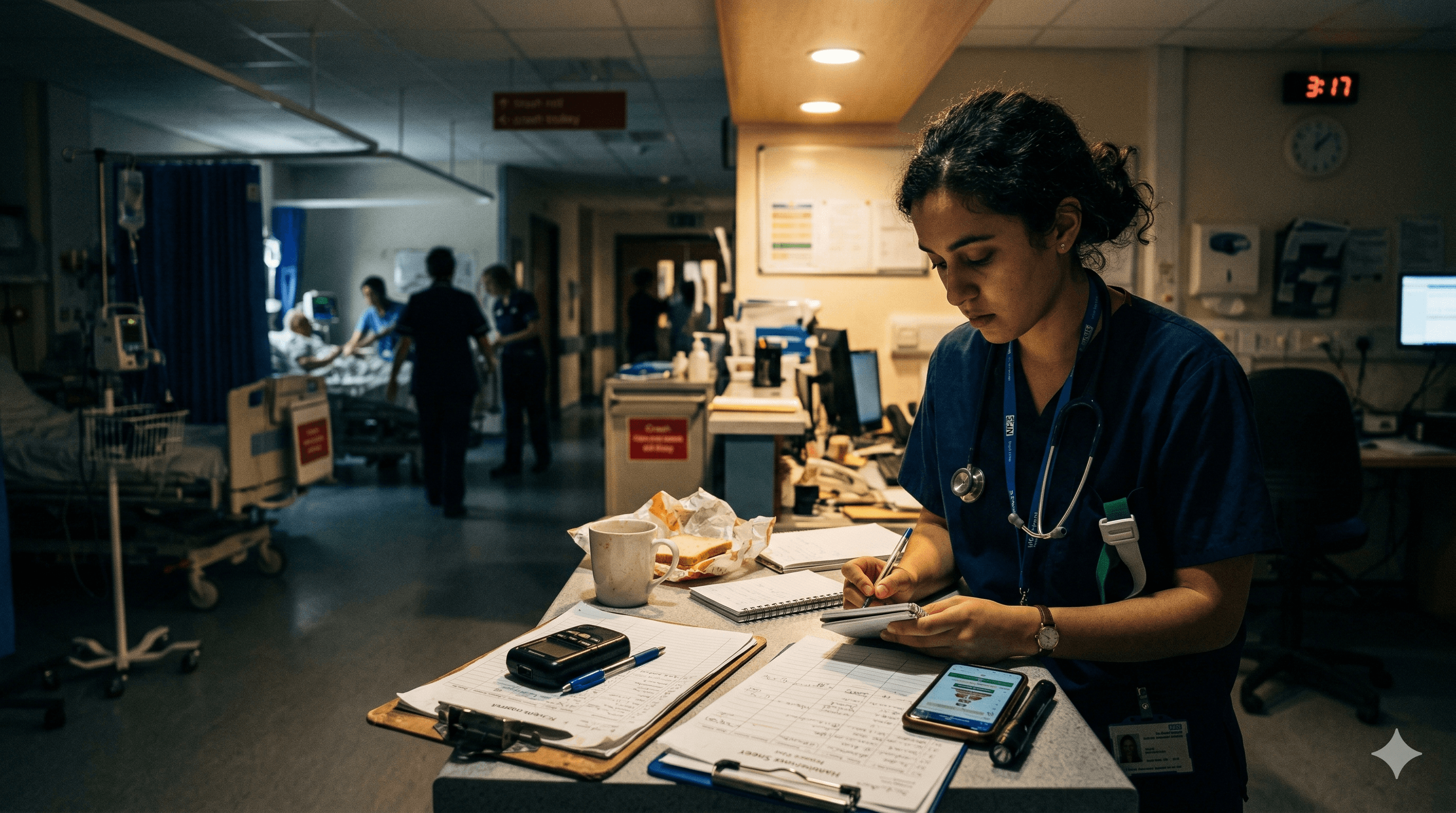
Your first night on call is a rite of passage that nobody adequately prepares you for. The theory is the same as daytime medicine. The reality — reduced staffing, sicker patients, less senior support, and your own fatigue — is completely different.
This isn't a clinical guide. It's the practical advice that the FY2 who's about to hand the bleep to you would give if they had ten minutes.
Before you start
Know the logistics before the shift begins. Where is the on-call room? Where are the blood gas machines? Where is crash trolley for each ward? Where do you get emergency drugs at night? Which pharmacy is open? What's the number for the on-call registrar, the on-call consultant, and critical care? Write these numbers on a piece of paper or save them in your phone. At 3am when the crash bleep goes off, you will not remember how to navigate the hospital switchboard.
Carry the essentials. Stethoscope, pen torch, tourniquet, a pen that works, and a printed copy of the ALS algorithm (or the app). A small notebook or structured handover sheet for tracking your jobs list. A phone charger.
Eat before you start. You may not eat again for 6 hours. Have a proper meal, not a cereal bar.
During the shift
Prioritise ruthlessly. You'll get called about many things simultaneously. Triage your jobs like you'd triage patients:
Immediate (do now): cardiac arrest, acute deterioration (NEWS ≥7), acute chest pain, acute breathlessness, anaphylaxis. Drop everything else.
Urgent (do within 30 minutes): abnormal observations not responding to initial management, new confusion, significant pain, falls with possible head injury.
Can wait (do when the urgent stuff is done): routine prescriptions, fluids for stable patients, discharge paperwork, non-urgent blood results.
The hardest skill on call isn't knowing what to do — it's knowing what not to do right now.
Use a structured assessment. When called about a sick patient, go to the bedside and do ABCDE. Not some of it — all of it, every time. The structure prevents you from anchoring on the obvious problem and missing the thing that's actually killing the patient.
Escalate early. The registrar would rather be called at the point of "I'm not sure this is right" than at the point of "the patient has arrested." There is no penalty for calling your senior with a well-structured concern: "I've been called to see Mr X, he's tachycardic at 130 with a BP of 85/50 despite a fluid challenge. I've done ABCDE, started oxygen, and taken bloods including a VBG. I'm concerned about sepsis and I think he needs a senior review." That call takes 30 seconds and your registrar will thank you for it.
Document everything. Every review, every escalation, every clinical decision. "Called to review at 0230. NEWS 7. ABCDE assessment: [findings]. Plan: [actions]. Discussed with on-call registrar Dr X — agreed plan." If you didn't document it, it didn't happen.
Handover clearly. When you hand over to the day team, be structured: which patients you saw, what you did, what's pending, and what needs following up. SBAR format works: Situation, Background, Assessment, Recommendation.
Staying functional
Caffeine strategically. Coffee at the start of the shift: yes. Coffee at 4am when you need to sleep after the shift: no. Caffeine has a half-life of 5–6 hours. A coffee at 4am will still be in your system at 10am when you're trying to sleep.
Eat something at 2–3am. Your body needs fuel even if you don't feel hungry. A sandwich, a banana, a cereal bar — anything. Cognitive function degrades significantly in the early hours if you haven't eaten.
Microbreaks. If there's a lull at 3–4am, sit down for 10 minutes. Close your eyes if you can. Even a brief rest improves alertness for the next call.
After the shift: go home and sleep. Don't go to teaching, don't do admin, don't socialise. Go home, close the curtains, and sleep. The rest of the world can wait.
The emotional dimension
Your first night on call, someone may die. It may happen despite everything you do correctly. It may happen and you may wonder if you missed something. This is normal — not the death, but the feeling.
Talk to someone. Your educational supervisor, a senior colleague, a peer. Not at 4am during the shift, but the next day when you've slept. The doctors who process difficult on-call experiences openly are the ones who sustain long careers. The ones who bury it and "get on with it" are the ones who burn out.
iatroX offers AI clinical search for real-time guideline queries — the reference tool for when you need an answer fast and the ward computer is logged out.