Most “which resource is best?” debates are a distraction.
In real-world general practice, the correct question is:
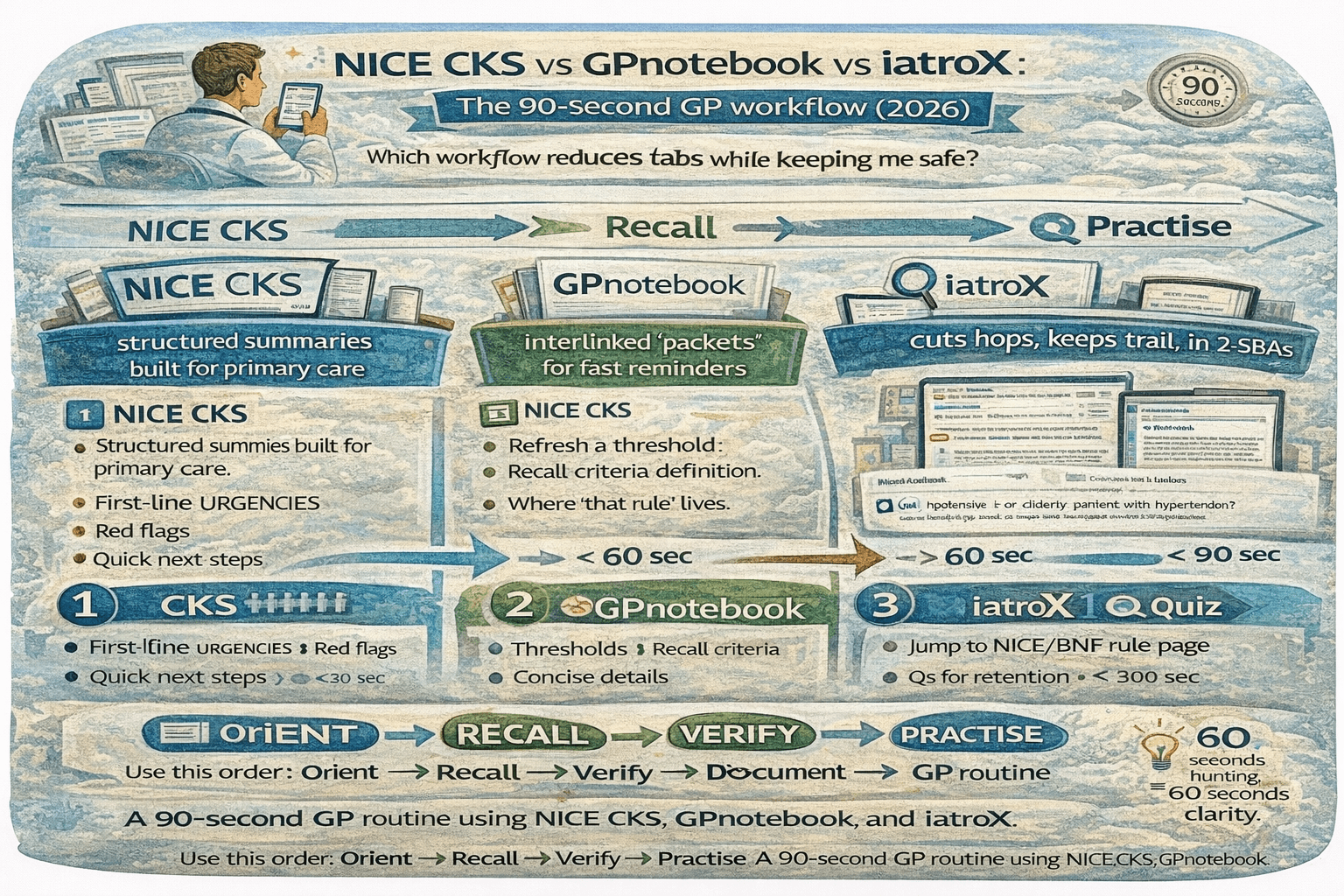
What is the fastest workflow that gets me to a defensible decision — without spawning 12 tabs and losing the trail?
This article gives you a pragmatic, repeatable routine for everyday queries using NICE CKS, GPnotebook, and iatroX.
The 90-second workflow (what to use first, second, third)
Here is the answer upfront — then we will justify it.
Default 3-step workflow (90 seconds):
- NICE CKS (Orient): confirm the shape of management in primary care.
- GPnotebook (Recall): quickly sanity-check a definition/threshold/branch you already half-know.
- iatroX (Glue): jump to authoritative leaf pages, capture scenario reasoning (/shared), and lock it in with practice (/q).
Why this order works:
- CKS is built for structured primary-care pathways.
- GPnotebook is built for rapid, interlinked recall.
- iatroX is built to reduce hops, keep the trail, and convert look-ups into retention.
What each tool is for (not “which is best”)
NICE CKS = structured primary-care summary
Use it when you need orientation.
CKS is excellent for:
- Confirming first-line management in primary care.
- Identifying red flags and appropriate next steps.
- Quickly understanding the branching structure of a topic (e.g., severity tiers, age groups, pregnancy considerations).
Two practical points worth remembering:
- CKS publicly states it covers 370+ topics, focused on common and significant primary care presentations.
- CKS content is actively maintained (the “What’s new” feed is a useful habit for staying current).
GPnotebook = ultra-fast recall layer
Use it when you already know the “shape”, but want the quickest refresh.
GPnotebook is especially good for:
- Quick definitions, thresholds, and “where does that rule live again?” moments.
- Fast in-consultation look-ups because content is organised into short, interlinked “packets”.
- Breadth: it describes its “Pages” corpus as 30,000+ concise, interlinked reference articles.
It is at its best when:
- You are already oriented, and you need speed.
- You need a fast reminder before you open the leaf page.
iatroX = workflow glue
Use it to cut hops, keep the decision trail, and reinforce learning.
iatroX adds three practical capabilities to the stack:
-
Knowledge Centre (iKC) as a “front door”
- A topic hub → authoritative leaf pages (NICE/CKS/SIGN/BNF and more)
- The goal is simple: make the first click the right click
-
/shared as scenario glue
- Referenced reasoning you can share, revisit, and use for learning/CPD
- Useful for edge cases (comorbidity, pregnancy, age, safeguarding, red flags)
-
/q for retention
- Short, exam-style questions that turn “I looked it up” into “I can recall it”
- A 2-minute practice step that pays dividends in speed and confidence
The failure mode: tab-sprawl + lost defensibility
Most clinicians have lived this pattern:
Google → multiple tabs → skim → half-remembered guidance → no audit trail
The time cost is obvious, but the bigger cost is subtle: you lose the ability to say, cleanly, what you anchored to.
Symptoms of tab-sprawl
Tick any that apply:
- You can’t remember which tab contains the key threshold.
- You vaguely recall a rule, but you can’t re-find it quickly.
- You have to “re-search” the same topic every few weeks.
- You document the plan, but not the anchor (source/date/pathway).
- You feel uneasy explaining the decision if challenged.
A better workflow prevents this by design.
The workflow: Question → Orient → Verify → Document
This is the routine to standardise.
1) Question
Start by naming the question precisely.
Aim for 7 words:
- “Stage 1 HTN: ABPM then what?”
- “High INR, no bleeding: next step?”
- “Child inattentive: ADHD pathway & red flags?”
2) Orient (CKS)
Use CKS to orient yourself:
- What is the pathway structure?
- What are the key branches?
- What are the red flags and referral triggers?
3) Verify (leaf page + recall)
Verify the canonical rule:
- Open the authoritative leaf page (NICE/CKS/SIGN/BNF as appropriate)
- Use GPnotebook for quick recall and to move faster between “branches”
4) Document
Document defensibly:
- “Aligned with NICE/CKS; date checked; safety net given.”
- If needed: add one short sentence of rationale.
Where iatroX fits (and why it’s not redundant)
iatroX is not trying to “replace” CKS or GPnotebook.
It is designed to make your workflow tighter:
- iKC (front door): fewer hops to authoritative leaf pages, less hunting.
- /shared: reusable scenario reasoning (especially for edge cases).
- /q: retention loop so you stop re-searching the same topic.
If CKS is your orientation map, and GPnotebook is your rapid recall layer, iatroX is the glue that:
- Keeps you anchored to authoritative sources.
- Reduces fragmentation.
- Converts a look-up into a stored clinical memory.
Copy/paste protocol (clinic-ready)
90-SECOND GP WORKFLOW (CKS → GPnotebook → iatroX)

1) If you have <30 seconds:
   - GPnotebook for definition/threshold/quick refresh.

2) If you have 1–3 minutes:
   - NICE CKS to orient to the pathway (red flags, branches, next steps).

3) If you need to be defensible:
   - iatroX Knowledge Centre → click the authoritative leaf page.
   - Optional: open a /shared scenario for edge cases.

4) If you need to retain:
   - Do 1 SBA (/q) or a 10-question quiz.

5) Document:
   - “Aligned with NICE/CKS; date checked; safety net given.”
Mini case walkthrough (Hypertension)
Scenario: You want to move from “raised BP reading” to “what next?” without a 15-minute tab hunt.
-
Orient with CKS
- Confirm the structure: confirmation testing, thresholds, treatment triggers, follow-up.
-
Use GPnotebook for rapid recall
- Quickly refresh a threshold, definition, or branching detail.
-
Use iatroX to keep the trail and practise
-
Open the topic hub:
-
Jump to the authoritative leaf page for the canonical pathway.
-
Do 1 SBA to lock it in:
-
Optional second example (acute): High INR, no bleeding
-
SBA for recall reinforcement:
Try it now (iatroX embeds)
-
Knowledge stack map (UK clinician workflow): https://www.iatrox.com/academy/toolkits/clinical-knowledge-tools-map
-
Knowledge Centre A–Z: https://www.iatrox.com/knowledge-centre
-
/shared example (ADHD): https://www.iatrox.com/shared/6890aa7063292c23fe56ea6e
-
/q example (Hypertension): https://www.iatrox.com/q/67da8882cd96d3ecd17d2257/hypertension
-
/q example (High INR, no bleeding): https://www.iatrox.com/q/6817491d554a83804185223d/high-inr-management-no-bleeding
Supporting sources (for the competitor claims)
-
NICE CKS health topics A–Z (states over 370 topics): https://cks.nice.org.uk/topics/
-
NICE CKS “About” page (topic scope and purpose): https://cks.nice.org.uk/about/
-
NICE CKS “What’s new” feed (shows ongoing updates): https://cks.nice.org.uk/whats-new/
-
GPnotebook homepage positioning (concise, quick, for busy GPs): https://gpnotebook.com/en-GB
-
GPnotebook “About us” (concise articles; interlinked packets): https://gpnotebook.com/en-GB/about-us
-
GPnotebook “Pages” overview (states 30,000+ concise, interlinked pages): https://gpnotebook.com/en-GB/pages