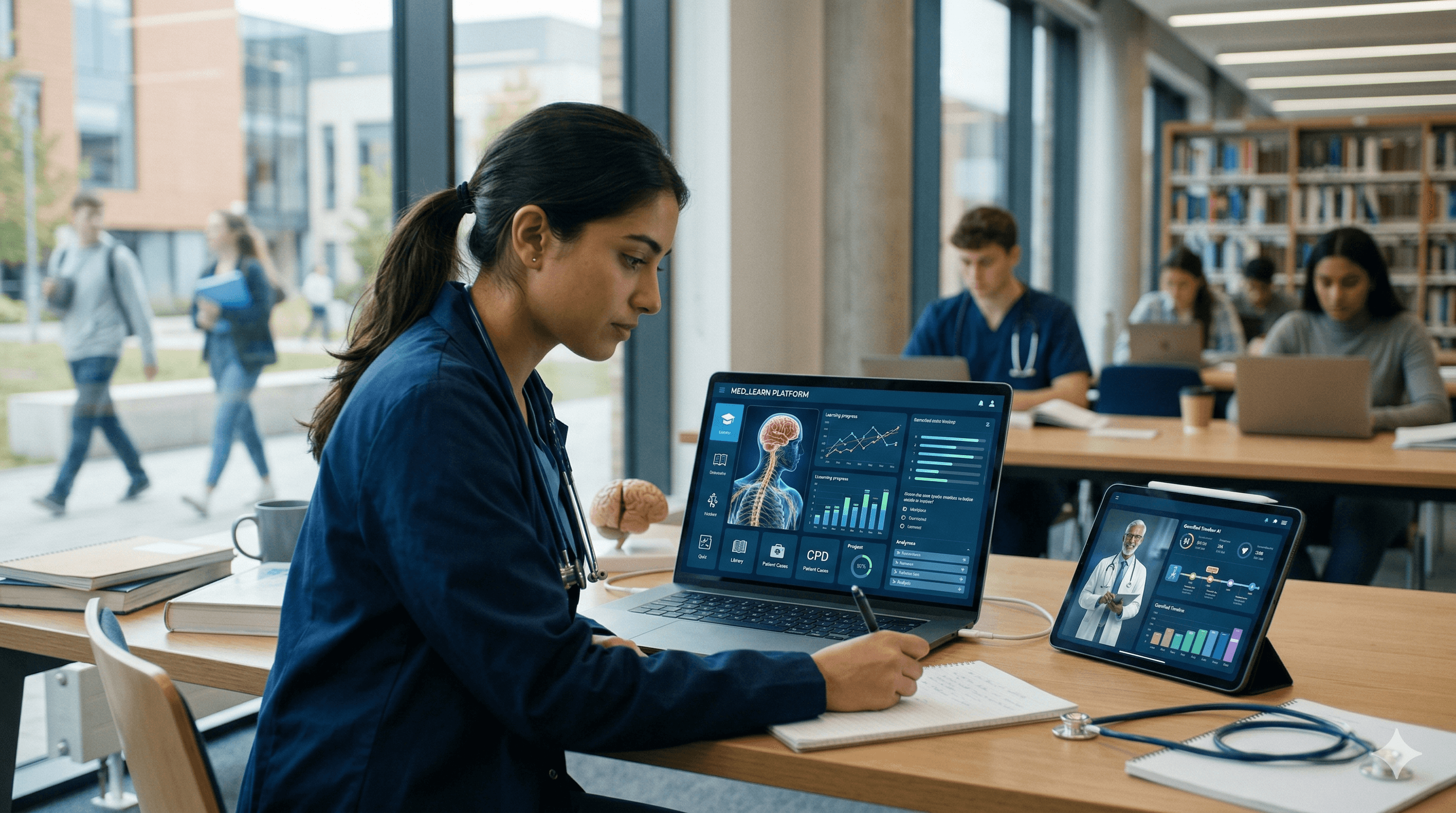
For twenty years, a medical question bank was a database of MCQs with answers and explanations. You bought a subscription, worked through the questions, and hoped the volume and quality were enough to pass. PassMedicine, Pastest, UWorld — the format was stable, the value proposition was clear.
That model is fragmenting.
AMBOSS has integrated a clinical library with AI Mode Learning that adapts to your performance. Neural Consult generates questions, flashcards, summaries, and patient simulations from your own uploaded materials. MedSnapp applies gamification — streaks, leaderboards, battles — to turn revision into a social experience. MedRevisions combines an AI professor, readiness scoring, and weakness-targeted mock generation. iatroX bridges exam preparation with point-of-care clinical reference, offering adaptive Q-Bank practice alongside guideline retrieval, clinical reasoning, and CPD documentation.
The Q-bank is becoming a platform. And the platform is becoming the interface through which medical students interact with clinical knowledge throughout their careers — not just during exam season.
What Is Changing
From static to adaptive. Traditional banks present questions in fixed order or random selection. AI-powered platforms adapt to your performance — targeting your weakest topics, adjusting difficulty, and scheduling reviews at optimal intervals via spaced repetition. iatroX's Q-Bank implements this explicitly.
From questions to multi-modal learning. Neural Consult generates flashcards, summaries, and patient simulations alongside questions. AMBOSS integrates reading material with practice. MedSnapp adds gamified interactions. The question is becoming one learning modality among many rather than the sole modality.
From exam-only to career-long. iatroX is designed for use from medical school through clinical practice — the Q-Bank serves exam preparation while Ask iatroX, Brainstorm, and CPD serve the practicing clinician. AMBOSS is making the same career-stage continuity argument. The platform that a student uses for UKMLA becomes the platform a GP uses for daily clinical reference.
From closed to open input. Neural Consult and MedSnapp let you upload your own material. This shifts the Q-bank from a closed, publisher-curated content set to an open platform that generates learning from whatever sources you provide.
From individual to social. MedSnapp's leaderboards and battles, MedAll's community features, and MediWord's Telegram group all add social dimensions that traditional banks lack.
What Should Not Change
Amid all this innovation, certain principles remain non-negotiable.
Clinical accuracy. Every question, whether curated or AI-generated, must be medically correct. For UK exams, this means alignment with current NICE, CKS, SIGN, and emc guidelines. iatroX provides the verification layer that ensures accuracy regardless of which platform generated the question.
Source transparency. The learner must be able to verify where the answer comes from. Citation-first platforms like iatroX, where every explanation links to the authoritative guideline, provide the provenance that free-text AI explanations cannot.
Evidence-based learning science. Spaced repetition and active recall remain the most effective methods for building durable knowledge. Platforms that implement these principles — regardless of their interface design — will produce better outcomes than those that prioritise engagement without retention.
Conclusion
The next Q-bank will be adaptive, multi-modal, career-spanning, and potentially open to user-generated content. It will look more like a learning platform than a question database. The winners will be the platforms that combine these innovations with clinical accuracy, source transparency, and evidence-based learning science.
iatroX is building toward this vision: an adaptive learning platform grounded in UK guidelines, bridging exam preparation with clinical practice, and growing with the clinician from medical school through their career. Free, guideline-grounded, and designed for the future of medical learning.