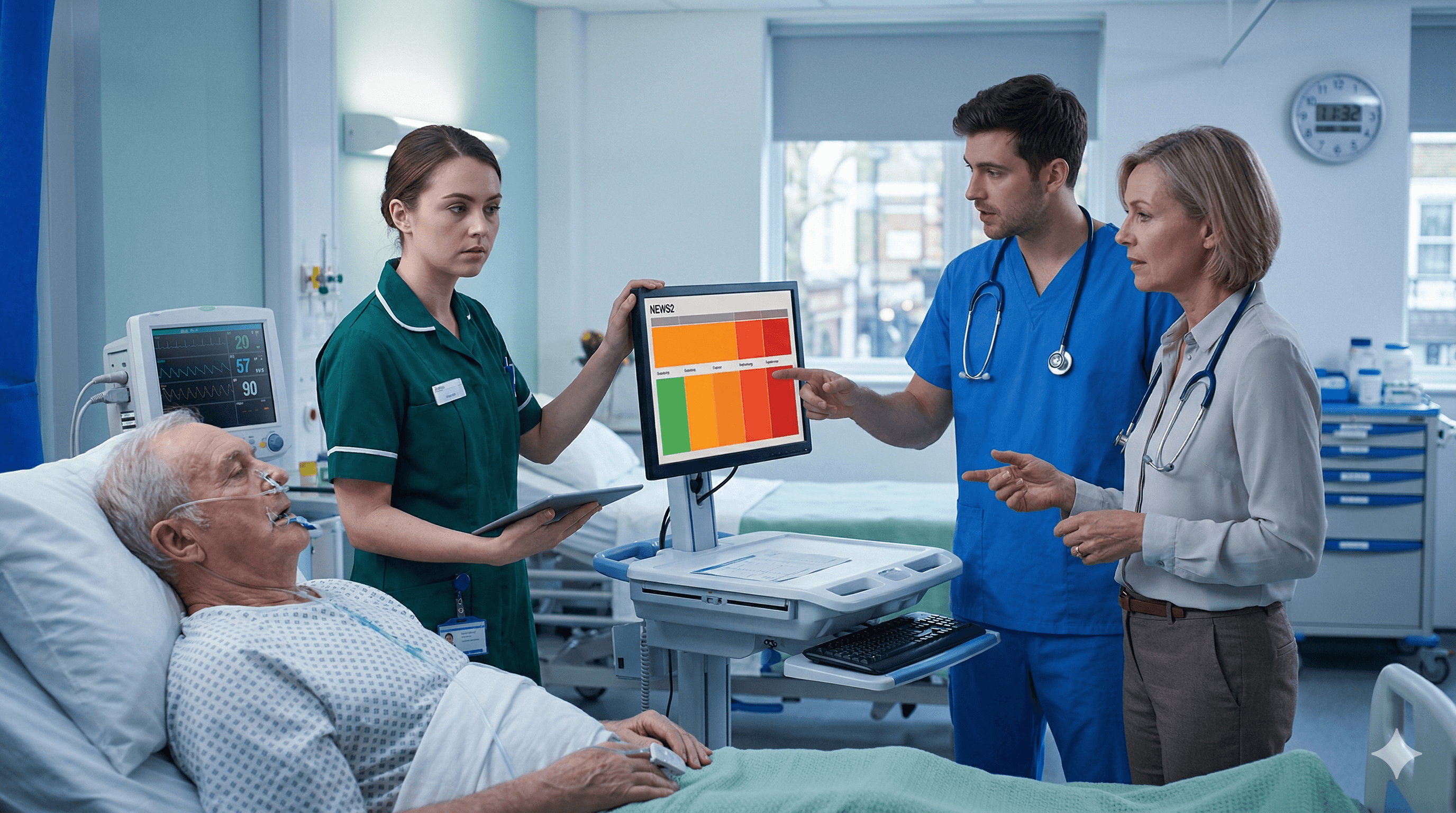
The National Early Warning Score 2 (NEWS2) is the standardised track-and-trigger system used across the NHS to identify patients at risk of clinical deterioration. It was developed by the Royal College of Physicians and is endorsed by NHS England as the standard early warning score for acute hospital settings. Correct calculation is straightforward. Correct escalation — knowing what to do with the score — is where clinical errors occur.
This guide covers the scoring parameters, the escalation thresholds, the common pitfalls, and how the iatroX NEWS2 calculator automates scoring with clinical interpretation.
The 7 Physiological Parameters
NEWS2 scores 7 physiological parameters, each scored 0-3 based on deviation from normal ranges.
Respiration rate (breaths per minute). Score 3: ≤8 or ≥25. Score 2: 9-11. Score 1: 12-20 scores 0. Score 1: 21-24. The extreme values (very low or very high) score highest because they represent the greatest physiological threat. Respiratory rate is consistently identified as the most sensitive early indicator of clinical deterioration — a rising respiratory rate often precedes other physiological changes by hours.
SpO2 Scale 1 (standard oxygen saturation). Score 3: ≤91%. Score 2: 92-93%. Score 1: 94-95%. Score 0: ≥96%. This is the default scale for most patients.
SpO2 Scale 2 (for patients with hypercapnic respiratory failure). Score 3: ≤83%. Score 2: 84-85%. Score 1: 86-87%. Score 0: 88-92% (or ≥93% on air). Score 3: ≥93% on supplemental oxygen. This scale exists because patients with chronic hypercapnic respiratory failure (typically COPD with type 2 respiratory failure) have target saturations of 88-92%. Over-oxygenating these patients is harmful — it suppresses the hypoxic drive and worsens hypercapnia. Scale 2 reflects this by scoring ≥93% on supplemental oxygen as a 3 (danger signal), whereas Scale 1 would score this as normal.
Supplemental oxygen. Score 2: receiving supplemental oxygen. Score 0: breathing room air. This parameter flags that the patient requires oxygen support — a relevant clinical context regardless of the saturation achieved.
Systolic blood pressure (mmHg). Score 3: ≤90 or ≥220. Score 2: 91-100. Score 1: 101-110. Score 0: 111-219. Extreme hypotension (≤90) and extreme hypertension (≥220) both score 3.
Heart rate (beats per minute). Score 3: ≤40 or ≥131. Score 2: 41-50 or 111-130. Score 1: 51-90 scores 0. Score 1: 91-110. Bradycardia and tachycardia at extreme ranges both score highest.
Consciousness (ACVPU scale). Score 0: Alert. Score 3: any other response — Confusion (new), Voice responsive, Pain responsive, Unresponsive. The NEWS2 update replaced the original AVPU with ACVPU, adding "new confusion" as a scoring criterion. Any reduction from baseline alertness scores 3 — there is no intermediate score.
Temperature (°C). Score 3: ≤35.0. Score 2: ≥39.1. Score 1: 35.1-36.0 or 38.1-39.0. Score 0: 36.1-38.0. Both hypothermia and hyperthermia score, with extreme hypothermia (≤35.0) scoring highest.
Aggregate Score Thresholds and Escalation
The aggregate NEWS2 score determines the escalation response.
Low (aggregate 1-4). Minimum 12-hourly observations. Assess by a competent registered nurse who should decide whether to increase frequency of monitoring or escalate clinical care. This is the most common range for stable ward patients — the score indicates mild physiological deviation but not immediate concern.
Low-medium (any single parameter scoring 3). Urgent assessment by a clinician competent to assess acutely unwell patients. A single parameter scoring 3 — even if the aggregate score is low — indicates a significant physiological abnormality in one system. A patient with an aggregate score of 3 (low) but a respiratory rate of 8 (individual score 3) needs urgent assessment despite the low aggregate.
Medium (aggregate 5-6). Urgent assessment by a clinician with core competencies in the care of acutely ill patients. This score indicates developing clinical deterioration requiring senior clinical input. Minimum hourly observations.
High (aggregate 7 or above). Emergency assessment by a clinical team with critical care competencies, including a practitioner with advanced airway management skills. Consider transfer to a Level 2 or Level 3 care area (HDU/ITU). Continuous monitoring of vital signs. This score indicates severe clinical deterioration requiring immediate escalation.
Common Pitfalls
Scale 1 vs Scale 2. The most common NEWS2 error in clinical practice. Scale 2 must be used for patients with confirmed hypercapnic respiratory failure — typically COPD patients with documented type 2 respiratory failure on previous blood gases. Using Scale 1 for these patients underscores the danger of over-oxygenation (SpO2 ≥96% on oxygen looks normal on Scale 1 but is a red flag on Scale 2). The decision to use Scale 2 should be documented clearly and communicated at every handover.
New confusion. The "C" in ACVPU is specifically new confusion — a change from the patient's baseline cognitive state. A patient with chronic dementia who is at their usual baseline scores 0 (Alert). The same patient who is acutely more confused than baseline scores 3 (Confusion). This distinction requires knowing the patient's baseline — which is why an accurate baseline cognitive assessment on admission is essential.
Frequency of observations. Each threshold specifies a minimum observation frequency. A score of 5-6 (medium) requires minimum hourly observations — not "when we get round to it." Non-adherence to observation frequency at the threshold specified by the NEWS2 score is a patient safety risk and a common finding in deterioration investigations.
Single parameter score of 3. This triggers an urgent response regardless of the aggregate score. A patient with a NEWS2 aggregate of 2 but an individual consciousness score of 3 (newly confused) requires urgent medical review — not routine 12-hourly observations. The single-parameter trigger is the most commonly overlooked escalation rule.
Incomplete observations. Occasionally, a parameter is not recorded — "unable to obtain BP" or "SpO2 probe not available." An incomplete NEWS2 cannot be scored accurately. A missing parameter is not a zero — it is missing data. The clinical team must be informed that the NEWS2 is incomplete and ensure the missing parameter is obtained as soon as possible. A falsely reassuring low aggregate score resulting from missing (not-scored) parameters is a patient safety risk.
Over-reliance on the score. NEWS2 is a screening tool, not a diagnostic tool. A NEWS2 of 0 does not mean the patient is well — it means their physiological parameters are within normal ranges at the time of observation. A patient with a normal NEWS2 can still be clinically deteriorating (for example, a patient with a normal heart rate and blood pressure who is quietly becoming hypoglycaemic, or a patient with stable observations who is developing peritonitis). Clinical judgment must accompany NEWS2 — the score supports decision-making, it does not replace it.
NEWS2 in Exams
NEWS2 is directly tested in the UKMLA, PSA, and nursing assessments. Common question formats include: calculating a NEWS2 from a set of observations and identifying the correct escalation response, identifying whether Scale 1 or Scale 2 should be used for a specific patient, and recognising when a single parameter score of 3 triggers escalation despite a low aggregate score. Practising with the iatroX NEWS2 calculator builds familiarity with the scoring thresholds — so that exam questions testing NEWS2 interpretation feel routine rather than requiring mental arithmetic under time pressure.
NICE and Royal College of Physicians Guidance
NICE endorses NEWS2 as the standard track-and-trigger system for acute settings (referenced in NICE guideline NG51 on sepsis recognition and CG50 on acutely ill adults). The Royal College of Physicians provides the definitive NEWS2 guidance, including the scoring charts, escalation algorithms, and clinical governance recommendations.
The evidence base for early warning scores in reducing cardiac arrests, unplanned ICU admissions, and in-hospital mortality is well established. NEWS2's value is not in the calculation itself (which is simple arithmetic) but in the systematic escalation framework it triggers — converting a physiological score into a mandated clinical response.
The iatroX NEWS2 Calculator
The iatroX NEWS2 calculator provides dynamic inputs for all 7 parameters, automatic scoring on both Scale 1 and Scale 2 (with a toggle to select the appropriate scale), aggregate score computation, and a colour-coded interpretation band with the specific escalation action required at each threshold.
The calculator does not replace clinical judgment — but it ensures the arithmetic is correct and the escalation threshold is clearly communicated. In a busy clinical environment where NEWS2 is calculated dozens of times per shift, automated scoring with clear escalation guidance reduces the risk of calculation errors and missed escalation triggers. The scale toggle (Scale 1 vs Scale 2) is prominently displayed, reducing the risk of the most common NEWS2 error — applying the wrong saturation scale.
Use the NEWS2 calculator in iatroX at iatrox.com/calculators.