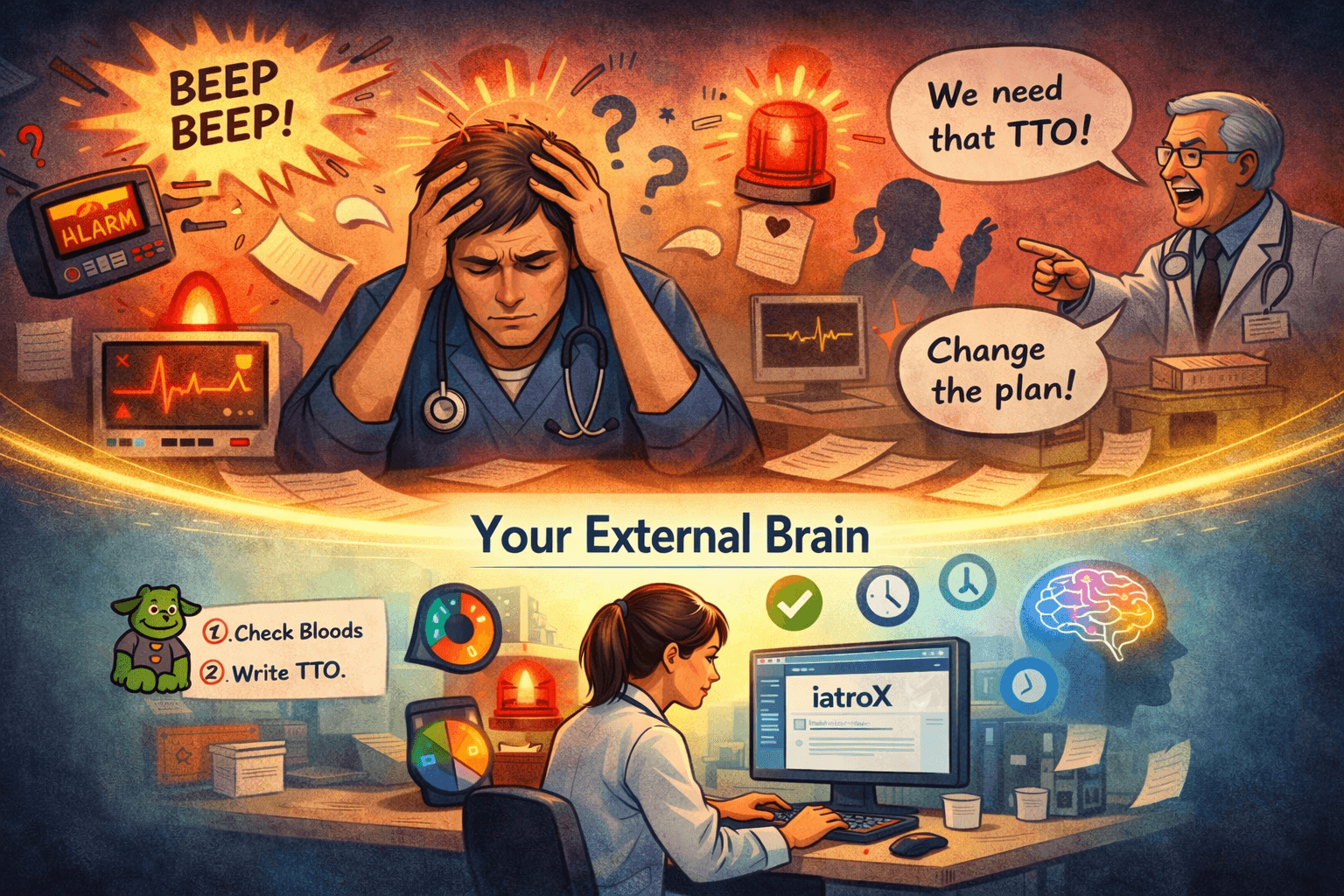
The problem: "working memory" vs. "the bleep"
For the neurodivergent clinician—whether you have ADHD, ASD, or simply a brain that works differently—the modern hospital environment is a sensory minefield. It is a space defined by constant interruptions: the crash bleep, the obs machine alarm, the nurse asking for a TTO, and the consultant changing the plan mid-round.
For a neurotypical brain, these are annoyances. For a neurodivergent brain that struggles with working memory and context switching, they are kryptonite. Every interruption wipes the slate clean. You forget where you were in the discharge letter. You lose the thread of the clinical plan. The cognitive effort required to simply "get back on track" ten times an hour is exhausting, leading to a profound sense of burnout that has nothing to do with your clinical competence and everything to do with your executive function.
You don't need to "try harder." You need to outsource your executive function to a tech stack that works as your external brain.
The "external brain" solution
Task initiation: Goblin Tools
We all know the "Wall of Awful"—that overwhelming feeling when you stare at a vague task like "Sort out the jobs list" and your brain just refuses to start.
- The tool: Goblin Tools (specifically the Magic ToDo feature).
- The win: It uses AI to break down "big scary tasks" into tiny, non-scary steps. You type in "Discharge Mrs. Jones," and it auto-generates a checklist: 1. Check bloods. 2. Confirm package of care. 3. Write TTO. 4. Call daughter. Suddenly, the mountain is just a series of molehills. It overcomes the inertia of starting.
Time blindness: Tiimo or Owaves
"Time blindness" is the inability to sense the passing of time, a common trait in ADHD. On a busy ward round, 10 minutes can feel like 10 seconds, leading to late meds and missed breaks.
- The tool: Tiimo or Owaves.
- The win: These are visual planners that show time as a physical shape on a dial, rather than just a number on a clock. Tiimo is designed specifically for neurodiversity, helping you "see" how much time you have left for a task. Owaves focuses on circadian rhythms, helping you visualize where your energy peaks and troughs are, ensuring you actually take that lunch break to recharge.
Clinical focus (the anti-distraction tool): iatroX
ADHD brains love to go down rabbit holes. You need to check the dose of Gentamicin. You open a web browser. You see a news headline about the NHS budget. You see an ad for a holiday. You remember you need to buy cat food. Five minutes later, you’re reading about cat food and you’ve forgotten the patient.
- The tool: iatroX.
- The angle: iatroX keeps you in a "clinical tunnel." It is a search engine with zero distractions. No ads, no news, no SEO clutter. You ask a question, you get the answer, and you get out. It protects your attention span from the internet's noise.
The "context switching" fix
The most expensive thing you spend every day is cognitive energy. Every time you switch from Patient A to the computer, then to your phone, then back to the patient, you pay a "cognitive cost." It takes mental energy to re-orient yourself.
iatroX reduces this cost by giving you the complete answer in one structured view. Instead of opening one tab for the guideline, another for the dose, and a third for the risk score, iatroX synthesizes the answer for you. It prevents that dreaded "what was I doing again?" moment by ensuring that when you reach for your phone, you find exactly what you need without having to navigate a maze to get there.