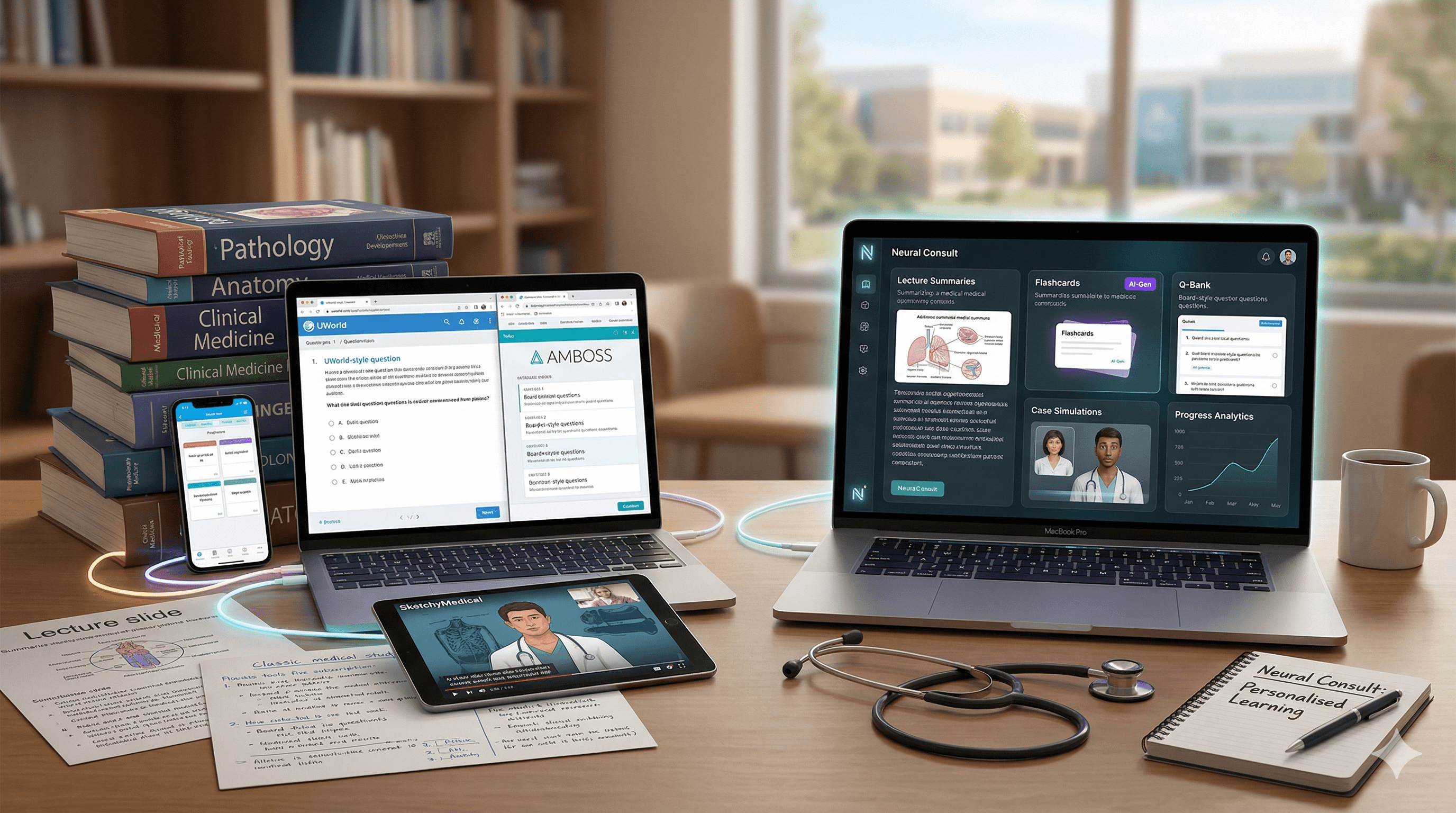
The classic medical study stack is familiar: UWorld for questions, AMBOSS for knowledge, Anki for flashcards, SketchyMedical for pathology, YouTube for everything else. Five tools, five subscriptions, five logins, five different interfaces.
Neural Consult is trying to replace the entire stack with a single AI-powered platform. Upload your lectures. The AI generates summaries, flashcards, board-style questions, and clinical case simulations — all in one place. It supports USMLE, UKMLA, MCCQE, NEET PG, and PANCE.
The promise is compelling: one cognitive loop from summary to recall to test to simulation, powered by your own curriculum material. But can one platform genuinely replace the established specialists?
Neural Consult: The All-In-One AI Play
Neural Consult's distinctive feature is curriculum personalisation. You upload your own lecture slides, articles, or notes, and the platform generates study materials from that content: AI-generated summaries via the Lecture Notebook, flashcards with spaced-repetition scheduling, board-style MCQs matched to your target exam format, and OSCE-style case simulations with virtual patients.
The platform supports multiple exam systems and is designed for medical students across career stages. Advisors include faculty from Northwestern Medicine and other US institutions. Students from St. George's, McMaster, and other schools are among the user base.
Strength: Personalisation. Your revision is built from your curriculum, not a generic Q-bank.
Limitation: The quality of AI-generated questions depends on the input material and the generation model. Unlike manually curated banks, AI-generated questions may contain errors, edge cases, or poorly calibrated difficulty — the provenance concern.
UWorld: The Board Question Specialist
UWorld remains the gold standard for USMLE preparation. Its questions are meticulously written by subject matter experts, peer-reviewed, and calibrated against real exam performance data. The explanations are comprehensive and clinically rich.
Strength: Question quality. UWorld's questions and explanations are the benchmark against which every other bank is measured.
Limitation: UWorld is a Q-bank, not a learning platform. It does not offer flashcards, lecture integration, simulations, or adaptive AI tutoring. It does one thing brilliantly and nothing else.
AMBOSS: The Knowledge Platform
AMBOSS combines a clinical library (expert-authored learning cards), a Q-bank (NBME-style questions), and AI Mode Learning (adaptive study sessions). It is the closest to a "medical intelligence platform" — supporting students from preclinical through to practice with integrated knowledge and assessment.
Strength: Depth and breadth. The library-plus-Q-bank integration means you can study a topic and test yourself on it within the same platform.
Limitation: Global focus. AMBOSS does not preferentially surface UK guidelines. For UKMLA or UK postgraduate exams, the content may need UK-specific supplementation.
iatroX: UK-Guideline-Grounded Learning
iatroX combines adaptive learning with a RAG layer over NICE, CKS and SIGN guidance and medicines information from relevant SmPCs on eMC. Answers and explanations can include links to retrieved sources, which learners should open and verify.
The Q-Bank uses adaptive spaced repetition mapped to multiple exam curricula (UKMLA, MRCGP AKT, MRCP, USMLE, MCCQE, AMC). Brainstorm provides structured clinical reasoning practice. Ask iatroX provides instant guideline retrieval. The CPD module documents professional development.
Strength: UK guideline grounding, the bridge between exam learning and clinical practice, and the fact that it is completely free.
Limitation: Not a lecture-to-flashcard generation engine like Neural Consult. Does not offer the library depth of AMBOSS or the question calibration of UWorld.
Can One Platform Replace the Stack?
Not yet. Each platform excels at a specific cognitive task: Neural Consult at personalised content generation, UWorld at calibrated board questions, AMBOSS at integrated knowledge, and iatroX at UK-grounded adaptive learning.
The practical approach: pick two or three tools that complement each other.
For USMLE: UWorld (primary Q-bank) + Neural Consult or AMBOSS (knowledge and personalisation) + iatroX (spaced repetition and adaptive weakness targeting).
For UKMLA: Quesmed or PassMedicine (primary UK Q-bank) + iatroX (adaptive learning, guideline clarification, clinical reasoning). Free.
For MCCQE: Neural Consult (MCCQE-specific content generation) + iatroX (spaced repetition and knowledge retention).
Conclusion
The all-in-one AI study platform is a compelling vision. Neural Consult is the most ambitious attempt to realise it. But the reality in 2026 is that specialist tools still outperform generalist platforms for specific exam preparation tasks.
The smartest candidates build a lean stack — and iatroX fits into every stack as the free, adaptive, guideline-grounded layer that ensures knowledge retention and clinical accuracy across all exam systems.