MRCP Part 1 covers everything. But it does not cover everything equally. Some specialties generate 20+ questions per sitting while others generate 2-3. Studying all topics for the same duration is inefficient — it means spending equal time on a specialty worth 15% of the exam as one worth 3%.
This guide estimates the specialty weightage and translates it into a revision time allocation.
Estimated Topic Weightage
Based on the MRCP Part 1 exam blueprint, candidate reports, and published analyses:
Cardiology: 12-15%. The single highest-weighted clinical specialty. Valvular disease, cardiomyopathies, arrhythmias, ACS management, heart failure, congenital heart disease, ECG interpretation. Invest heavily.
Respiratory: 8-10%. COPD, asthma, interstitial lung disease, sarcoidosis, TB, PE, lung cancer, pleural disease. Overlaps significantly with radiology (chest X-ray interpretation).
Gastroenterology and hepatology: 8-10%. IBD, coeliac, liver disease (all types), portal hypertension, pancreatitis, GI malignancy. Liver disease is particularly high-yield.
Neurology: 7-9%. Stroke, MS, epilepsy, movement disorders, peripheral neuropathy, myasthenia, MND, headache. Questions often combine neurology with neuroanatomy.
Endocrine: 7-9%. Diabetes complications, thyroid (all conditions), adrenal disorders, pituitary, calcium metabolism, porphyria. MEN syndromes are perennial favourites.
Renal: 6-8%. Glomerulonephritis, nephrotic vs nephritic, AKI, CKD, electrolytes, renal tubular acidosis, ADPKD. Electrolyte disorders overlap with clinical sciences.
Clinical pharmacology: 8-12%. Spans all specialties. Drug interactions, adverse effects, monitoring, prescribing in special populations. See the dedicated pharmacology guide.
Rheumatology and immunology: 5-7%. SLE, RA, vasculitis, spondyloarthropathies, immunodeficiency, autoimmune mechanisms.
Haematology and oncology: 5-7%. Leukaemias, lymphomas, myeloma, myeloproliferative disorders, coagulation, transfusion.
Infectious disease: 4-6%. HIV, tropical infections, antimicrobials, infection control.
Clinical sciences (genetics, immunology, biochemistry): 5-8%. The "basic science" component that clinical doctors find hardest. Inheritance patterns, immunological mechanisms, metabolic pathways, acid-base.
Statistics and EBM: 3-5%. Finite, predictable, learnable. Free marks if prepared; lost marks if not.
Dermatology, ophthalmology, psychiatry: 2-4% each. Lower volume but still testable. Skin manifestations of systemic disease (dermatology) and psychiatric medications (psychiatry) are the highest-yield sub-topics.
The Time Allocation Framework
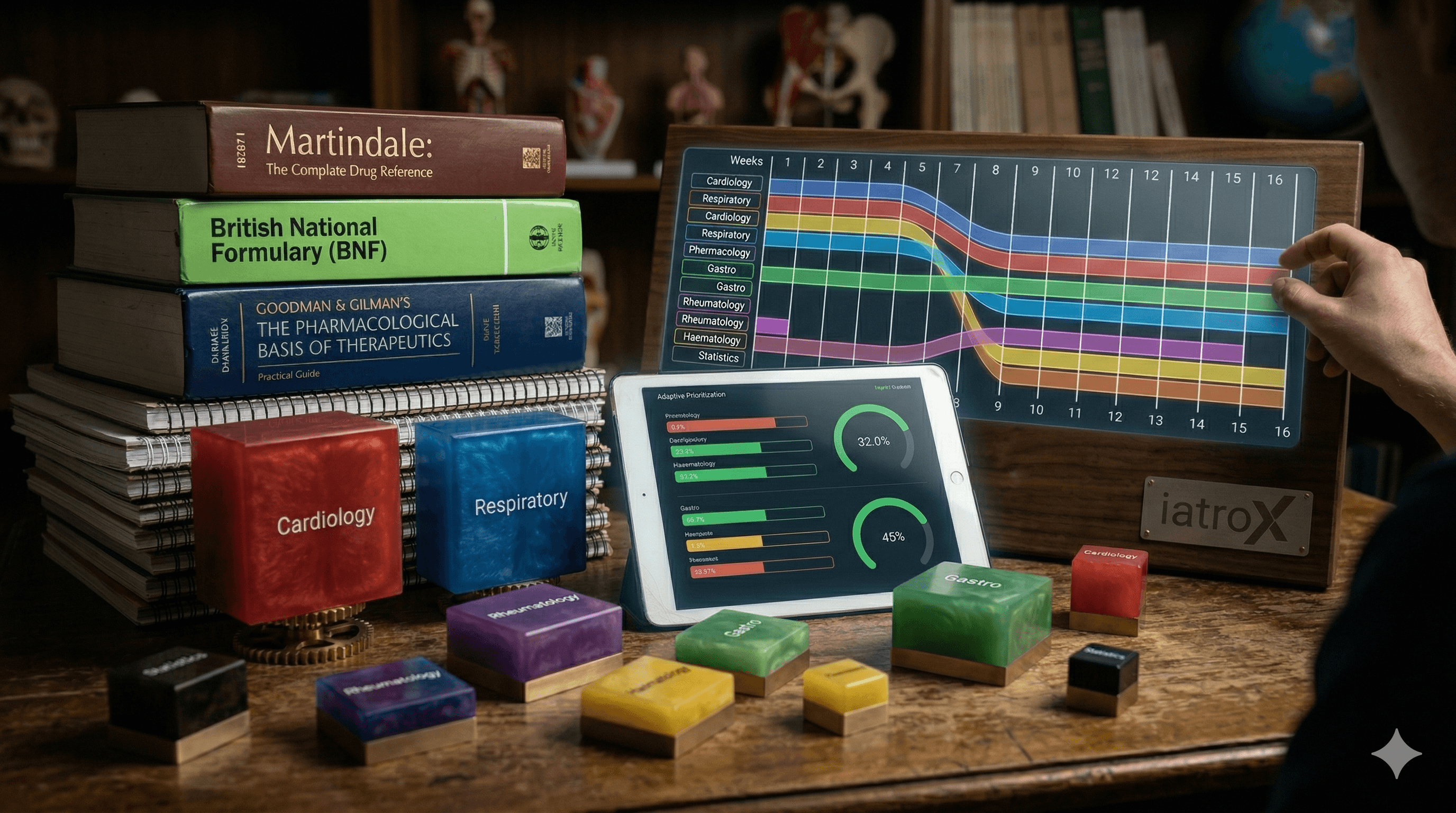
Over a 16-week preparation, allocate time proportionally:
35-40 hours each: Cardiology, clinical pharmacology, respiratory.
25-35 hours each: GI/hepatology, neurology, endocrine, renal.
15-25 hours each: Haematology, rheumatology/immunology, clinical sciences, infectious disease.
8-15 hours each: Statistics/EBM, dermatology, ophthalmology, psychiatry.
The iatroX Q-Bank adaptive algorithm does this allocation automatically — it identifies which specialties you are weakest in and prioritises them, ensuring your practice time is spent where it generates the most learning. This is more efficient than manual time allocation because it adjusts in real time based on your evolving performance.
The Key Insight
The candidates who fail MRCP Part 1 are rarely weak across the board. They are typically strong in 60-70% of specialties and weak in 2-3 specific areas that collectively cost them the passing margin. Clinical pharmacology, clinical sciences, and statistics are the most common "weak trio."
Identify your weak trio early. Address it specifically. Use adaptive tools that target weakness rather than reinforcing strength. That is the allocation strategy that turns a near-miss into a pass.