The MRCGP Applied Knowledge Test (AKT) has evolved. If you are sitting the exam in 2026, you are facing a tighter, more concentrated assessment than previous cohorts.
The "volume-based" strategy of simply churning through thousands of random questions is no longer efficient. To pass comfortably, your revision needs to mirror the new structural reality of the exam.
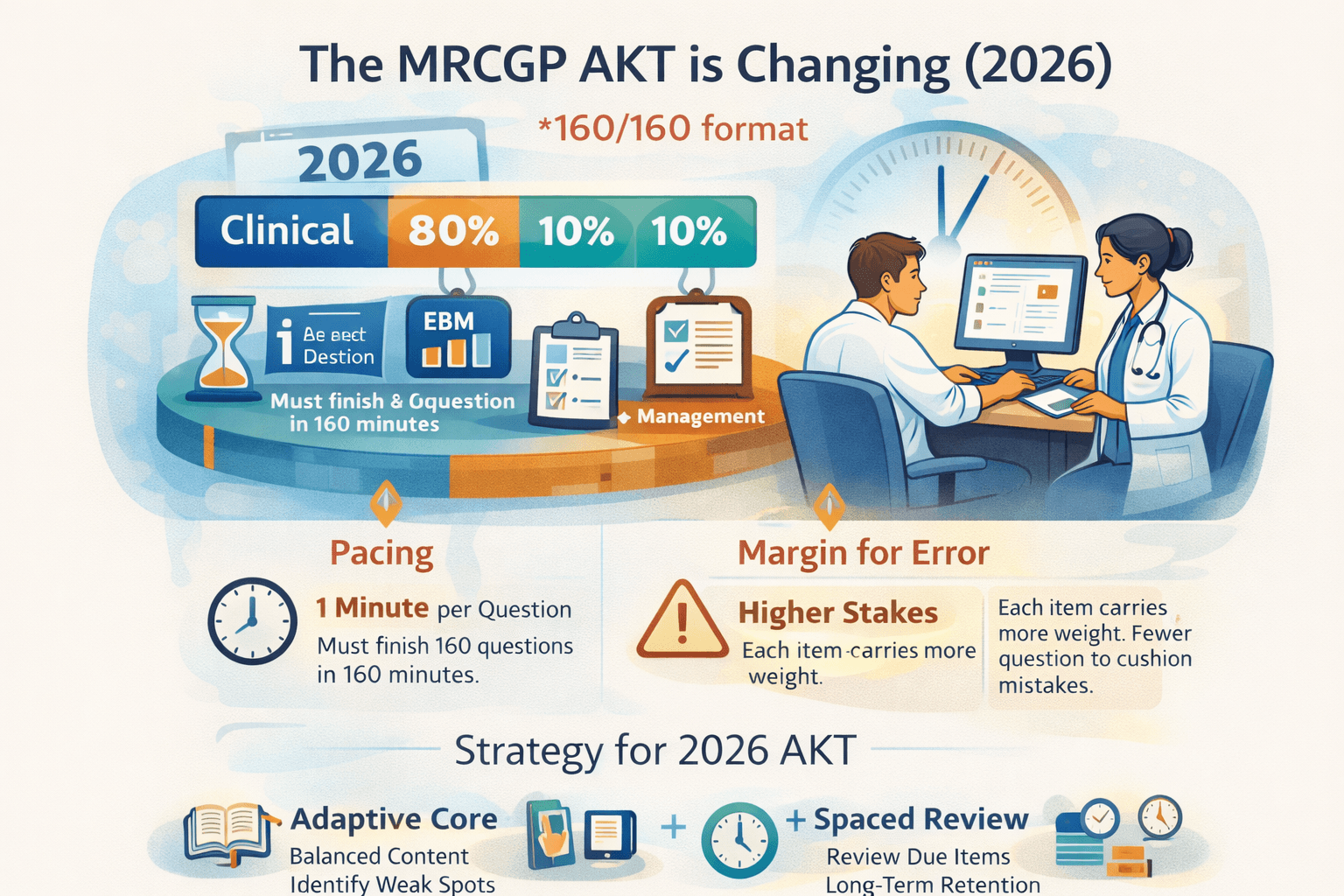
The new 160/160 format
The defining change introduced in October 2025 is the reduction in item count and duration.
The 2026 AKT profile
Items: 160 SBA items (reduced from 200)
Duration: 160 minutes
Pacing: 1 minute per item
The 80/10/10 split:
80% Clinical medicine
10% Evidence-based practice
10% Organisation and management
What the format change means for strategy
While the content footprint—the vast GP curriculum—remains unchanged, the reduction in question count has two specific strategic implications for 2026 candidates.
First, each item carries more weight. In a 200-item exam, a string of silly mistakes was recoverable. In a 160-item exam, the margin for error narrows. The "noise" has been removed, meaning the questions that remain are likely to be higher-yield and less filler.
Second, pacing discipline is non-negotiable. The ratio remains strictly 60 seconds per question. Many candidates mistakenly believe a shorter exam feels less pressured. In reality, the intensity is higher because there are fewer "easy" recall questions to buy you time for the complex calculations or admin scenarios.
The 8-week plan
An 8-week horizon is optimal for most full-time trainees. Stretching it longer often leads to burnout; compressing it shorter leads to cramming.
Daily: the adaptive core
- Adaptive blocks: Do 30–50 questions daily. Do not just hit "random." Use an adaptive engine that feeds you your weak areas (e.g., genetics, ophthalmology) rather than your comfort zones.
- The error log: Review every incorrect answer. If you didn't know the guideline, read the specific summary (e.g., CKS or NICE).
- Spaced repetition: Before starting new questions, clear your "due" reviews. This ensures retention of facts you learned two weeks ago.
Weekly: the conditioning phase
- Timed conditioning: Once a week, sit a mock block of 160 items in exactly 160 minutes. You need to train your bladder and your concentration span to handle the full duration without fatigue-induced errors.
How to stop “clinical-only bias”
The most common reason for failure is not a lack of clinical knowledge; it is neglecting the 20% of the exam that is non-clinical.
The 80/10/10 split is strict. You will get ~16 questions on stats and ~16 questions on organisation. If you ignore these to focus on cardiology, you are capping your maximum score before you even start.
The fix: Schedule specific "non-clinical days." For example, every Tuesday is strictly for evidence-based practice (funnel plots, trial phases, relative risk calculations). Every Thursday is strictly for organisation/management (DVLA rules, certification, fitness to work).
Resource stack (neutral)
A robust revision strategy often involves a mix of resources to cover different needs:
- Official RCGP pages: Essential for the latest curriculum updates and the official feedback reports, which highlight recurring candidate errors.
- GP SelfTest: The RCGP’s own tool. It is useful for getting a feel for the "house style" of questions.
- Commercial banks: Paid options like PassMedicine, Pastest, or BMJ OnExam are traditional heavyweights. They offer vast libraries of questions if you prefer volume-based bulk testing.
Where iatroX fits
iatroX operates differently from the legacy banks. It is designed as a free adaptive + spaced repetition engine explicitly mapped to the UK exam curricula.
Instead of charging you to access a static database, iatroX uses an algorithm to profile your knowledge state. It identifies that you are strong in respiratory medicine but failing on DVLA guidelines, and it adjusts your daily feed accordingly. It is the efficiency layer in your stack—ensuring you spend your limited revision time on the topics that will actually improve your score.
FAQ
How many questions/day should I do while working full time? Aim for quality over quantity. 30–50 high-quality adaptive questions with deep review of the explanations are better than 100 questions blitzed with no retention.
When should I do full mocks? Start full 160-item timed mocks 4 weeks out. Do one every weekend. This gives you four full "dress rehearsals" to sort out your timing and exam-day nutrition.