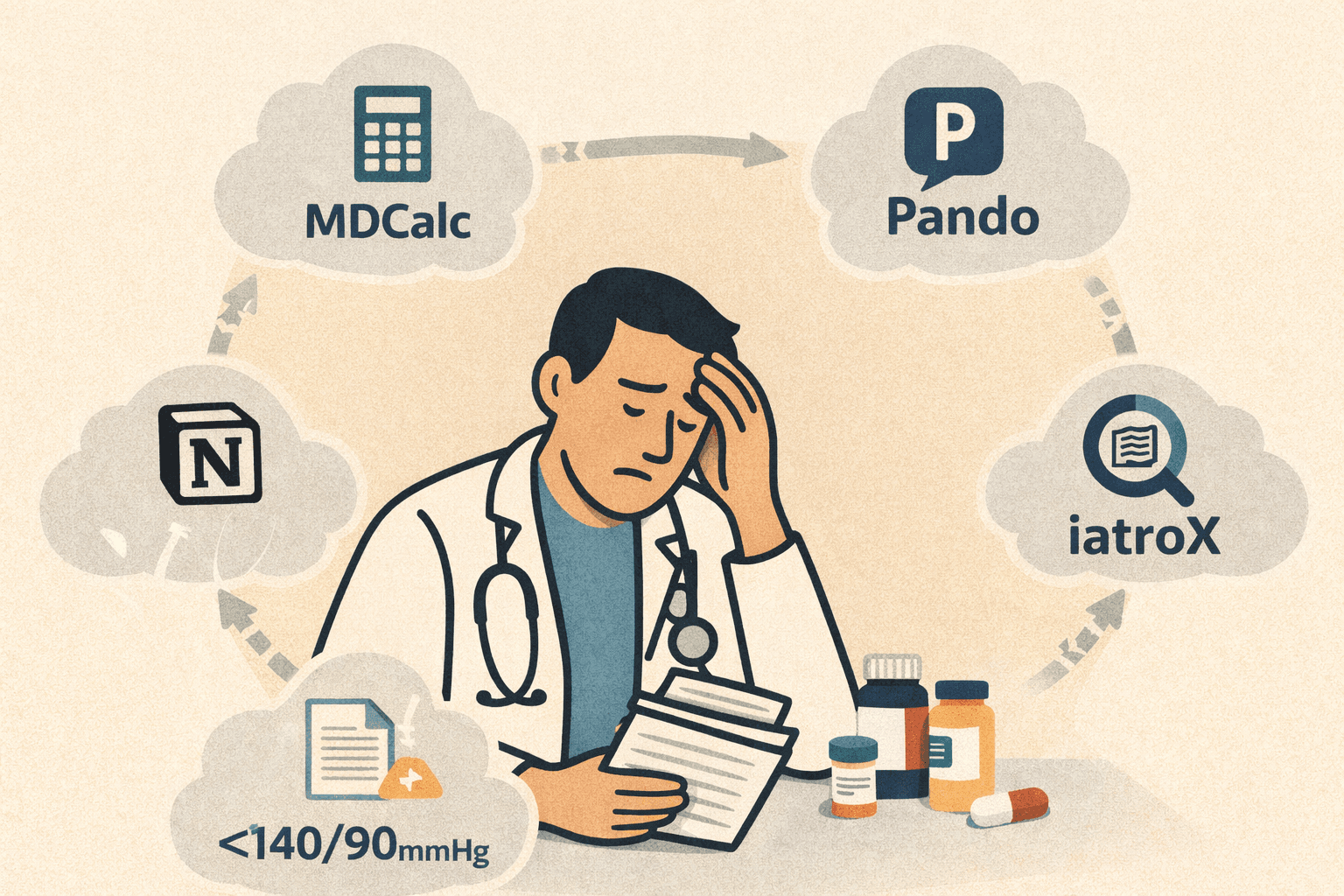
Introduction: the hidden cost of "context switching"
Decision fatigue is not just a buzzword; it's a physiological reality on a busy ward round. Studies suggest a clinician can make hundreds of micro-decisions in a single shift. Every time you switch context—from finding a bleep number to calculating a score to remembering a guideline—your brain pays a metabolic tax. This accumulation of micro-decisions is a primary driver of burnout.
The premise of the modern clinician's tech stack is simple: you don't need more information; you need better access to it. By offloading the "retrieval" and "calculation" tasks to reliable tools, you preserve your cognitive bandwidth for the high-stakes clinical decisions that only you can make.
The core stack (the "external brain")
The calculator: MDCalc
- Why: Because calculating a Wells Score or CHA2DS2-VASc score in your head is dangerous. It’s prone to error, especially at 3 AM.
- The win: MDCalc is the gold standard. It provides the calculator, the evidence behind it, and the "next step" advice. Use it to standardise your risk stratification.
The communicator: Pando / Siilo
- Why: Using WhatsApp for clinical data is a governance nightmare. It blurs the line between your professional and personal life, contributing to "always-on" stress.
- The win: Secure messaging apps like Pando or Siilo are GDPR-compliant, separate your work chats from your social life, and allow for the safe sharing of clinical images.
The navigator (knowledge retrieval): iatroX
- Why: Traditional guideline searches are slow. Googling "asthma management" forces you to wade through patient-facing SEO clutter before finding the clinical protocol.
- The win: iatroX is designed for the "zero-friction" query. It acts as an intelligent layer over trusted sources like NICE and the SmPC/emc, giving you the specific, cited answer you need in seconds without the noise.
The organizer: Notion / Obsidian
- Why: For the "super-user" building a long-term career. Keeping track of research ideas, audit data, and revision notes across multiple notebooks is inefficient.
- The win: Tools like Notion or Obsidian allow you to build a "Second Brain"—a searchable, interlinked database of your professional life. Use them to track your portfolio, log CPD reflections, and organise your exam revision.
Hardware check
Your software is only as good as the device it runs on.
- The power bank: A dead phone is a useless "external brain." A small, high-capacity power bank is as essential as your stethoscope.
- The iPad Mini: For many, this is the perfect ward companion. It fits in a white coat pocket, has a screen large enough for reading ECGs or X-rays, and supports full EMR apps that phone screens struggle with.
The "zero-friction" goal
The best technology is invisible. It shouldn't require five clicks and a login to get an answer. It should work instantly, solve the micro-problem (the calculation, the guideline, the message), and then get out of the way so you can get back to what matters: the patient.