If you ask a medical student how much they study, they will say "8 hours a day." If you ask a GP trainee or IMT working a full-time rota, that answer is physically impossible.
When you are working 48+ hours a week, commuting, and trying to maintain a relationship, the traditional "brute force" method of studying fails. You do not have a time problem; you have an energy problem.
This guide outlines the Minimum Effective Dose (MED) strategy—a revision protocol designed specifically for the full-time clinician who needs to pass high-stakes exams (AKT, MRCP, MSRA) without burning out.
The constraint is time + cognitive bandwidth
Most revision plans ignore Cognitive Load Theory. Your brain has a finite working memory capacity. After a ward round, a clinic, and two hours of discharge summaries, your "cognitive battery" is drained.
Forcing yourself to do 100 questions at 8 PM when you are exhausted increases extraneous load (the effort required to process information) and reduces germane load (the effort used to create permanent schemas). You are reading the words, but you are not retaining them. ScienceDirect
The MED rule
The Minimum Effective Dose is the smallest amount of input required to produce the desired outcome (passing). It relies on consistency, not intensity.
The MED Schedule
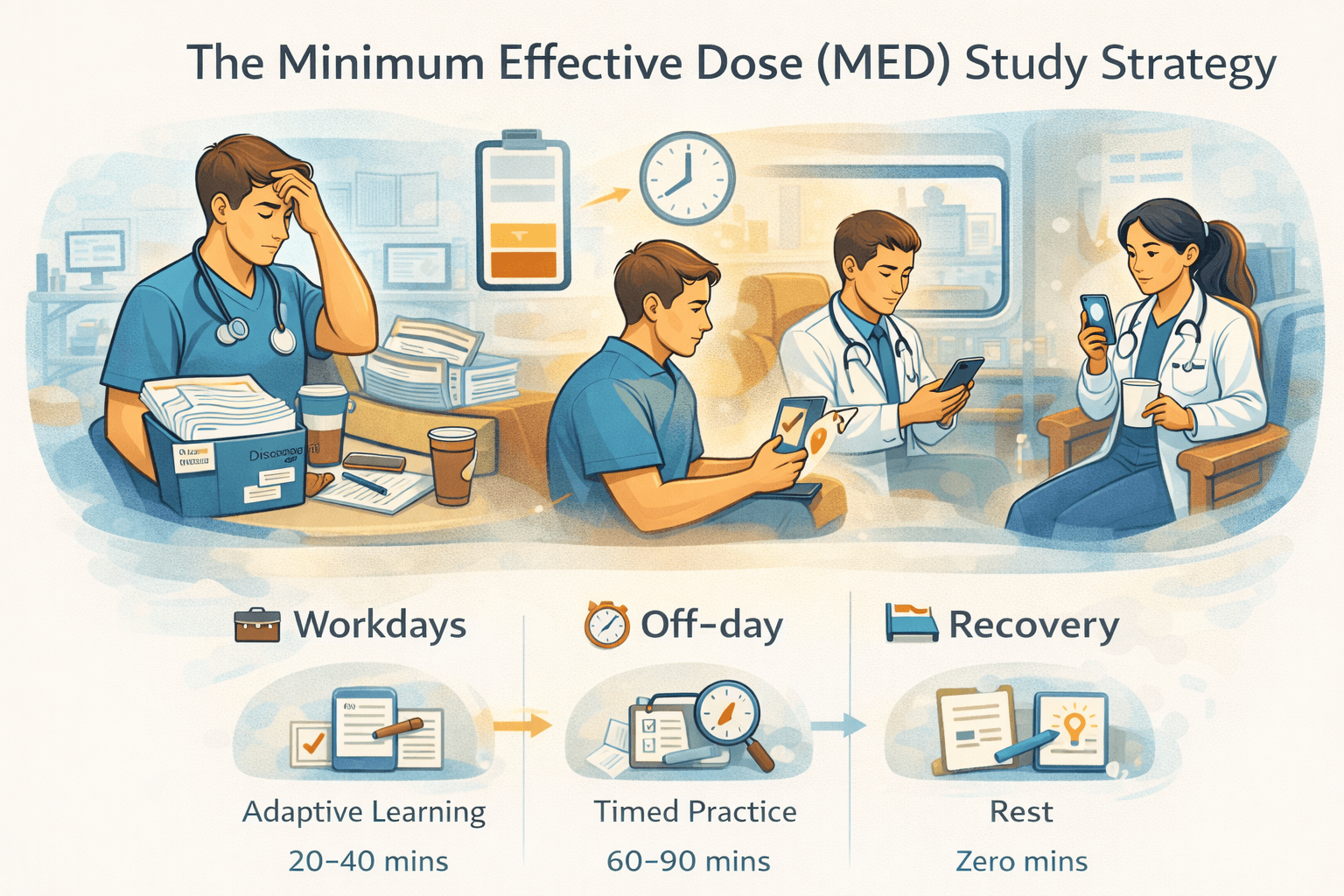
- 5 days/week (Workdays): 20–40 minutes maximum.
- 1 day/week (Off-day): 60–90 minutes (one solid block).
- 1 day/week (Recovery): 0 minutes. Zero guilt.
This schedule totals roughly 4–5 hours of high-quality, high-retention study per week, which is superior to 15 hours of low-quality, exhausted "zombie studying."
The “micro-session menu”
Stop waiting for a "free hour" to appear; it never will. Instead, use a menu of micro-sessions that fit into the dead space of your day (commute, cancelled clinic patient, coffee break).
- The 10-Minute Block (The "Snack"):
- Activity: 5–10 rapid-fire questions on your phone.
- Goal: Maintenance. Keep the synaptic pathways open.
- The 20-Minute Block (The "Meal"):
- Activity: 15 questions + reading the guidelines for the errors.
- Goal: Learning. Tackle a specific weak topic (e.g., "Ophthalmology red flags").
- The 30-Minute Block (The "Feast"):
- Activity: Reviewing your error log + clearing your spaced repetition queue.
- Goal: Retention. ensuring you don't forget what you learned last week.
The weekly cadence
Structure your week to match your energy levels, not just your roster.
- Monday – Friday (Survival Mode):
- Focus: Adaptive Targeting + Retention.
- Use your micro-sessions. Do not attempt full mocks. Your goal is simply to clear your "spaced repetition" due list.
- Saturday (Performance Mode):
- Focus: Timed Conditions.
- This is where you sit down for 60–90 minutes. Do a timed 50-question block to train your pacing and stamina. Review it deeply.
- Sunday (Recovery Mode):
- Focus: Rest.
- Your brain consolidates memory during sleep and rest. If you skip this, your retention from the week drops.
Why this works (evidence anchors)
This is not just a "lazy" hack; it is evidence-based. Systematic reviews of health professional education show that spaced digital education (short bursts repeated over time) significantly improves knowledge and skill retention compared to "massed" (crammed) learning.
By reducing the session length, you increase the frequency of retrieval, which is the primary driver of long-term memory. JMIR
Where iatroX fits
The MED strategy falls apart if you have to spend 10 minutes setting up your books or logging into a clunky website. You need a tool that is instant and intelligent.
iatroX acts as your free daily engine. Because it combines adaptive learning (giving you the right questions) with spaced repetition (scheduling them at the right time), it makes the "10-minute micro-session" viable. You can open the app, do 5 high-yield questions targeted at your weaknesses, and close it—knowing you have done your "dose" for the morning.