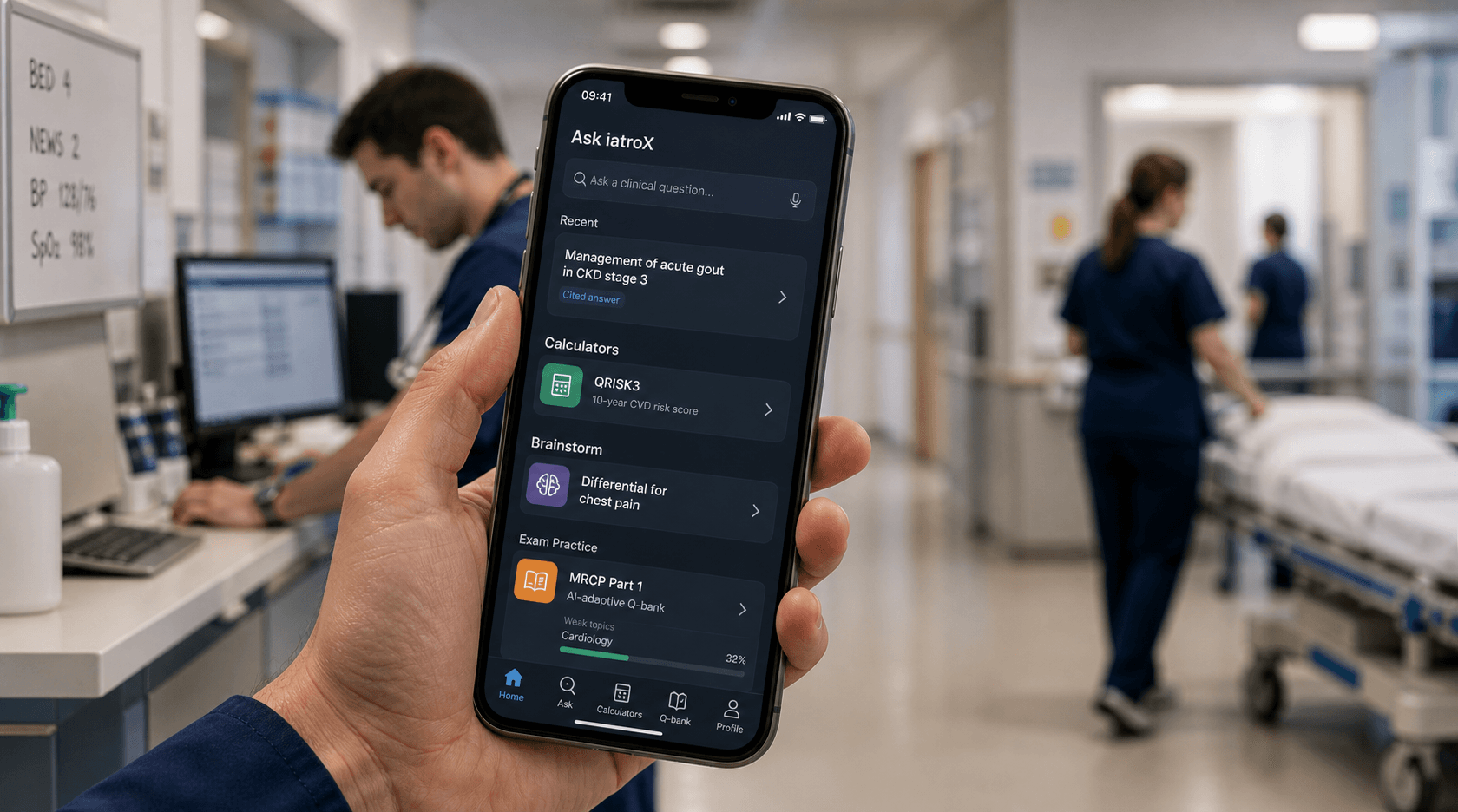
Doctors and trainees need clinical information at the point of need — not only at a desk, not only during allocated study time, not only when a laptop is open and a reference book is nearby. A clinical knowledge app that supports questions, brainstorming, calculators, and exam preparation in one mobile-accessible environment changes when and where medical knowledge is used — and therefore how much of it is actually used.
Why Doctors Need a Different Kind of Medical App
Most medical apps do one thing. A calculator app scores risk. A Q-bank app tests knowledge. A guideline app shows recommendations. A generic AI chatbot answers questions with variable accuracy and no clinical specificity. A drug reference app provides formulary data. Each requires a separate download, a separate account, a separate interface, and a separate mental context.
The result is predictable: clinicians carry five or six medical apps on their phones and use each one infrequently — or, more commonly, default to a general search engine because it is faster than remembering which single-purpose app handles the current question. The tools exist. The friction of using them is too high for the micro-moments of clinical practice.
A clinical knowledge app consolidates these workflows. Ask a clinical question, check a calculator, brainstorm a case, practise an exam question — without switching between four different apps, four different logins, and four different interfaces. The consolidation is not a convenience feature — it is a usability requirement for tools that need to work during the 30-second gaps between patients.
Clinical Information Retrieval in Your Pocket
Ask iatroX provides cited clinical answers oriented around UK practice. The workflow is designed for the speed of clinical practice: ask a natural-language question, receive a structured response with source links, verify where needed, apply clinical judgment. Mobile-optimised for genuine 30-second interactions between patients — not desktop-designed layouts awkwardly adapted for small screens.
The mobile-first design reflects how clinicians actually use clinical knowledge tools. A study question at 7am on the train. A guideline check at 11am between clinic patients. A calculator at 2pm during a ward round. A brainstorming query at 5pm about a complex patient seen that afternoon. A revision session at 9pm before bed. Each interaction is brief, contextual, and time-constrained. Each requires an app that opens fast, responds faster, and does not waste time on unnecessary navigation.
Brainstorming Clinical Questions
Not every clinical interaction is a lookup. Sometimes the question is open-ended and exploratory: "Help me structure a differential for this presentation." "What investigations should I consider?" "What am I missing?" "What would a senior think about this?"
These are brainstorming queries — the kind of thinking that clinicians do with colleagues when available, with seniors when accessible, or with themselves when neither is around. iatroX supports this brainstorming workflow: structured clinical reasoning, red flag review, differential diagnosis support, and case-based thinking. The AI supports the process — providing structure, prompting consideration of possibilities, and retrieving relevant information. The clinician retains the judgment — evaluating which possibilities apply, which to pursue, and what to do next.
Brainstorming is different from diagnosis, and the distinction is important. iatroX is not diagnosing patients. It is helping clinicians think through clinical problems more systematically — the same cognitive process they already engage in, supported by faster information access and structured reasoning scaffolds.
Calculators for Practical Risk Scoring
iatroX calculators include 80+ clinical scoring tools — NEWS2, QRISK3, Glasgow-Blatchford, CHA₂DS₂-VASc, MELD, MELD-Na, Wells, YEARS, PECARN, Canadian C-Spine, SOFA, Lille, APACHE II, and many others. Each includes editorial content explaining when to use the calculator, what the score means clinically, which guideline recommends it, and what action the score should trigger.
Having calculators in the same app as clinical search means the workflow is continuous. Check the guideline recommendation for statin initiation → calculate the QRISK3 score → verify the threshold → make the prescribing decision. All in one environment, in one session, without switching apps.
Exam Preparation and Structured Learning
iatroX includes 15+ adaptive exam Q-banks covering major UK, US, Italian, and international medical exams. AI-adaptive question selection driven by cumulative performance data. Spaced repetition at evidence-backed intervals. Mock exam modes with realistic timing and deferred explanations. Performance analytics showing weak topics and improvement trends.
Core clinical information-retrieval and brainstorming workflows are designed to be accessible with low friction. Exam-preparation products may include paid components depending on the exam and region — reflecting the investment required to build and maintain thousands of curriculum-mapped, quality-reviewed exam questions with detailed clinical explanations.
What Is Accessible, and What May Be Paid
iatroX keeps core clinical information-retrieval and brainstorming workflows accessible — these are the workflows clinicians use most frequently and that should not face subscription barriers at the point of clinical need. Structured exam-preparation products — large Q-banks with curriculum mapping, adaptive algorithms, performance analytics, and mock exam modes — may include paid components where appropriate.
The principle is straightforward: clinical access should be broad. Structured exam preparation can be supported by a sustainable model. The distinction is transparent — clinicians know what they are getting and what is available at each tier.
Start Using iatroX
iatroX brings together the workflows clinicians already use separately: asking, searching, calculating, brainstorming, revising, and learning. Available as a mobile app and on the web. Designed for the everyday moments — not the ideal conditions — of clinical practice.
Open iatroX and start with a clinical question, calculator, or exam-preparation session →