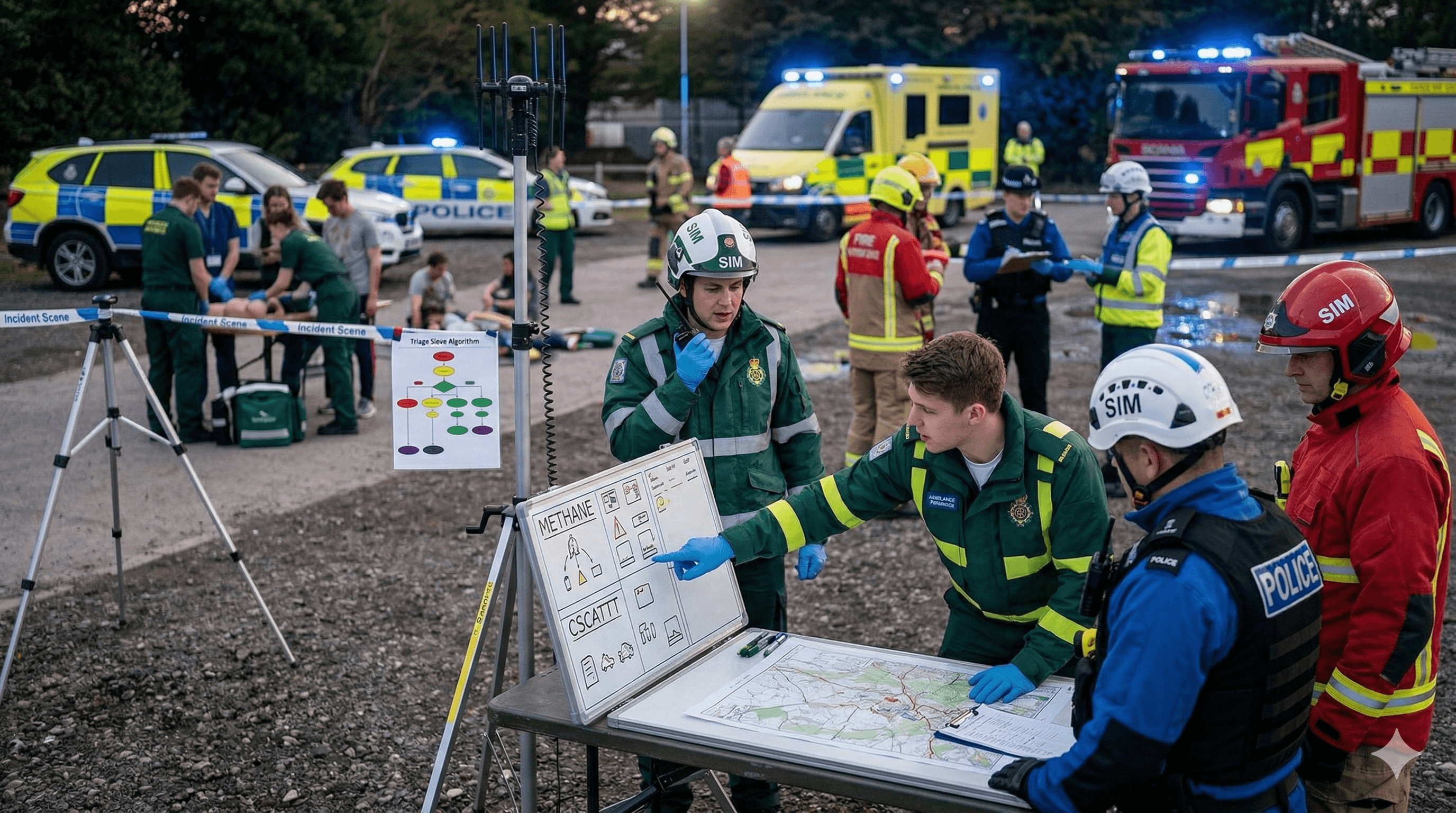
Major incident management is one of the most unique topics in the DipIMC — tested in both the SBA paper and the OSPE, and one of the areas where candidates with clinical but not operational pre-hospital experience struggle most. Hospital doctors manage patients. Pre-hospital practitioners manage scenes. The DipIMC tests both.
METHANE: The Scene Report
METHANE is the standard UK framework for reporting a major incident. Every candidate must know it.
M — Major incident declared (or standby). State clearly whether you are declaring or requesting standby.
E — Exact location. Grid reference, road name, landmarks. Be specific — responders need to find you.
T — Type of incident. RTC, building collapse, chemical release, explosion, flood, etc.
H — Hazards. Present and potential. Fire, chemical contamination, structural instability, weather, secondary devices.
A — Access. Best approach routes. Any restrictions (flooded roads, debris, cordons).
N — Number of casualties. Estimated. State if unknown but give best estimate.
E — Emergency services. Present and required. Which services are on scene? What additional resources are needed?
METHANE may appear as an OSPE station (you arrive at a scene and must deliver a METHANE report to a simulated control room) or as SBA questions testing specific elements.
CSCATTT: Scene Management Framework
CSCATTT provides the overarching structure for managing the medical response at a major incident.
C — Command. Establish who is in charge at the scene. Medical commander, ambulance commander, police commander. Know the command structure and your role within it.
S — Safety. Self, scene, survivors. In that order. You cannot help anyone if you become a casualty.
C — Communication. Establish communication channels. METHANE report. Updates to control. Communication between agencies (JESIP principles).
A — Assessment. Assess the scene, the number of casualties, the severity distribution, and the resources needed.
T — Triage. Categorise casualties by clinical priority using triage sieve (primary triage) and triage sort (secondary triage).
T — Treatment. Provide life-saving interventions based on triage category. In a major incident, this is limited to immediately life-threatening problems — not definitive care.
T — Transport. Evacuate casualties to appropriate receiving hospitals based on triage category and hospital capacity.
Triage Sieve (Primary Triage)
The triage sieve is a rapid, algorithm-based primary triage tool used at the scene of a major incident.
Walking? Yes → Priority 3 (Delayed, Green). No → assess further.
Breathing? Open airway → if still not breathing → Dead (expectant, Purple/Black). If breathing → assess rate.
Respiratory rate? Under 10 or over 30 → Priority 1 (Immediate, Red). 10-30 → assess circulation.
Circulation? Capillary refill over 2 seconds or pulse over 120 → Priority 1 (Immediate, Red). Normal → Priority 2 (Urgent, Yellow).
The triage sieve can be assessed in OSPE stations with multiple simulated casualties where you must triage rapidly and correctly.
Triage Sort (Secondary Triage)
Triage sort uses the Triage Revised Trauma Score (T-RTS) for more detailed secondary triage at the casualty clearing station. It assigns scores based on respiratory rate, systolic BP, and GCS. Higher scores indicate lower priority; lower scores indicate higher priority.
JESIP: Joint Working Principles
JESIP (Joint Emergency Services Interoperability Programme) defines how emergency services work together at incidents. The key principles: co-locate, communicate, co-ordinate, jointly understand risk, and share situational awareness. Know these principles — they may be tested in communication or scene management stations.
How to Prepare
Major incident management is a knowledge domain that requires specific study — clinical training does not cover it. Read the NARU Command and Control Guidance. Learn the METHANE, CSCATTT, and triage frameworks until they are automatic. Practise delivering a METHANE report out loud (timing and clarity matter).
The iatroX DipIMC Q-Bank includes major incident management questions mapped to the FPHC curriculum. Ask iatroX provides reference for the clinical management aspects of major incident casualties.