Introduction
We have all been there. It is the middle of a consultation, and your eyes are oscillating between the patient and the computer screen. The patient pauses, waiting for eye contact; you keep typing. The relationship subtly degrades—not because you don't care, but because your workflow prioritises documentation and information retrieval over presence.
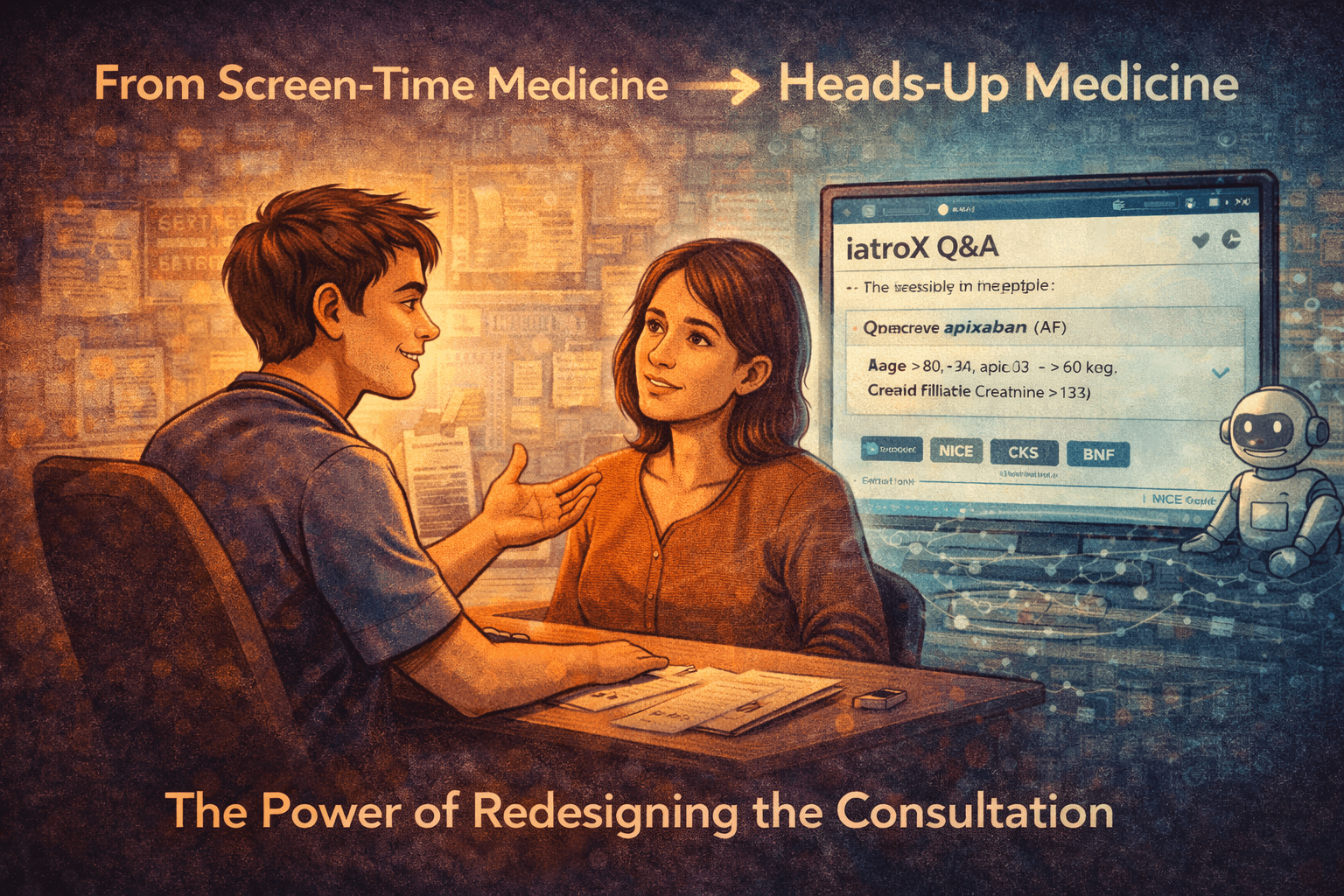
The most powerful promise of clinical AI in 2025 isn’t "superhuman diagnosis." It is restoring attention. By automating the cognitive burden of retrieval, checking, and summarising, tools like iatroX can allow clinicians to return to the uniquely human work of medicine.
The current state: “screen-time medicine”
The data confirms what every clinician feels: screens are dominating our time.
- EHR burden: A large analysis in JAMA Network Open found that primary care physicians spent a median of ~36 minutes on EHR tasks per visit.
- During the encounter: A 2025 analysis reported that PCPs spend between one-third and one-half of every face-to-face visit interfacing with the computer (PMC).
- The impact: This "screen-time medicine" has a cost. Research shows that excessive EHR focus can make clinicians appear distracted or less compassionate, risking missed non-verbal cues and damaging the patient-centred relationship (PMC).
The modern consultation has become an information workflow, where cognitive energy is consumed by retrieval and compliance rather than connection and judgement.
The future state: “heads-up medicine”
"Heads-up medicine" is a future where the clinician remains present, maintains eye contact, and listens actively. Digital tools act as quiet support, not the centre of attention.
We already know that automation can give time back. Real-world quality improvement studies have shown that AI scribing interventions are associated with reduced total EHR time and after-hours work (PMC). NHS England has issued specific guidance for these tools, recognising their potential while emphasising the need for governance and human review (NHS England).
If automation can reduce the documentation load, then a complementary class of tools—like iatroX Q&A—can reduce the retrieval-and-checking load during clinical reasoning.
The role of iatroX: it handles the science so the human can handle the art
iatroX Q&A is designed as a rapid clinical retrieval layer. It answers the question, "What’s the guideline-consistent next step?" with verifiable provenance.
It automates the micro-tasks that fragment your attention:
- Hunting for the right guideline page.
- Extracting the relevant paragraph.
- Summarising decision points.
- Surfacing contraindications or red flags.
Crucially, it does not replace clinical judgement, shared decision-making, or the nuanced understanding of a patient's values. It simply handles the information retrieval so you can focus on the human interaction.
The consultation redesign: “Q&A as the quiet assistant”
Here is a practical model for a "Heads-Up" workflow:
Phase 1 — Before the patient enters (30–60 seconds): Use iatroX Q&A to pre-check the guideline pathway, key red flags, and first-line options for the likely presentation.
Phase 2 — During the consultation (minimal screen time): Focus entirely on the narrative and non-verbal cues. If a factual check is needed, perform a single, purposeful lookup: "Let me quickly check the most up-to-date guidance for this exact scenario."
Phase 3 — After the consultation (30–90 seconds): Confirm dosing or criteria and capture a clean plan summary (always verifying against the cited source).
This allows for a "patient-friendly" micro-script that builds trust: "I’m going to check the latest guidance so we make the safest choice," or "Let’s look at the options together and decide what fits you."
The safety and governance paragraph
To use these tools safely, follow the golden rules:
- Don’t enter identifiable patient data into non-approved tools.
- Verify key recommendations in the cited source.
- Treat AI outputs as decision support, not decisions. "Human review" is a design requirement, not a slogan, echoing NHS England's emphasis on verification for generative tooling (NHS England).
Why this is the “irony” of automation
The paradox of digital health is that more technology initially created more clerical work and more screen time. The next wave of technology—if used properly—can reverse it. By automating the bureaucratic and retrieval burden it created, AI can make the clinician's role more human, not less: more attention, better listening, and better shared decisions.
We built a robot so you don’t have to be one.
Use iatroX Q&A to do the science checks quickly—then put the screen down and do the human work.