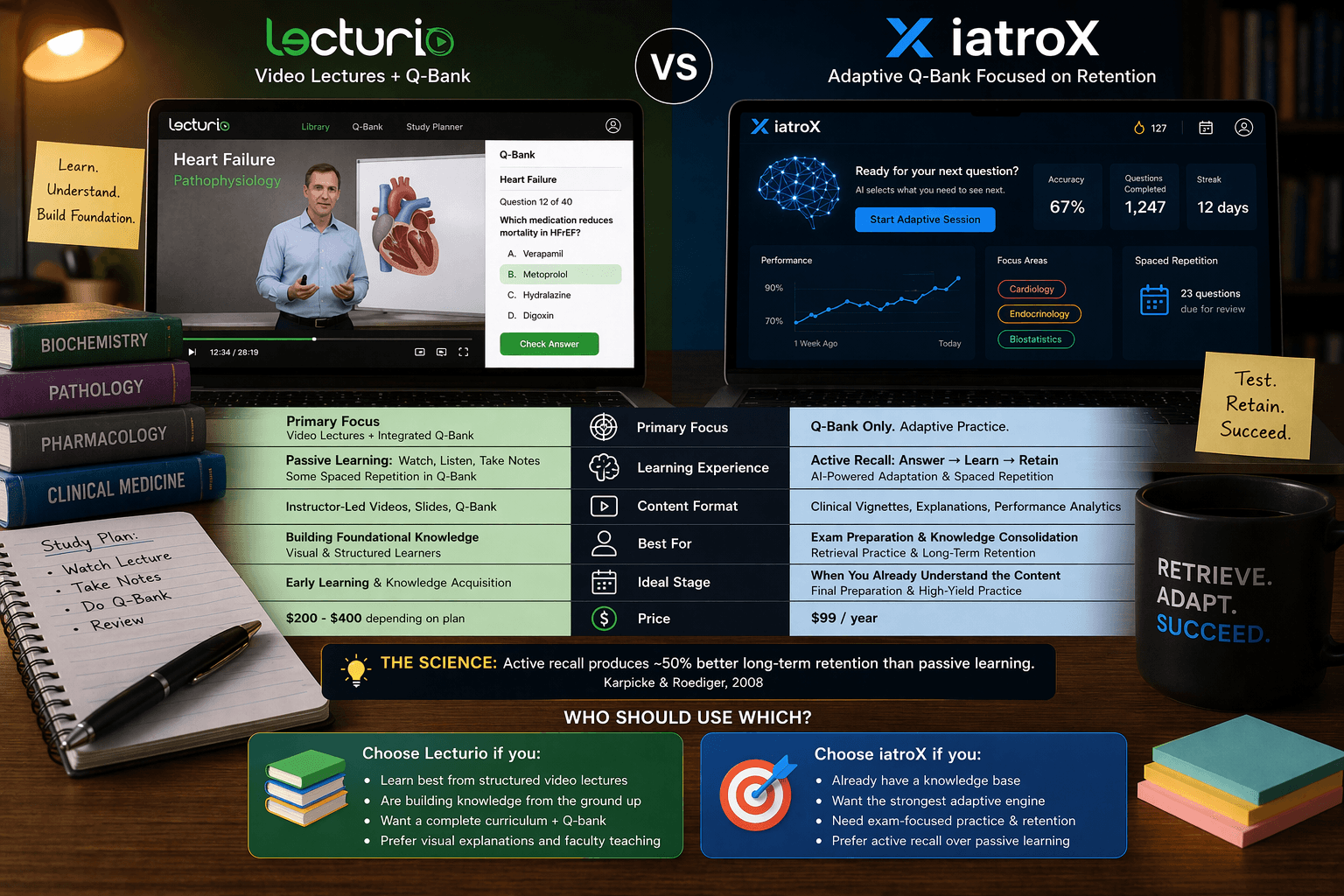
Lecturio is built around video lectures — a comprehensive library of medical teaching videos covering preclinical and clinical content, taught by faculty from partner medical schools. The platform includes an integrated Q-bank with some spaced repetition features, but video is the primary product. For visual learners who prefer structured, instructor-led content delivery, Lecturio provides a complete curriculum from biochemistry through clinical medicine with high production values.
iatroX is Q-bank-first. No lectures. No video library. No instructor-led curriculum. Every interaction is a retrieval exercise — a clinical vignette requiring you to generate an answer from memory before seeing the explanation. This design reflects the learning science directly: active recall (testing yourself) produces approximately 50% better long-term retention than passive consumption (watching lectures or reading), per Karpicke and Roediger's landmark 2008 study. Video lectures feel productive — the material seems familiar after watching — but this familiarity is the recognition illusion, not genuine recall ability.
That said, these tools serve different learning stages. Lecturio is strongest during initial knowledge acquisition — building the conceptual foundation from scratch. When you do not yet understand the pathophysiology of heart failure, a well-produced video explanation is genuinely valuable. iatroX is strongest during knowledge consolidation and exam preparation — ensuring that existing knowledge is retrievable under timed exam conditions. Once you understand heart failure, you need to practise applying that understanding to clinical vignettes under time pressure.
Who should use Lecturio. Candidates who learn best from structured video content. Earlier-stage learners building foundational knowledge. Those who want a complete curriculum alongside question practice. Who should use iatroX. Candidates who already have a clinical knowledge base and need adaptive practice and retention. Those in the exam preparation phase prioritising retrieval practice over new content acquisition.