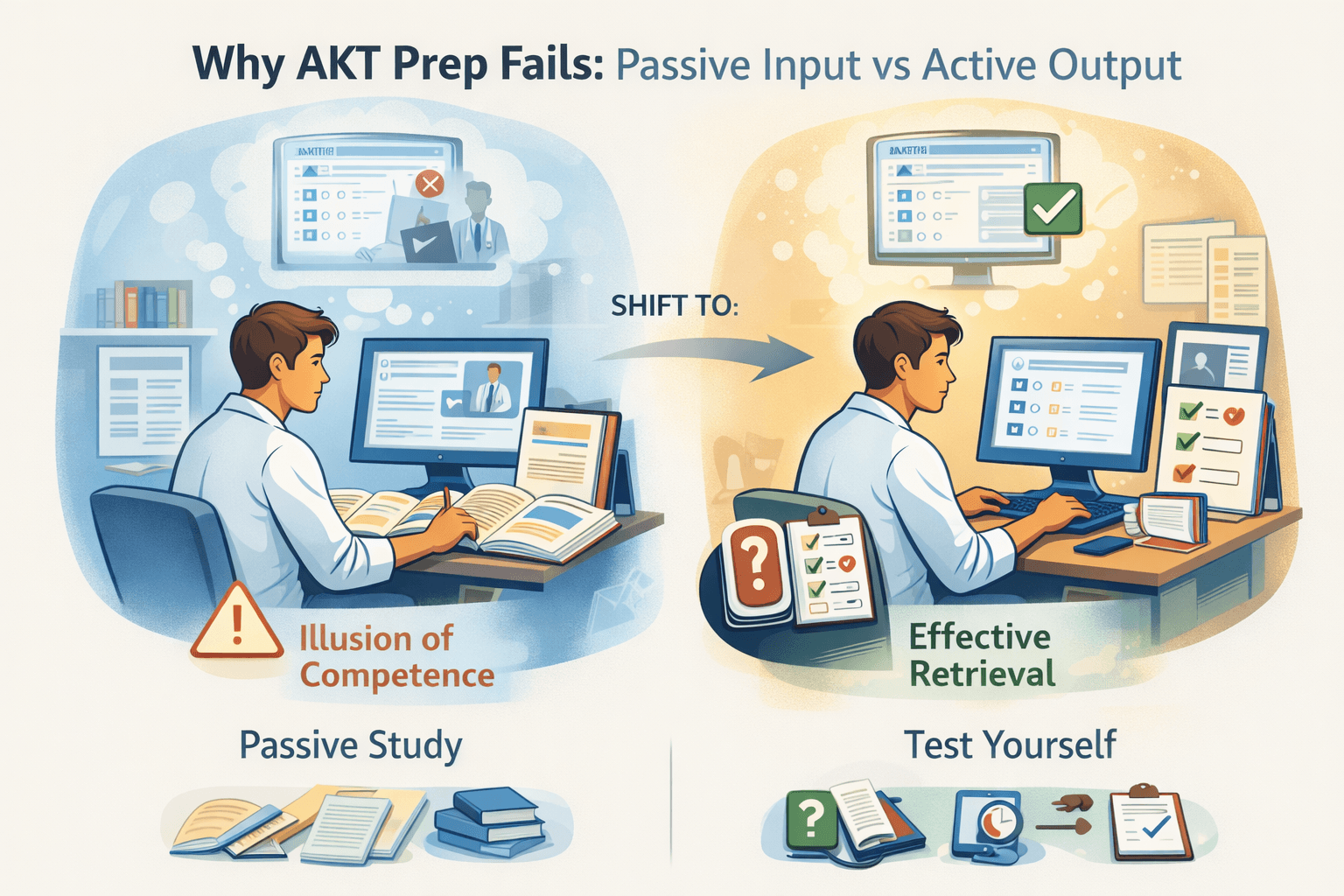
Why AKT prep fails (and how to fix it)
The most common reason for failure in the UKMLA AKT isn't a lack of knowledge; it's a lack of effective retrieval. Many students spend hours highlighting notes, re-watching lectures, or passively reading textbook chapters. This creates the "illusion of competence"—you recognise the material when you see it, but you cannot recall it under pressure.
The fix is to shift from passive input to active output. You must test yourself before you feel ready.
The evidence
This isn't just study advice; it's science. A systematic review published in BMC Medical Education confirmed that retrieval practice (testing yourself) and distributed practice (spaced repetition) are two of the most effective learning strategies for health professions education. They consistently lead to better exam outcomes and long-term retention compared to massed practice ("cramming") or re-reading (PMC).
A 6-week AKT plan
This plan is designed for high-yield efficiency. It assumes you are working around clinical placements.
Daily Routine (Mon-Fri)
- Volume: 40–80 questions per day.
- Method: Do them in timed, random blocks of 20. Do not use "tutor mode" (seeing the answer immediately) for every block; you need to practice retrieval without prompts.
- The "Golden Hour": Spend the last 30 minutes of your study session exclusively on your Error Log and Spaced Repetition queue.
Weekly Routine (Weekend)
- The Mock: Sit one timed, 100-question block under strict exam conditions (no phone, no breaks).
- Forensic Review: Spend 2 hours reviewing that mock. Analysing why you got a question wrong is more valuable than getting it right.
Error log method (the “why you got it wrong” taxonomy)
Don't just read the explanation and move on. Categorise every mistake in a spreadsheet or notebook to identify your "failure mode":
- Knowledge Gap: "I simply didn't know that fact." (Action: Add to Anki/iatroX).
- Misread: "I missed the word 'chronic' in the stem." (Action: Slow down).
- Time Pressure: "I guessed because I ran out of time." (Action: Drills).
- Distractor Trap: "I picked the second-best answer because I didn't spot the contraindication." (Action: Review the guideline).
Spaced repetition implementation
You cannot review everything. You must be ruthless.
- Resurface: High-yield facts, first-line management steps (NICE CKS), and "red flag" criteria.
- Drop: Niche pathophysiology or low-yield histology that rarely appears.
- The Rule: If you get a card right three times in a row with "Easy" confidence, suspend it. Focus your cognitive load on the material you are struggling to retain.
Best resource stack
The most efficient students use a simple rule: "One primary Q-bank + one retention engine."
- Primary Q-Bank: Choose one major bank (Passmedicine, Quesmed, or BMJ OnExamination) for your bulk question practice.
- Retention Engine: Use a dedicated tool to manage your spaced repetition. Don't rely on the Q-bank's "reset" function alone, as it lacks true adaptive scheduling.
iatroX placement
iatroX is designed to be your retention engine.
- Weakness Discovery: Use the Adaptive Quiz mode to identify the specific MLA content map domains where you are weak.
- Automated Spacing: Instead of manually scheduling reviews, iatroX's spaced repetition algorithm automatically resurfaces the questions and concepts you struggle with at the optimal interval for memory consolidation.
- Cost: It is free to use, making it the perfect partner to your paid Q-bank subscription.
FAQs
How many questions per day? Quality beats quantity, but aim for 40-80 questions. If you are just clicking through without reading explanations, 100 questions is worthless. If you are deep-diving into 40 questions and logging errors, that is high-yield.
When to start mocks? Start immediately. Do a baseline mock in Week 1. Do not wait until you "feel ready." The mock tells you what you need to study.