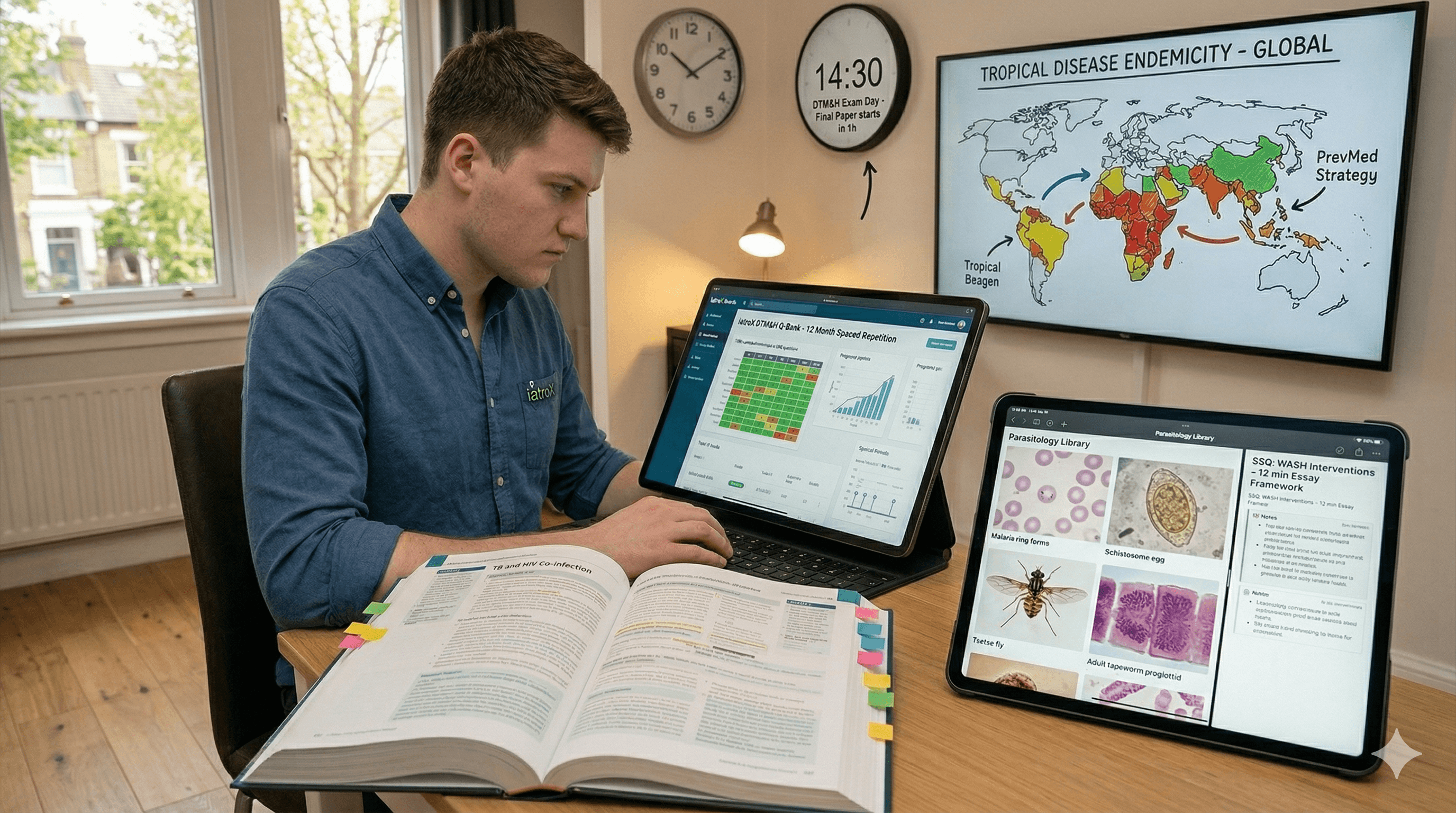
The DTM&H exam is sat once per year — usually in late May. Most candidates have been studying for 3-6 months before that date, either through a full-time course (LSHTM, LSTM) or a part-time course (Glasgow, Sheffield, MSF). The exam covers four papers in a single day, testing clinical tropical medicine, parasitology, and preventive medicine.
The candidates who pass are those who integrate revision into their course from the beginning, not those who cram in the final weeks.
Phase 1: Active Learning During Your Course (Months 1-4)
Start Q-bank practice from day one. Begin the iatroX DTM&H Q-Bank with 15-20 questions daily from the first week of your course. This serves two purposes: it tests your understanding of lecture content in real time (identifying gaps immediately rather than months later), and it starts the spaced repetition cycle — so material from month 1 is automatically reviewed throughout months 2-6.
Build a parasitology image library. During every microscopy session, study each slide carefully. Note the distinguishing features. Photograph slides if permitted. By the end of your course's parasitology teaching, you should be able to identify the 30-40 highest-yield organisms from morphology alone.
Take structured notes on preventive medicine topics. The SSQ paper requires you to write structured essays. As your course covers public health, WASH, epidemiology, and health systems topics, create concise summary notes that you can use as essay frameworks during revision.
Use Ask iatroX for clinical queries. When a lecture covers a tropical disease and you are unsure about the management pathway, verify it immediately. Building this habit during the course means you arrive at revision with a solid, verified knowledge base rather than vague recollections that need checking.
Phase 2: Intensive Revision (Month 5 — April/May)
Increase Q-bank volume. Move to 30-50 iatroX DTM&H Q-Bank questions daily. The adaptive algorithm is now working with several months of performance data and will precisely target your weakest areas.
Practise SSQ essays under timed conditions. Write 5 practice essays per week, 12 minutes each. Choose from past paper topics or generate your own from the curriculum areas: WASH interventions, immunisation programme design, malaria control strategy, NCD burden in tropical settings, maternal health in resource-limited settings, epidemiological study design. Structure every answer: define the issue, outline the key evidence, discuss the interventions, and conclude with the current challenges or future directions.
Intensive parasitology review. Work through image-based identification daily. Use the iatroX Q-Bank parasitology questions alongside your course microscopy resources and online image databases (CDC DPDx).
Review FPHC-equivalent key topics. Malaria (all species, diagnosis, treatment — including severe malaria management), TB (diagnosis, treatment including MDR-TB), HIV (diagnosis, ART, opportunistic infections), NTDs (schistosomiasis, filariasis, leishmaniasis, trypanosomiasis, helminth infections), diarrhoeal diseases (cholera, typhoid, amoebic dysentery), and vector-borne diseases (dengue, chikungunya, Zika, yellow fever).
Phase 3: Final Week
Light revision only. Review your summary notes, key drug treatments, and high-yield parasitology images. Do 15-20 Q-bank questions daily to maintain the spaced repetition streak without adding cognitive load.
Prepare your exam environment. The exam is online with remote invigilation. Test your computer, webcam, microphone, and internet connection. Set up a quiet, private room. Ensure you have water, snacks (for breaks between papers), and a clock.
Rest. The exam is an entire day (09:30-17:30 GMT). You need energy and concentration for four papers. Sleep well the night before.
Paper-Specific Tips
MCQ papers: One minute per question. Do not agonise — select your best answer and move on. Flag uncertain questions for review if time permits. No negative marking.
SSQ paper (preventive medicine): Read all 10 questions before choosing your 5. Select the 5 you can answer most completely — not the 5 that look easiest at first glance. Structure every answer. Write concisely — quality over quantity in 12 minutes per question.
SAQ paper (parasitology): Less than 2 minutes per image. Quick identification, short structured answer, move on. If you cannot identify an organism, describe what you see (size, shape, features) — partial marks are available for accurate morphological description even without correct identification.