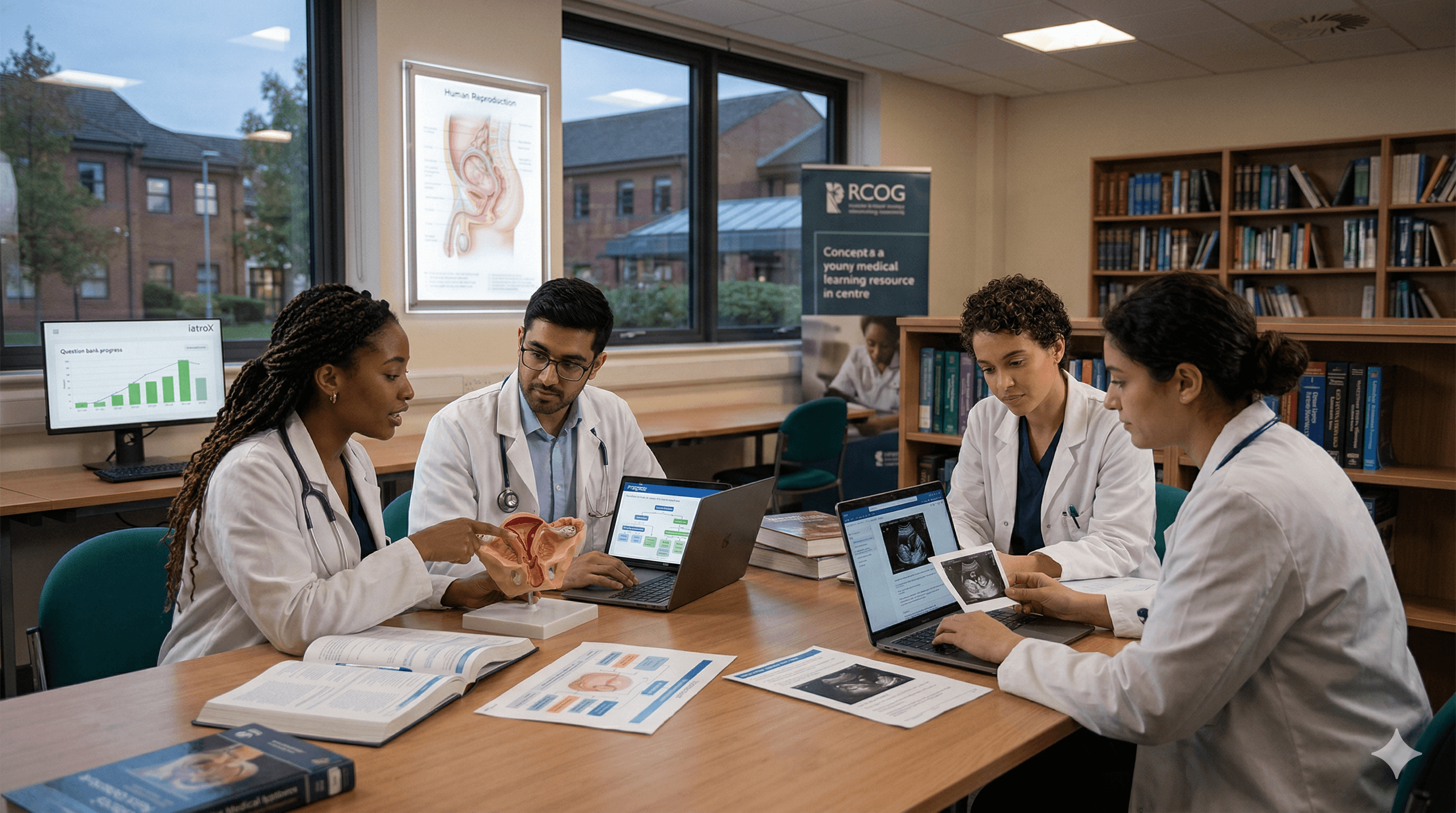
The Diploma of the Royal College of Obstetricians and Gynaecologists is the most popular postgraduate women's health qualification among GP trainees. It demonstrates knowledge and clinical decision-making across obstetrics, gynaecology, and sexual and reproductive health — and it is increasingly valued by practices, patients, and appraisers.
The exam is achievable first time with structured preparation. This guide covers everything you need.
The Format
120 single best answer questions. Each worth 2 marks. 3 hours. Computer-based at Pearson VUE test centres across the UK and Ireland. The pass mark is standard-set using a modified Angoff method — meaning it varies by exam difficulty, and there is no fixed percentage or quota.
The exam is held twice yearly — March and October. Fee: approximately £476. Book through your RCOG account.
The Seven Syllabus Modules
Module 1: Fertility regulation and sexual health. Contraception (all methods, UKMEC), STIs, cervical screening, HPV vaccination, sexual assault management.
Module 2: Unplanned pregnancy. Options counselling, abortion (medical and surgical methods, legal framework), ectopic pregnancy, gestational trophoblastic disease.
Module 3: Antenatal care. Booking, screening (Down's, anomaly scan), gestational diabetes, pre-eclampsia, antenatal infections, rhesus disease, fetal growth, mental health in pregnancy.
Module 4: Labour and delivery. Normal labour, monitoring (CTG interpretation), induction, operative delivery (ventouse, forceps), caesarean section, shoulder dystocia, cord prolapse, PPH.
Module 5: Postpartum period. Postnatal care, breastfeeding, postnatal depression, VTE prophylaxis, contraception postpartum.
Module 6: Gynaecological presentations. Abnormal uterine bleeding, fibroids, endometriosis, ovarian pathology, pelvic organ prolapse, urinary incontinence, menopause, infertility.
Module 7: Early pregnancy complications. Miscarriage (including recurrent), ectopic pregnancy, hyperemesis gravidarum, pregnancy of unknown location.
The Key Guidelines
The DRCOG is a guideline-based exam. The questions are built from specific UK guidelines, and knowing those guidelines is the most direct path to the correct answers.
RCOG Green Top Guidelines: These are the highest-yield resource. Prioritise: GTG 52 (PPH), GTG 26 (operative vaginal delivery), GTG 37a/b (reducing risk of VTE), GTG 63 (antepartum haemorrhage), GTG 22 (breech presentation), GTG 17 (ectopic pregnancy), GTG 54 (induction of labour), and any recently updated Green Tops.
NICE guidelines: Antenatal care (NG201), intrapartum care (NG235), postnatal care (NG194), hypertension in pregnancy (NG133), diabetes in pregnancy (NG3), ectopic pregnancy and miscarriage (NG126).
FSRH guidelines: UKMEC summary table, emergency contraception, quick-starting contraception, contraceptive method-specific guidelines.
BASHH guidelines: STI management (chlamydia, gonorrhoea, syphilis, genital herpes, PID).
Ask iatroX provides instant reference for all of these guidelines — NICE, RCOG, FSRH, and BASHH — with citations. When a Q-bank question references a guideline you have not read, you can access the key recommendation in seconds.
How to Prepare
Primary Q-bank: iatroX DRCOG Q-Bank provides 600+ curriculum-mapped questions with adaptive spaced repetition — free to access through a single iatroX Boards subscription that includes multiple specialty Q-banks. PassMedicine (1,000+ questions, approximately £30-50) provides additional volume with peer comparison.
Supplementary: RCOG's own revision resource (140 SBAs), BMJ OnExamination (if BMA member — free), and the DRCOG Revision Guide by Susan Ward.
Guideline reading: Allocate time to read the Green Top Guidelines listed above. The exam tests specific recommendations from these guidelines — not just the headlines but the details in the full text.
RCOG revision course: One-day course (approximately £201). Covers key syllabus content with practice questions and a mock paper. Useful but not essential if you are preparing systematically with Q-banks and guidelines.
Clinical reference: Ask iatroX during your O&G placement and throughout your preparation. Every clinical encounter in women's health reinforces DRCOG content — and instant guideline verification ensures you learn the current recommendation, not an outdated one.
The Study Approach
Start Q-bank practice 3-4 months before the exam. Target 1,500-2,000+ questions across all sources. Read the high-yield Green Top Guidelines during months 2-3. Complete 2-3 full timed mock exams (120 questions, 3 hours) in the final month. Use the adaptive spaced repetition in iatroX to target weaknesses automatically.
The DRCOG is achievable. Structured preparation with the right resources, sufficient question volume, and guideline-aligned knowledge produces first-time passes. Start today.