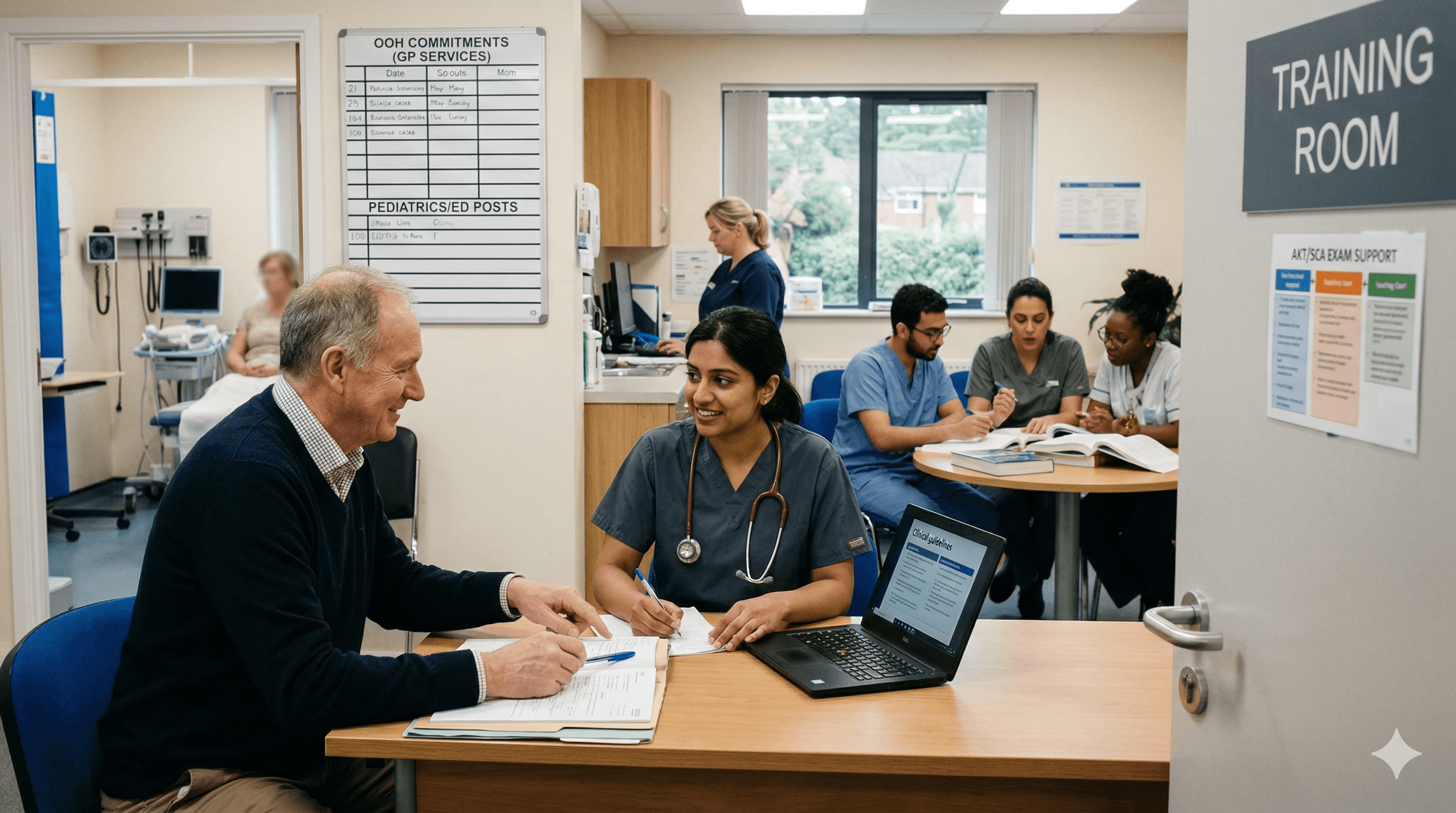
When ranking GP training programmes, most applicants start with geography — understandably, because where you live for three years matters. But geography alone is a weak predictor of training quality. The programme that's five miles from your family but has poor exam support, difficult OOH requirements, and unsupportive supervisors will make you miserable regardless of the commute.
Here are the factors that experienced GP trainees say actually matter.
Training practice quality
This is the single most important factor. Your final year (ST3) is spent primarily in your training practice, and the quality of that experience determines both your exam outcomes and your early confidence as a qualified GP.
Ask about: appointment length (10 vs 15 minutes — this affects your learning), protected tutorial time (weekly dedicated educational sessions with your trainer), patient case-mix (complexity and variety), and whether the practice has a track record of trainees passing exams at first attempt. The deanery can provide exam pass rates by training practice — ask for them.
Red flags: Training practices that use registrars primarily for service provision (seeing a full patient list from day one with minimal supervision), trainers who are too busy to do regular tutorials, and practices with high trainee turnover.
Hospital posts
GP training includes 18 months in hospital posts (typically in ST1 and ST2). The quality of these posts varies enormously.
Valuable hospital posts: Emergency medicine (develops acute assessment skills), paediatrics (essential for GP), psychiatry (increasingly relevant), and obstetrics/gynaecology. Posts where you're supernumerary or have protected teaching time are better than those where you're essentially a service-grade SHO.
Less useful hospital posts: Highly subspecialised posts where the clinical exposure doesn't translate to general practice (e.g., tertiary oncology, cardiac surgery). Some programmes offer more flexibility in choosing hospital posts than others — ask about this.
Exam support
MRCGP pass rates vary significantly between programmes and deaneries. The AKT and SCA (formerly CSA) are challenging exams, and the support your programme provides makes a measurable difference.
Ask about: AKT teaching sessions, SCA practice groups, mock exams, and whether the programme pays for or subsidises exam preparation courses. Some programmes run dedicated SCA practice clinics with actors — these are invaluable.
Out-of-hours requirements
OOH commitments during GP training vary by programme. Some require extensive OOH during ST3 (nights and weekends in urgent care or OOH GP services). Others have minimal OOH requirements.
Ask about: frequency of OOH shifts in ST3, whether OOH is in a GP OOH service or a hospital, and whether OOH counts toward your training time or is additional to your normal sessions. Excessive OOH disrupts study time and wellbeing — particularly in the run-up to AKT/SCA.
The training programme director (TPD)
A good TPD fights for their trainees — advocating for reasonable rotas, resolving training practice issues, and providing pastoral support when things go wrong. A poor TPD treats the role as administrative. You can't easily assess this before joining, but speaking to current trainees gives a strong signal.
How to find out
Talk to current trainees. Not at open days (where everyone's on best behaviour), but informally. Medical forums, social media, and RCGP trainee groups are good places to find honest opinions. The question to ask: "If you were choosing again, would you pick this programme?"
Check deanery performance data. Some deaneries publish MRCGP pass rates, trainee satisfaction scores, and quality metrics. These are the most objective data available.
Visit. If you can, visit the area and ideally the training practice before committing. The investment of a day trip is small compared to three years in the wrong programme.
iatroX supports GP trainees with AI clinical search covering NICE/CKS guidelines and a UK qbank for AKT preparation. Built by a GP who's been through the training pathway.