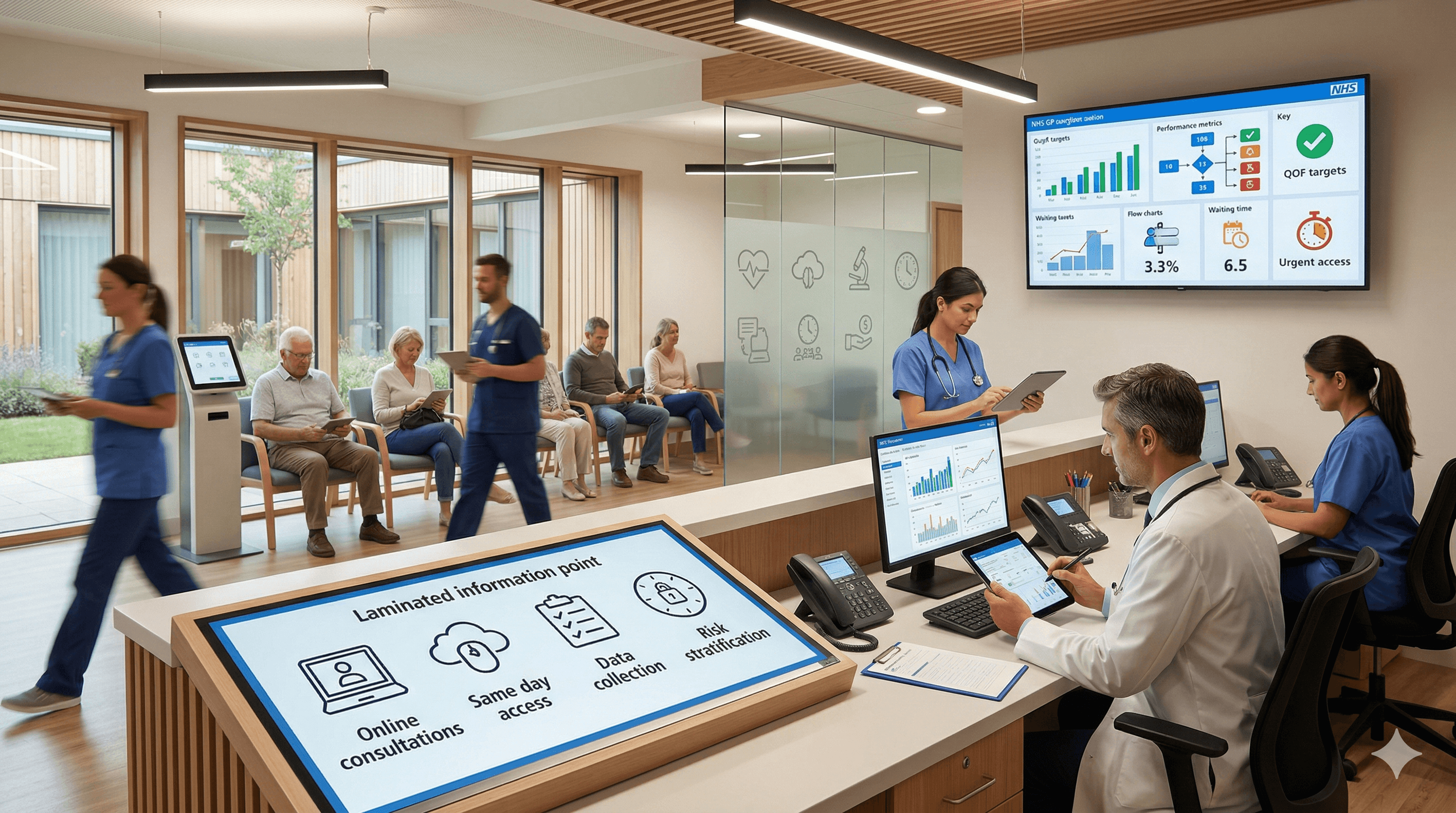
The 2026/27 GP contract introduces operational requirements that are difficult to meet with traditional workflows alone. Same-day urgent access for all clinically urgent patients. Risk stratification using digital tools. QOF indicators aligned to current NICE guidance. Data collection across five access metrics. Online consultation access throughout core hours.
Each of these creates workload. AI tools can reduce some of that workload — not by replacing clinical judgement, but by handling the retrieval, preparation, and documentation that surrounds it.
Risk Stratification
The contract requires PCNs to use digital risk stratification tools to identify patients who would benefit most from continuity of care. Risk stratification is inherently data-driven and is one of the most natural applications for AI in primary care. The tools that perform this — embedded within EMIS, SystmOne, or provided by third parties like Eclipse or QAdmissions — use algorithmic analysis to flag high-risk patients who might otherwise be identified only when they present in crisis.
Once a high-risk patient is identified, the clinical challenge is managing them effectively within a 10-minute consultation. These are typically the patients with four conditions and eight medications where the management decisions are the hardest. Ask iatroX provides instant guideline-grounded reference for exactly these patients — medication interactions, treatment thresholds, referral criteria, and care process requirements, all cited to the specific NICE recommendation.
Same-Day Urgent Access
Meeting the same-day requirement means having sufficient clinical capacity to see every urgent patient on the day they present. AI contributes at two points in this workflow.
At the triage stage, AI-powered triage within online consultation tools (like Rapid Health Smart Triage) can identify which requests are clinically urgent and which can safely wait — ensuring same-day slots are used for genuinely urgent needs. The independent evaluation at The Groves Medical Centre showed urgent same-day requests falling from 62% to 19% after Smart Triage deployment, meaning same-day capacity was preserved for patients who actually needed it.
At the documentation stage, AI ambient scribes (Heidi, TORTUS, Accurx Scribe) reduce documentation time per consultation by 2-3 minutes. Across a full clinic session, that translates to 2-3 additional patients seen — capacity that directly supports same-day access without extending the working day.
QOF Achievement
The 2026/27 QOF changes require explicit alignment with current NICE guidance. The diabetes indicator demands all 8 care processes. The heart failure indicator expects the four pillars. The obesity indicators require referral pathways and medicines optimisation.
iatroX provides the guideline verification layer. When you are reviewing a heart failure patient and need to confirm the four pillars, Ask iatroX gives you the NICE NG106 answer with a citation in seconds. When you are assessing whether a patient qualifies for GLP-1 prescribing, it provides the NICE criteria instantly. This is faster than navigating CKS manually and ensures your clinical approach generates the QOF achievement it should.
The Q-Bank helps clinicians maintain their knowledge across the QOF domains through spaced repetition — ensuring the clinical knowledge underpinning QOF achievement is current and durable.
Data Collection and Online Access
The contract's data collection requirements need cloud-based telephony and systematic recording of consultation outcomes. This is infrastructure rather than clinical AI. But the platforms that aggregate and report this data increasingly use AI for pattern detection and performance analysis.
Online consultation throughout core hours is mandatory. AI tools that process online requests — routing them to appropriate clinicians, summarising patient-submitted information, and flagging urgency — reduce the administrative burden that unlimited online access creates.
The Practical Stack for the 2026/27 Contract
Clinical reference and QOF support: iatroX. Free. Ambient documentation: Heidi, TORTUS, or Accurx Scribe. Online consultation and triage: Rapid Health Smart Triage, Accurx, eConsult, or Anima. Risk stratification: Embedded in EMIS/SystmOne or via ICB-provided tools. Telephony: Cloud-based system with reporting capability. Prescribing reference: organisation-approved medicines-reference service; check local access and procurement.
Start with accessible tools. iatroX costs nothing and can be paired with NICE CKS, relevant SmPCs on eMC, and the medicines-reference services available through your organisation.