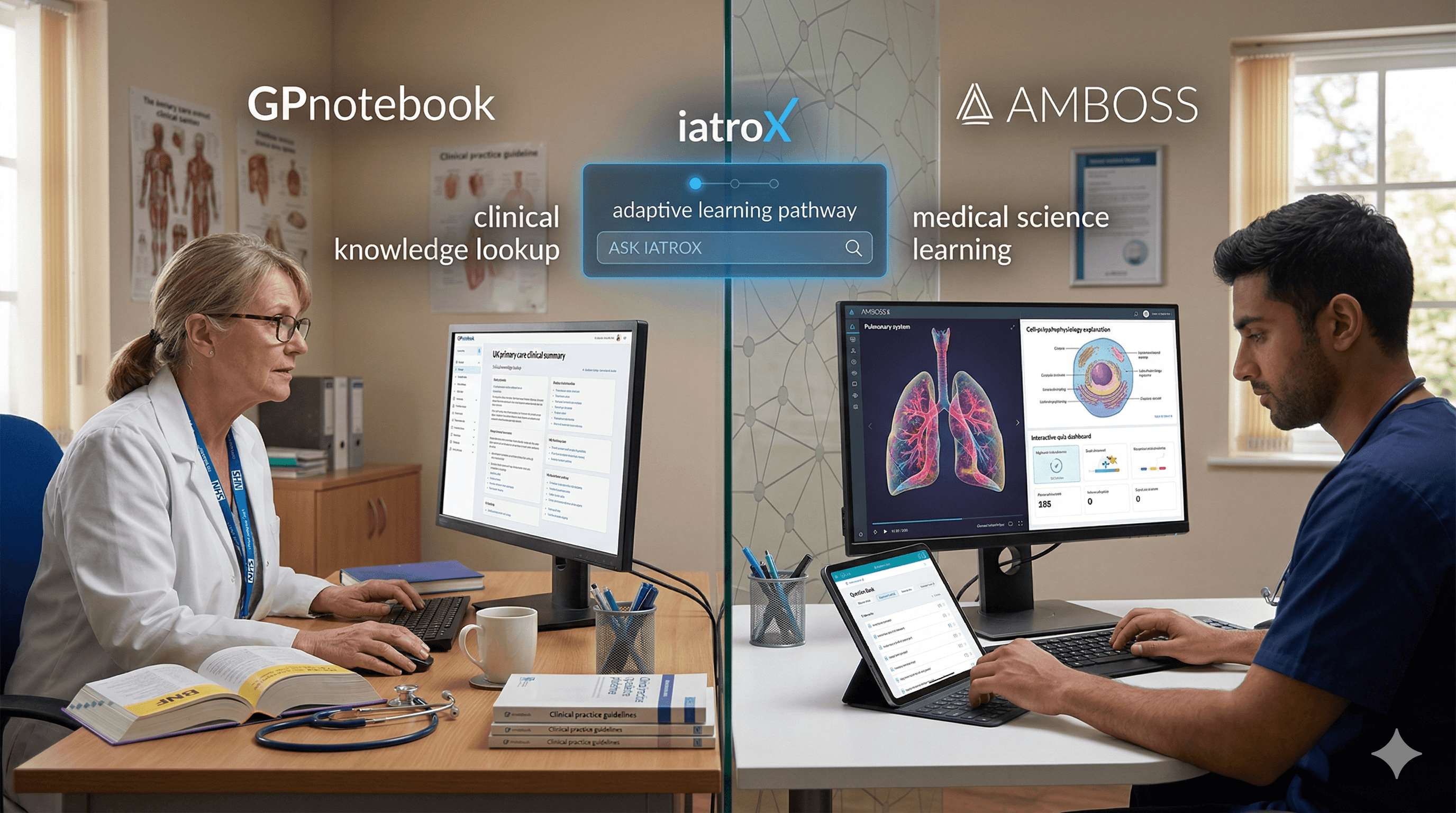
GPnotebook and AMBOSS serve different audiences — and understanding the difference prevents you from using the wrong tool for the wrong purpose.
GPnotebook is a UK primary care reference — 30,000+ pages written by practising GPs, structured for quick lookup during 10-minute consultations. The content naturally references NICE, CKS, and current UK medicines information. Education modules (GEMs), quizzes, and podcasts add learning dimensions. Free tier available; Pro at £7.99/month.
AMBOSS is a global medical knowledge platform — a searchable library with integrated Q-bank, strong in pathophysiology, pharmacology, and hospital-based medicine. The content is internationally oriented. Subscription-based.
For GP Trainees
GPnotebook wins on UK-specificity. The pages reference NICE guidelines, UK prescribing conventions, and NHS-contextualised management pathways naturally — because they are written by UK GPs for UK GPs. During a consultation when you need a quick answer to a primary care question, GPnotebook provides it in UK clinical language.
AMBOSS wins on medical science depth. When you encounter a condition you have not thought about since medical school — sarcoidosis, Wilson's disease, phaeochromocytoma — and need to rebuild your understanding of the pathophysiology, AMBOSS provides deeper, more visual explanations than GPnotebook's concise pages. The integrated Q-bank adds a testing dimension that GPnotebook's reference-only format does not offer.
The MRCGP AKT Dimension
For the AKT, neither is a primary revision tool. GPnotebook does not provide AKT-format questions, adaptive learning, or curriculum mapping. AMBOSS does not cover AKT organisational or EBP domains and is not mapped to the RCGP curriculum.
GPnotebook's GEMs and quizzes provide some learning value for AKT preparation. AMBOSS's Q-bank covers clinical medicine broadly. Neither replaces a dedicated AKT Q-bank.
Where iatroX Fits
GPnotebook covers GP breadth. AMBOSS covers medical depth. iatroX bridges both — UK-specific, guideline-grounded, with adaptive revision mapped to RCGP curricula and citation-first clinical Q&A.