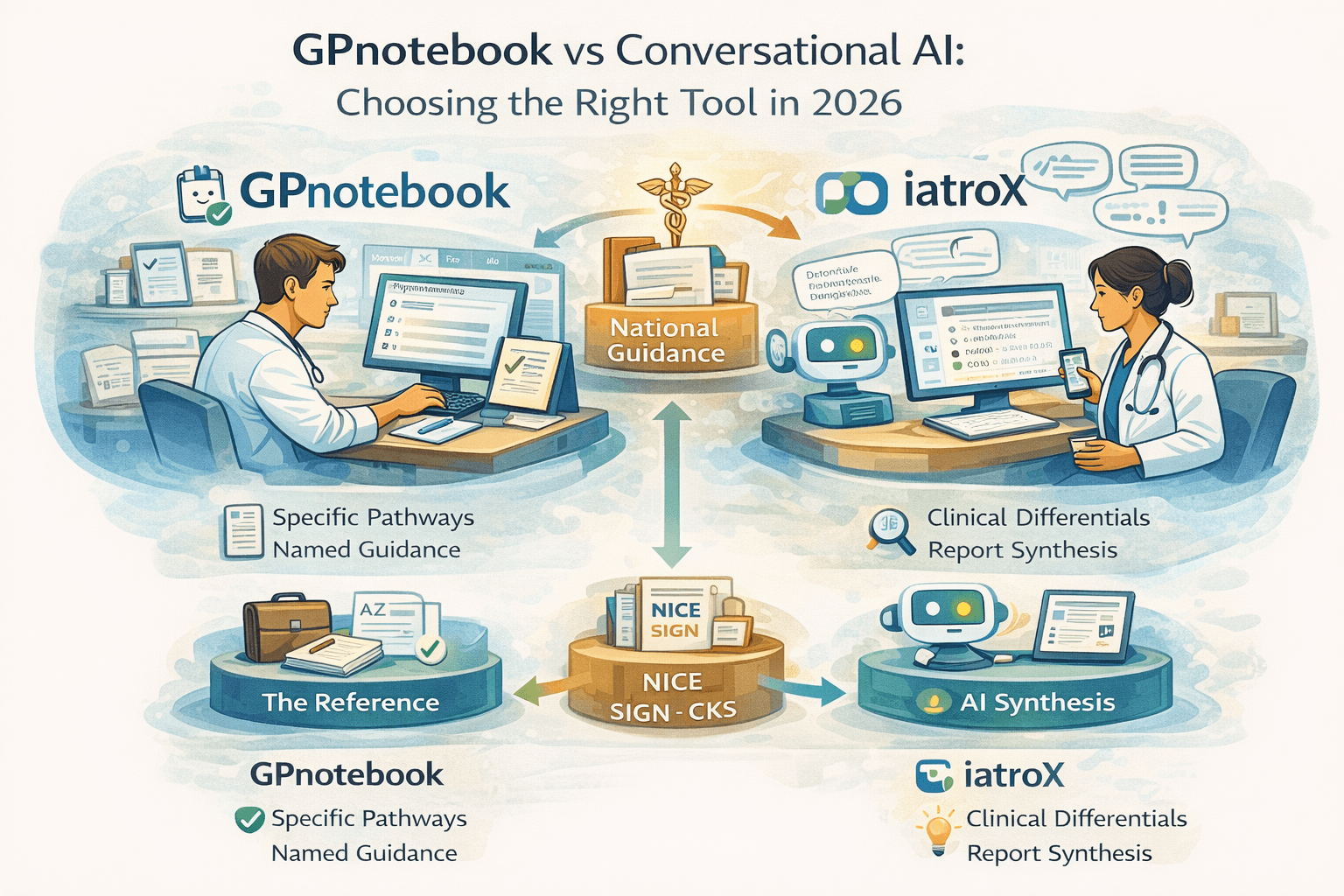
Updated July 2026 following the launch of GPnotebook AI Answers. The original version of this guide contrasted GPnotebook as a static reference against AI clinical search as a separate category. That framing is now obsolete in the best possible way: GPnotebook is itself part of the clinical AI category, offering structured natural-language answers built primarily on its clinician-authored library. What UK clinicians need in 2026 is not a static-versus-AI decision but a map of three different AI models and a workflow for using them safely.
The three models of clinical AI search
The category has resolved into three architectures, distinguished by what they retrieve from.
Publisher-grounded AI synthesises a curated internal library. GPnotebook AI Answers is the UK primary-care example: answers drawn primarily from its 35,000+ GP-authored articles, supplemented where needed by authoritative sources such as NICE, with links back to the supporting pages and automatic CPD capture for Pro subscribers. Internationally, AMBOSS AI Mode Clinical Care and UpToDate Expert AI follow the same pattern over their own libraries. These tools are strongest where their library is strongest: for GPnotebook, familiar primary-care questions answered in familiar language.
National-guideline-grounded AI retrieves from the guidance layer itself. iatroX works this way: Ask iatroX searches NICE, CKS, SmPC/eMC, MHRA, SIGN and NHS content and returns citation-led answers whose links land on the canonical sources. This model is strongest for jurisdiction-critical questions, exact thresholds, referral criteria, dosing wording, where verification distance matters most.
Broad literature-grounded AI synthesises the research corpus. OpenEvidence defined this model before withdrawing from the UK and EU in April 2026; Vera Health is a currently accessible example. These tools are strongest for emerging evidence and specialist uncertainty, and weakest on UK pathway specificity, which they were never designed to encode.
What each retrieves, and where each performs best
The retrieval target is the product. A publisher-grounded tool tells you what its curated pages say. A guideline-grounded tool tells you what the national sources indicate. A literature-grounded tool tells you what the research suggests. All three can be accurate; they are accurate about different layers of the evidence stack, and the failure mode in practice is asking one layer a question that belongs to another.
The revised open-first decision tree
For a familiar, concise topic where you want the authored page, open the GPnotebook page directly; deterministic retrieval of a known destination remains unbeatable. For a question that spans several GPnotebook topics, a drug switch, an uncommon presentation, a referral question whose page you cannot name, use GPnotebook AI Answers; that is exactly what the synthesis layer is for. For a direct UK guideline question, an exact criterion, or synthesis across national sources and medicines references, use iatroX, because its citations land where your verification needs to happen. For emerging international evidence or a research-flavoured question, use a literature-grounded platform, then translate any conclusion back into UK guidance before acting on it. And for any high-risk decision, two-week-wait thresholds, pregnancy prescribing, renal dosing, go to the canonical source and senior clinical judgement; no summary of any architecture is the final word.
The verification protocol, adapted
The original protocol in this guide survives with one crucial upgrade: distinguish links to secondary summaries from links to original guidance. Scan the answer against your clinical intuition. Check what the citations actually are: a link to a GPnotebook article is a link to an excellent summary, and a link to NICE or an SmPC is a link to the recommendation itself; treat the first as one verification step from done and the second as the destination. Click through rather than trusting the preview. Verify the date and jurisdiction of the underlying source. Check population context, adult versus paediatric, pregnancy, renal function. Document the underlying guideline in the record, not the tool that surfaced it. And keep the final decision human; every tool in this stack is retrieval and synthesis, not judgement.
Where iatroX fits in the 2026 stack
iatroX occupies the guideline-grounded layer deliberately. Its trust proposition is architectural: retrieval restricted to the UK guidance corpus, citation-aware synthesis, fidelity controls with fail-safe behaviour, and UKCA marking with MHRA Class I registration for the clinical decision-support tool. In the combined workflow it is the tool you open when the question is a UK pathway question and the answer must be anchored to the source, sitting comfortably alongside GPnotebook's curated explanation layer and a literature engine for the research edge cases.
The combined workflow, in one line
Orient with the AI layer that matches your question's type, read the curated summary when structure helps, and confirm anything high-stakes at the canonical source before it touches a patient. GPnotebook joining the AI category has not complicated that workflow; it has strengthened the middle of it, and UK clinicians are better served in 2026 than they were a year ago.