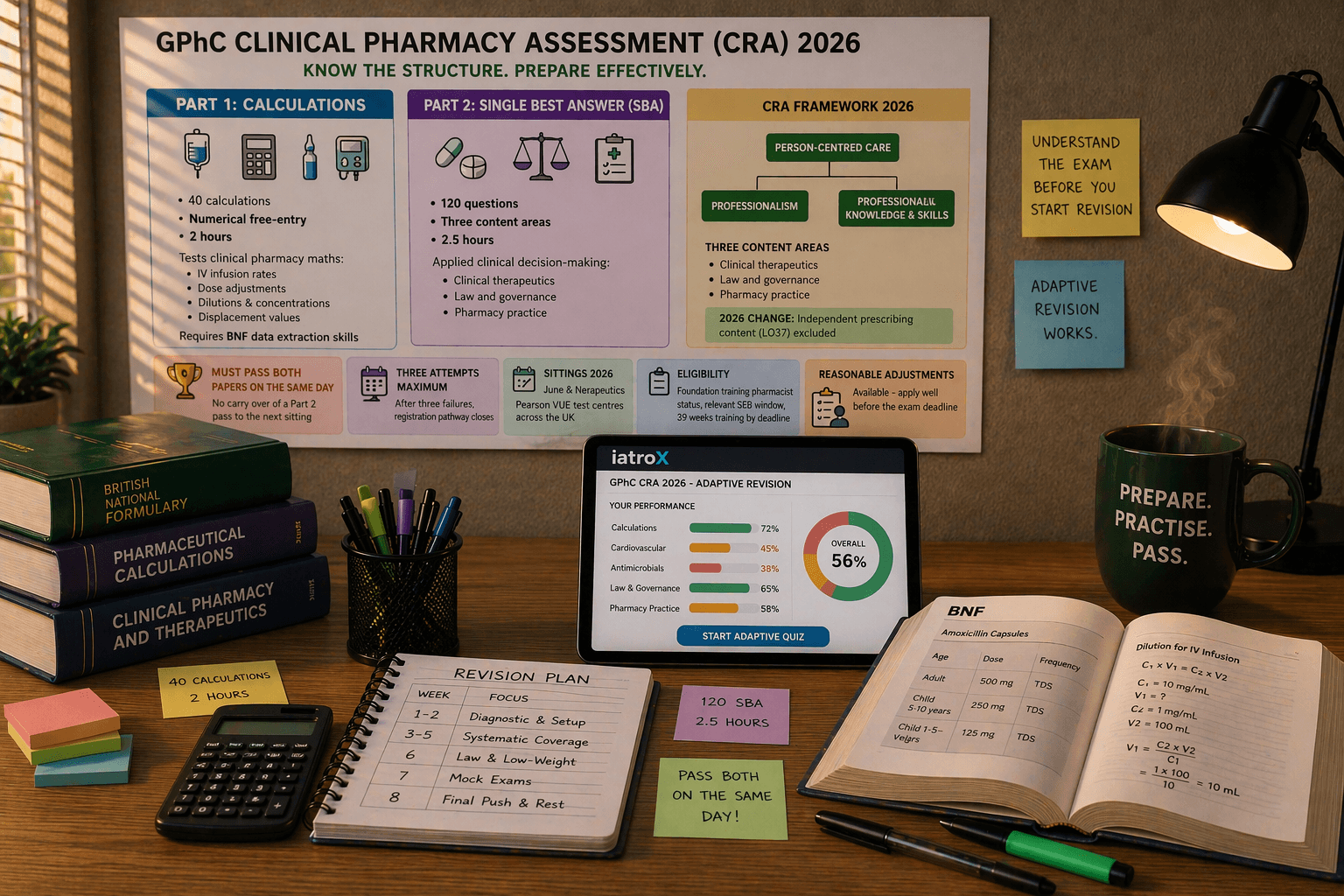
Understanding the exam structure before starting revision ensures you prepare for what is actually tested.
Part 1: 40 calculations, numerical free-entry (not MCQ), 2 hours. Tests clinical pharmacy maths — IV infusion rates, dose adjustments, dilutions, concentrations, displacement values. Requires BNF data extraction skills.
Part 2: 120 SBA questions, three content areas, 2.5 hours. Clinical therapeutics, law and governance, pharmacy practice. Applied clinical decision-making — not factual recall.
Must pass both on the same day. No carrying over a Part 2 pass to the next sitting.
CRA framework 2026: Three domains (person-centred care, professionalism, professional knowledge and skills) across three content areas. The 2026 change: independent prescribing content (LO37) excluded to ensure fairness across training pathways.
Attempt limit: Three maximum. After three failures, the registration pathway closes.
Sittings: June and November (autumn) 2026. Pearson VUE test centres across the UK. Computer-based.
Eligibility: Foundation training pharmacist status, relevant SEB training window, 39 weeks training by deadline.
Reasonable adjustments: Available — apply well before the exam deadline.
iatroX's GPhC Q-bank is mapped to the 2026 CRA framework across all three content areas — adaptive revision matching the exam structure.