Introduction
For Physician Associates (PAs), Advanced Nurse Practitioners (ANPs), and Advanced Clinical Practitioners (ACPs) working in UK General Practice, finding the "right" answer is rarely simple. You are often caught between a national NICE guideline, a concise CKS summary, a restrictive local formulary, and perhaps a conflicting specialist letter citing European guidance.
Navigating this is a core professional skill, not just an administrative task. This guide provides a practical evidence toolkit for the modern multidisciplinary team, explaining the hierarchy of UK guidance, how to handle conflicts between local and national advice, and how AI tools like iatroX can help you collate the evidence safely.
Why guideline navigation is a skill (not just “reading”)
Clinical guidelines are not instructions; they are recommendations based on evidence at a specific point in time. "Navigation" means understanding the intent and scope of the document.
- Scope: Is this for secondary care or primary care?
- Status: Is it a legal mandate (NICE TA) or a best-practice suggestion?
- Currency: Has it been superseded by a local safety alert?
UK-first: NICE and CKS roles
Understanding the difference between these two is critical for safe practice.
NICE Guidelines (NG/CG)
These are the comprehensive, evidence-based recommendations for health and social care in England and Wales.
- Role: They set the "Gold Standard." They explain the evidence base, the cost-effectiveness, and the full care pathway.
- When to use: When you have a complex patient, when treatment has failed, or when you need to understand the "why" behind a decision (GMC UK).
NICE Clinical Knowledge Summaries (CKS)
These are practical summaries of the evidence, specifically commissioned for primary care.
- Role: They provide the "What to do now." They operationalise the full guideline into steps: "History," "Assessment," "Management," "Referral."
- When to use: For the vast majority of routine consultations. If CKS says "refer," and you don't, you need a very good documented reason.
Local pathways and ARRS reality
For staff hired under the Additional Roles Reimbursement Scheme (ARRS), local pathways are often the operational reality.
- The Constraint: You might read a NICE guideline recommending a specific novel drug, but your local Integrated Care Board (ICB) formulary categorises it as "Amber" (specialist initiation only) or "Red" (hospital only).
- The Rule: You must follow local referral pathways and formularies. They take into account local commissioned services and safety agreements. If national guidance suggests a path that doesn't exist locally, you cannot follow it safely.
- The Action: Bookmark your local "Pathways" or "RefHelp" site. It is as important as the current UK medicines information.
When international guidance appears (ESC/US sources)
You will often see letters from consultants citing European Society of Cardiology (ESC) or US guidelines, which may be more aggressive than NICE.
- The Conflict: ESC might recommend a lower blood pressure target or earlier lipid lowering than NICE.
- How to Reconcile: As a primary care clinician in the UK, your medico-legal safety net is NICE. If a specialist asks you to prescribe outside of NICE guidance based on international evidence, they should generally retain responsibility for that decision or provide a clear shared-care protocol.
- The Exception: If the international guidance is widely accepted as the new standard (e.g., in rapidly moving fields like heart failure) and your local specialists have adopted it, you may follow it, but document "As per Cardiology advice/local protocol" clearly.
How iatroX helps
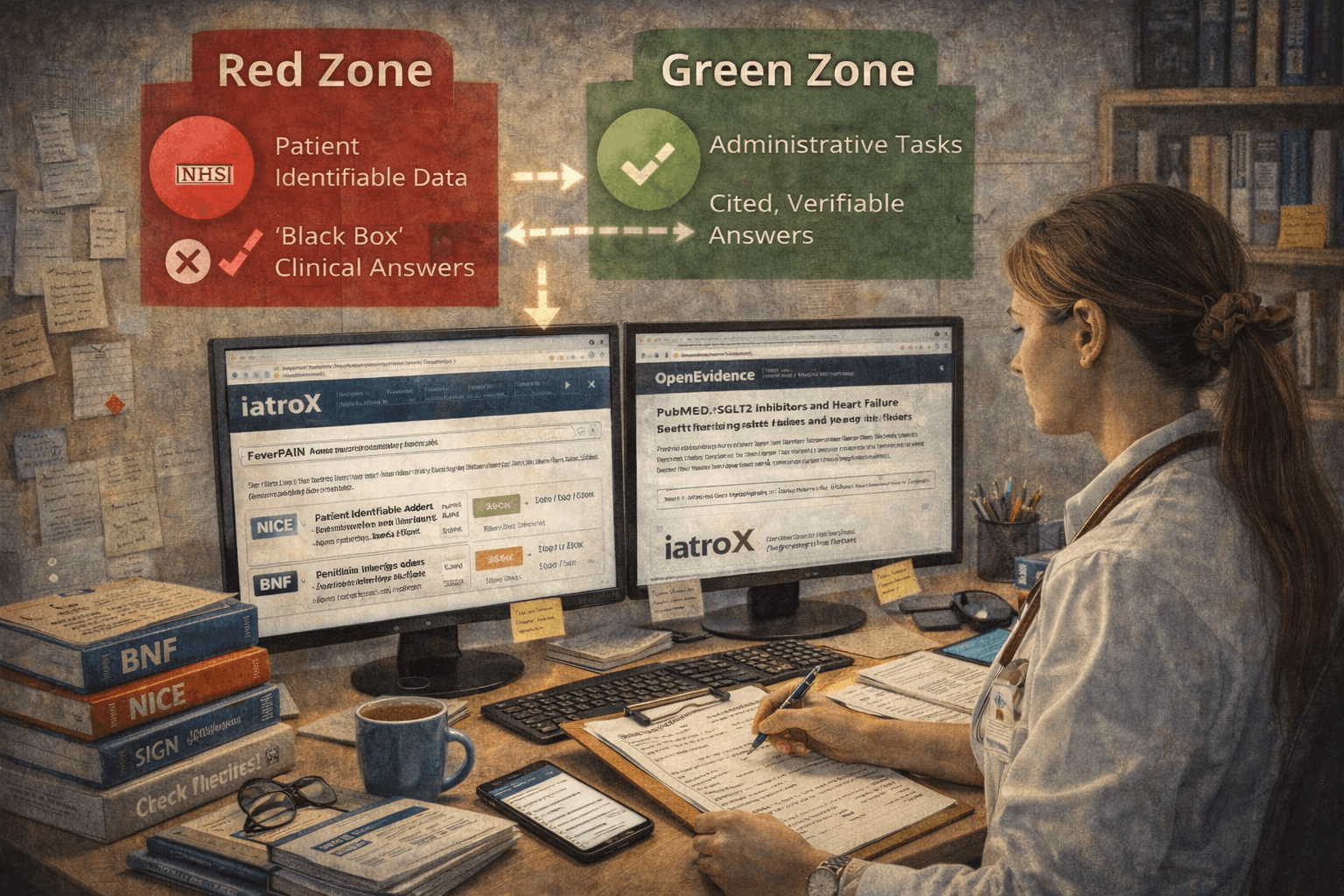
iatroX is designed to act as a collation layer for this complex ecosystem.
- UK Default: When you ask a question, iatroX prioritises the UK answer (NICE and CKS guidance, with medicines information from SmPCs via eMC).
- Conflict Awareness: If there is a divergence—for example, if a European guideline suggests a different approach—a good AI tool should surface this difference rather than blending it into a single generic answer.
- Citation Visibility: Crucially, iatroX keeps the citations visible. You can click to see if the advice comes from NICE NG123 or a Local Trust Policy, allowing you to weight the evidence appropriately for your patient.
FAQ
Can I rely on CKS alone? For most routine primary care, yes. It is a safe and accepted standard. For complex, multimorbid patients, you may need to consult the full NICE guideline or specialist advice.
What if the local formulary contradicts the current UK medicines information? The relevant SmPC on eMC defines the authorised particulars for a product. Applicable guidance and interaction resources support safe use, while the local formulary identifies what is funded and preferred locally. Follow the local formulary where appropriate, but do not override a contraindication, safety warning or patient-specific requirement.
Is it wrong to use US guidelines? It is not "wrong," but it is risky if it contradicts UK advice. The US healthcare system has different cost-benefit thresholds. Always check if the UK has a verified equivalent recommendation first.