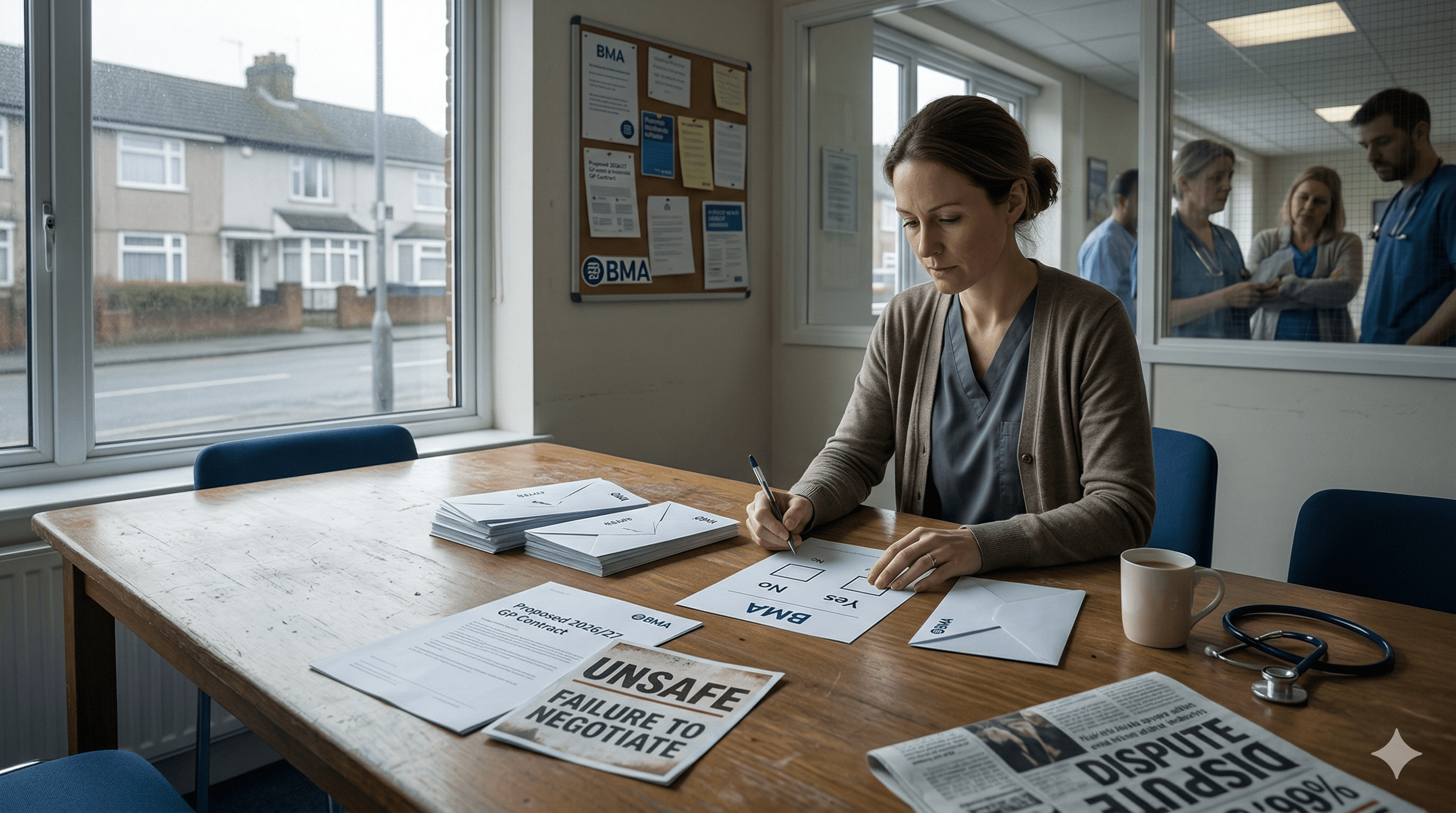
In March 2026, the BMA held a referendum on the 2026/27 GP contract. Over 55% of GP members voted — a strong turnout for a professional ballot. Of those who voted, 99% rejected it. This is the most decisive rejection of a GP contract in BMA history.
The contract is being imposed regardless.
Why GPC England Is in Dispute
GPC England entered dispute with the Government on October 1, 2025 — before the 2026/27 contract was even published. The dispute centres on three issues.
Unsafe contract changes from October 2025. The 2025/26 contract required practices to keep online consultation tools open throughout core hours and enable GP Connect for record access from October 2025. GPC England accepted this on the condition that safeguards would be in place — specifically, a technical solution to prevent urgent clinical requests being submitted through the route intended for routine queries. That technical solution was not delivered. The BMA and RCGP's Joint GP IT Committee concluded the system was "not yet safe." Similarly, GP Connect Update Record — allowing community pharmacists to write into GP records — was introduced without the safety assurances GPC England had been promised.
Failure to negotiate. GPC England expected bilateral negotiations toward a new substantive GMS contract. Instead, DHSC described the 2026/27 process as a "consultation" and widened it to include other stakeholders — RCGP, NHS Confederation, Healthwatch, NAPC, and others. The contract was then imposed without GPC England's agreement. This was the first time DHSC openly used the word "consultation" rather than "negotiation."
Resource restoration. Since 2015, general practice has lost over 6,000 GP partners (approximately 28%) and 25% of GMS contracts. The 2026/27 uplift of 1.4% real-terms does not restore the cumulative real-terms losses since 2019. The BMA argues that the profession is critically endangered and that the current funding trajectory is unsustainable.
What the 99% Rejection Means
The rejection is a mandate for GPC England to escalate pressure on the Government. It does not, on its own, change the contract terms. The contract is imposed and practices must comply with its requirements from April 2026.
GPC England is demanding an immediate return to direct bilateral negotiations for a new substantive GMS contract within this Parliament. The 99% vote strengthens that negotiating position significantly — it is very difficult for Government to claim the profession supports the direction of travel when virtually every GP who voted said no.
What Might Happen Next
GPC England may escalate collective action — potentially including guidance on safe working limits, restrictions on non-contractual work, or formal industrial action. The Government may agree to negotiate, particularly if patient access metrics worsen or GP recruitment deteriorates. A compromise may emerge around specific contract requirements where implementation flexibility is offered in exchange for de-escalation.
What is unlikely: the contract being withdrawn entirely. The changes are already taking effect and NHS England is publishing implementation guidance.
What GPs Should Do
Implement the contractual requirements. Being in dispute does not mean practices can ignore the contract — the BMA has been explicit about this. Non-compliance risks remedial breach notices from ICBs.
Document the impact. If the same-day urgent access requirement creates unsafe working conditions, document it. If online consultation demand exceeds safe capacity, document it. Evidence of harm is the most powerful tool in any negotiation.
Stay informed through the BMA and your LMC. And ensure your clinical practice meets the standards the contract expects — the QOF changes, the NICE alignment, the risk stratification requirements reflect clinical best practice regardless of the contract dispute. iatroX provides the guideline reference that ensures your clinical care meets the standard, even while the contractual framework is contested.