Introduction: the real shift isn’t intelligence, it’s workflow
For the last decade, digital health has been about digitising the record. The next decade will be about reconfiguring the work. We are moving from an era of Search and Answers to one of Copilots, Agents, and finally, Orchestration.
The critical innovation here isn't just a smarter chatbot. It is coordination. It is about systems that can perceive a clinical need and execute the multi-step tasks required to solve it—scheduling, routing, drafting, and following up—across the fractured landscape of clinical software (McKinsey, Google Cloud).
The baseline: why GPs feel “underwater” (and why ambient matters)
Ambient documentation is a first-order lever
The feeling of drowning in administration is the defining symptom of modern general practice. Ambient clinical documentation (or ambient scribing) is the first technology to offer a genuine lifeline. By listening to the consultation and automatically drafting structured notes and letters, it attacks the root cause of the problem: the clerical burden.
The Evidence: Observational and quality improvement studies have consistently associated ambient scribe use with improved clinician efficiency and a reduced mental burden. One JAMA Network Open study linked it to a greater sense of engagement with patients, validating the intuitive sense that less typing means more listening. Crucially, NHS England has now published dedicated guidance for adopting these tools, signalling a clear national intent to scale this technology safely (NHS England, JAMA Network).
From “copilot” to “agentic” AI: what changes, precisely?
To understand the future, we need to define our terms.
- Copilot: Assists a human doing a task (e.g., drafting a letter, summarising a history). The human is the pilot; the AI is the helper.
- Agentic AI: Goal-driven systems that can plan and execute multi-step tasks across tools with minimal prompting.
Operational Definition: Agentic clinical AI is a system that can take actions—schedule, route, populate, draft, follow up—across clinical software, not merely generate text. It is the difference between an AI writing a referral letter and an AI writing the letter, opening the referral form, attaching the relevant history, and queuing it for your signature.
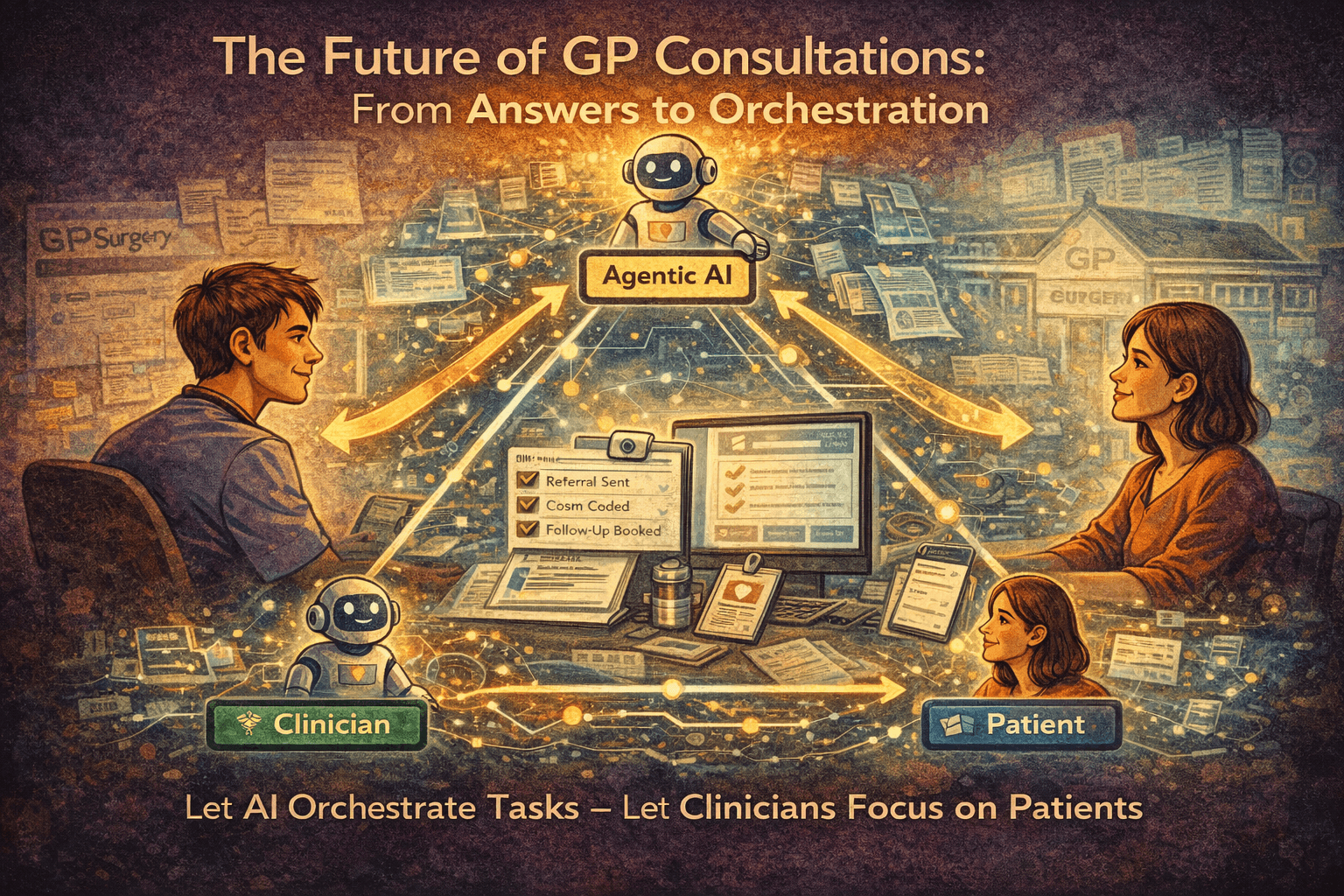
The new consultation triangle: clinician – patient – machine
The core risk: the machine becomes the “main character”
There is a failure mode we must avoid: the clinician talks to the tool, the tool structures the visit, and the patient becomes a data source rather than a partner. UK GPs are already ambivalent about this, with views ranging from scepticism to excitement. The design goal must be "heads-up medicine"—technology that reduces the cognitive load without stealing attention from the patient (JMIR).
The design goal: “heads-up medicine”
Practical design moves for this future include:
- "Quiet UI": Minimal interaction required during the consult.
- Post-consult synthesis: The AI does the heavy lifting after the patient leaves.
- Clear provenance: Every claim is cited.
- Transparency: Patient-facing scripts that explain the AI's role without defensiveness.
What agentic clinical AI must never be allowed to do
We need "red lines" to ensure safety and trust. Agentic AI must have no autonomy in high-stakes actions.
- No unsupervised clinical decisions (diagnosis, prescribing, escalation).
- No unsupervised ordering of tests or referrals.
- No "silent documentation" (notes entered without review).
- No invisible policy-making (changing templates or thresholds without governance).
This aligns with the NHS ambient scribing emphasis on adoption safeguards and the non-negotiable requirement for clinician review (NHS England).
Why the next productivity leap won’t be “answers” — it’ll be orchestration
Answers are cheap; follow-through is expensive
Finding the right guideline is only step one. A correct answer still requires documenting, safety-netting, writing referrals, creating patient information, planning follow-up, and coding. This is the "follow-through tax" that eats up a GP's day.
Orchestration is the missing layer
Agentic systems can coordinate this follow-through. They can draft the tasks, route the reminders, template the letters, and queue the patient instructions. This is where the next leap in productivity lies—not in knowing what to do, but in the doing of it.
Where iatroX fits
iatroX is the clinical intelligence layer inside this future orchestration stack.
- Q&A as rapid clinical retrieval: The clinician asks; iatroX returns structured, checkable guidance quickly.
- Navigator role: iatroX supports decision-making without becoming the decision-maker.
- Consultation-preserving: By reducing "search time," we support heads-up attention.
Let agents orchestrate the admin. Let iatroX compress the clinical retrieval. Let clinicians keep the relationship.
Closing: the outcome metric is not “AI usage” — it’s “patient attention”
The best clinical AI is felt as presence: less screen time, clearer thinking, and better shared decisions.