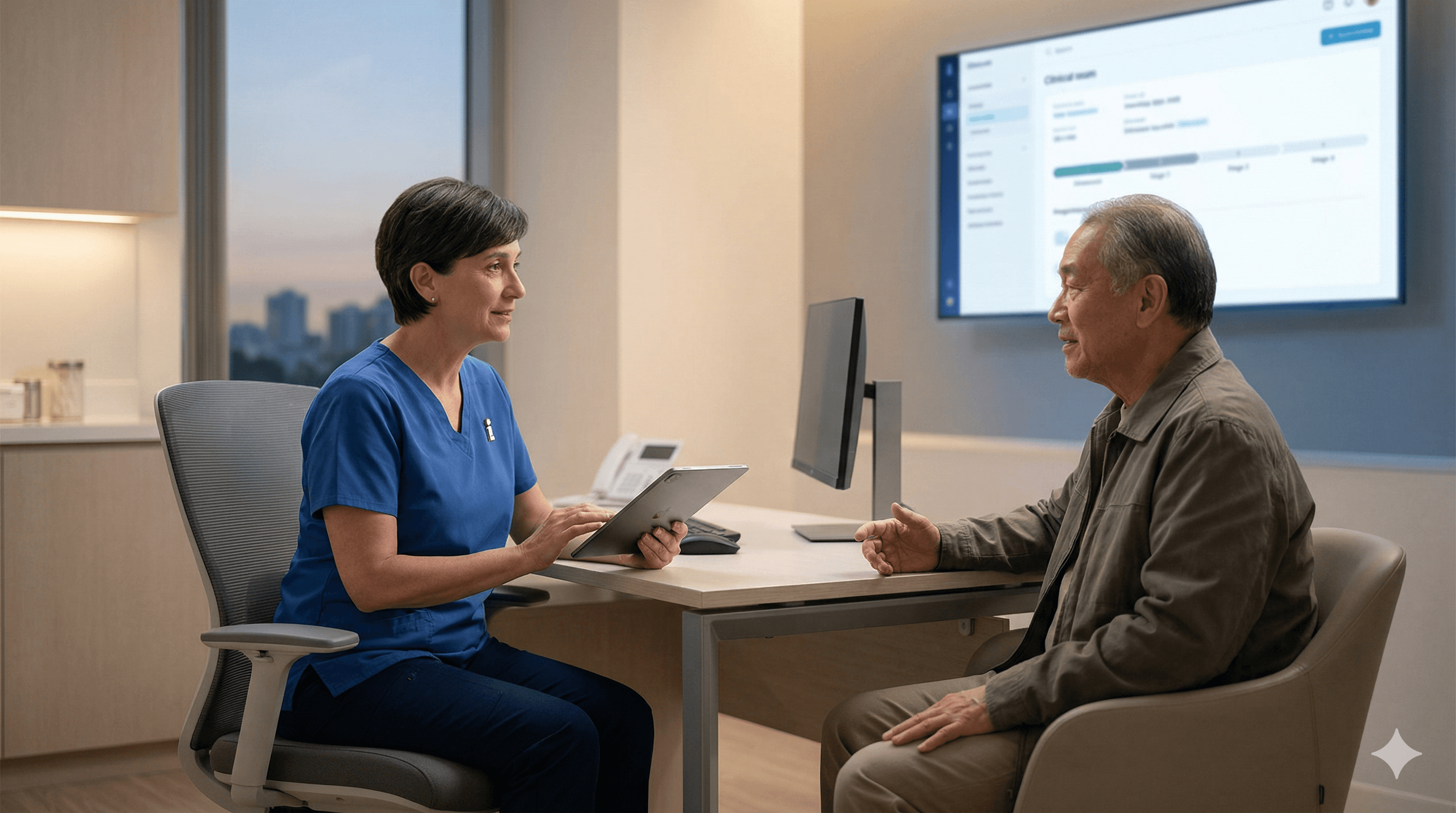
The history of clinical documentation technology follows a clear trajectory, and understanding where it has been reveals exactly where it is going.
Phase 1: Dictation (1990s-2010s). Clinicians spoke into a recorder. A human transcriptionist converted the audio into text. The turnaround was hours to days. The cost was high. The accuracy depended on the transcriptionist.
Phase 2: Speech recognition (2010s). Dragon Medical and similar tools converted speech to text in real time. The clinician still had to dictate deliberately — structured sentences, explicit section headers, correction commands. It was faster than transcription but still required the clinician to construct the note mentally while speaking.
Phase 3: Ambient scribing (2020-2025). The paradigm shift. Tools like Nuance DAX, Abridge, Heidi, TORTUS, and Freed began listening to natural patient-clinician conversations and generating structured clinical notes automatically. The clinician stopped dictating and started talking to the patient. The AI produced the documentation. This is the phase that went mainstream, with Abridge earning Best in KLAS for Ambient AI in both 2025 and 2026, and NHS England backing ambient voice technology with a national registry and evaluation.
Phase 4: Context-aware documentation (2025-2026). The ambient scribe gains access to the patient's chart. Ambience Healthcare calls this "Chart Awareness." Abridge's inpatient product incorporates prior note data from Epic. Freed lets clinicians chat with the AI about patient history before the visit. The scribe is no longer just listening to the conversation — it knows the patient's story before the conversation begins.
Phase 5: Agentic workflow (emerging). The documentation platform expands upstream and downstream. Pre-visit: it prepares a patient summary. During visit: it documents. Post-visit: it codes, generates letters, initiates authorisations, and creates patient summaries. Pre-visit outreach: it contacts the patient to gather intake information. Follow-up: it checks outcomes. The scribe becomes an agent — an AI system that acts across the full clinical workflow rather than observing a single moment within it.
How Each Major Player Is Expanding
Abridge started as an ambient scribe and is expanding in both directions. Its inpatient product facilitates pre-charting, post-charting, and switching between patients. It generates patient after-visit summaries. In January 2026, it partnered with Availity for real-time prior authorisation. Outpatient order suggestions are in Epic Workshop pilot. The trajectory is clear: from documentation to full encounter management.
Freed started as a lightweight, affordable scribe for small practices and has added pre-visit summaries (chat with patient history, key follow-ups, and care summaries), post-visit patient instructions, clinical letter generation, and ICD-10 coding with one-click EHR push. It is building the full workflow for the solo clinician and small group, without requiring enterprise IT.
Nuance/Microsoft has the broadest ambition. DAX Copilot handles ambient documentation. Dragon Medical One handles dictation. The Desktop Copilot works across apps and EHRs. New AI actions generate referral letters, after-visit summaries, and summarised evidence linked to the transcript. Nursing documentation launched in 2026. Order suggestions from ambient recordings are live in Epic. Microsoft is unifying everything under the Dragon Copilot brand — positioning it as a full clinical assistant, not just a scribe.
DeepScribe expanded from ambient scribe into a dedicated AI Pre-Charting product that pulls clinical details from the EHR and outside sources: referrals, notes, labs, imaging, and prior visit summaries. It claims to cut pre-visit charting to three minutes. Strong oncology specialisation.
DeepCura has built the broadest single-platform offering for small practices: AI receptionist, ambient scribe, billing validation, prior authorisation, referral letters, task management, fax processing, and payment collection. It may be the closest current example of the full-loop concept in a self-serve product.
Navina approached from the opposite direction — starting with pre-charting and chart review rather than scribing. Its AI reconciles data from EHRs, health information exchanges, claims, and unstructured notes into a unified patient summary with HCC and care gap identification. The AAFP study validated 61% reduction in prep time, 25% more diagnoses found, and 23% lower burnout scores. It now also provides ambient documentation, fusing conversation data with historical chart data.
What This Means for Clinicians
The practical implication is that the "AI scribe" category is disappearing. It is being replaced by the "AI clinical workflow" category — a broader set of tools that handle preparation, documentation, coding, communication, and follow-up.
For clinicians evaluating tools in 2026, the buying decision is no longer "which scribe is best?" It is "which platform covers the most of my workflow, integrates with my clinical system, and maintains clinical safety across every function?"
This also means the knowledge layer becomes more important, not less. A scribe that only writes notes needs to be accurate about what was said. An agent that pre-charts, suggests diagnoses, recommends investigations, and generates referrals needs to be accurate about clinical guidelines — and the clinician needs a way to verify those suggestions rapidly.
iatroX fills this role. When an AI agent suggests a medication change based on the pre-chart, the clinician can verify the NICE recommendation in seconds via Ask iatroX. When the post-visit AI generates a referral letter, the clinician can check the referral criteria against national guidance via the Knowledge Centre. The agent handles the workflow; iatroX ensures the clinical content within that workflow is guideline-grounded.
The UK Gap
In the US, this evolution is well underway. In the UK, it has barely started. The ambient scribe category (Heidi, TORTUS, Accurx Scribe) is gaining NHS traction, but no UK-specific vendor is building pre-charting, post-visit automation, or full-loop workflow tools.
This matters because the UK's clinical workflow is different — 10-minute consultations, EMIS/SystmOne rather than Epic, QOF coding rather than HCC capture, and a guidelines-first culture built around NICE and CKS guidance and current UK medicines information. A US-built full-loop agent cannot be transplanted directly into UK primary care without significant adaptation.
The opportunity for UK-focused vendors — or for US vendors willing to invest in NHS adaptation — is substantial. And for clinicians, the opportunity is to prepare: adopt the tools that solve today's bottleneck, integrate them with your clinical system, and use a UK-grounded knowledge layer like iatroX to maintain clinical safety as the workflow tools expand.
Conclusion
The scribe was the beginning, not the destination. The trajectory from dictation to agent is clear, the major vendors are executing on it, and the clinical workflow of 2028 will look fundamentally different from the workflow of 2024.
The clinician's role in this new world is not smaller — it is more focused. When the AI handles the preparation, documentation, coding, and follow-up, the clinician's job becomes pure clinical reasoning and human connection. Tools like iatroX ensure that the reasoning is guideline-grounded. The agent handles the workflow. The clinician handles the judgement. That division of labour is the future of clinical practice.