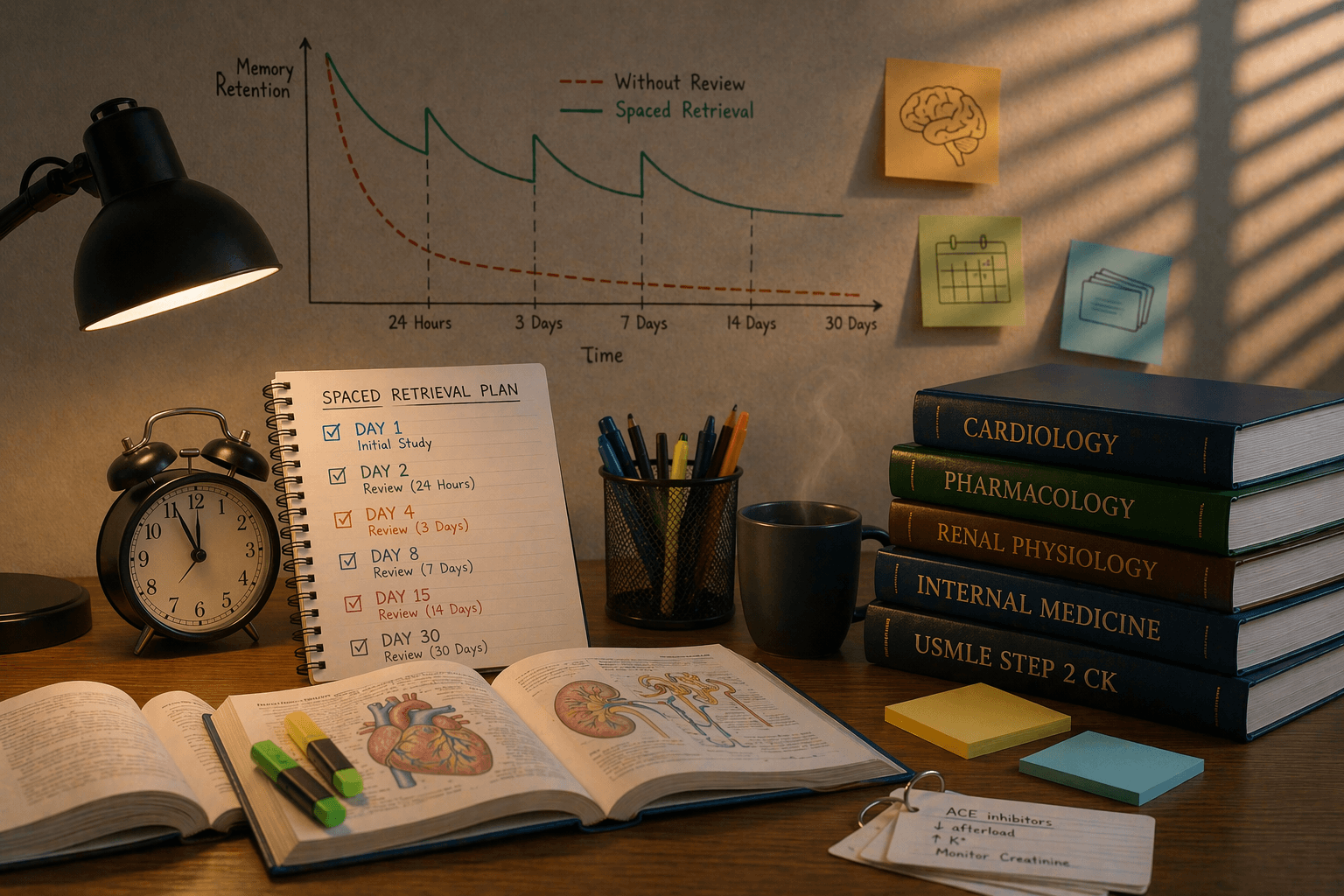
Hermann Ebbinghaus quantified memory decay in 1885. His finding — that without active review, humans lose approximately 70% of new information within 24 hours and 90%+ within a week — has been replicated thousands of times across a century of memory research. The forgetting curve is not a hypothesis; it is a measured property of human memory.
Applied to Medical Education
The cardiology chapter you studied on Monday is 70% forgotten by Tuesday if you do not review it. The pharmacology you learned three weeks ago is almost entirely gone by exam day. The renal physiology from month one of your study period might as well not have been studied if you have not revisited it since. This is not a failure of intelligence or effort — it is how human memory works, universally.
Why This Matters for Board Prep
Cramming works — for 48 hours. The material is accessible for the immediate post-study period. But board exams require months of accumulated knowledge, all accessible on a single exam day. Step 2 CK covers the entire clinical curriculum. ABIM covers all of internal medicine. You cannot cram all of medicine in the 48 hours before the exam. The only path to durable retention across months is intervening against the forgetting curve with spaced retrieval.
The Fix
Spaced retrieval practice at expanding intervals is the only proven method to flatten the forgetting curve. The mechanism: each time you successfully retrieve information from memory, the memory trace strengthens and the next optimal review interval extends. After enough spaced retrievals, the information becomes durably stored — accessible months or years later without additional review.
The intervals: first review within 24 hours. Second review at 3 days. Third at 7 days. Fourth at 14 days. Fifth at 30 days. Each successful retrieval extends the interval. Failed retrievals reset to shorter intervals.
How iatroX Implements This
iatroX automates spaced retrieval scheduling. The algorithm tracks your performance per topic, schedules question review at optimal intervals, and adjusts based on your accuracy. Topics you struggle with resurface sooner. Topics you have mastered recede to longer intervals. Every study session is optimally targeted — no wasted repetition on known material, no forgotten material falling through the cracks.