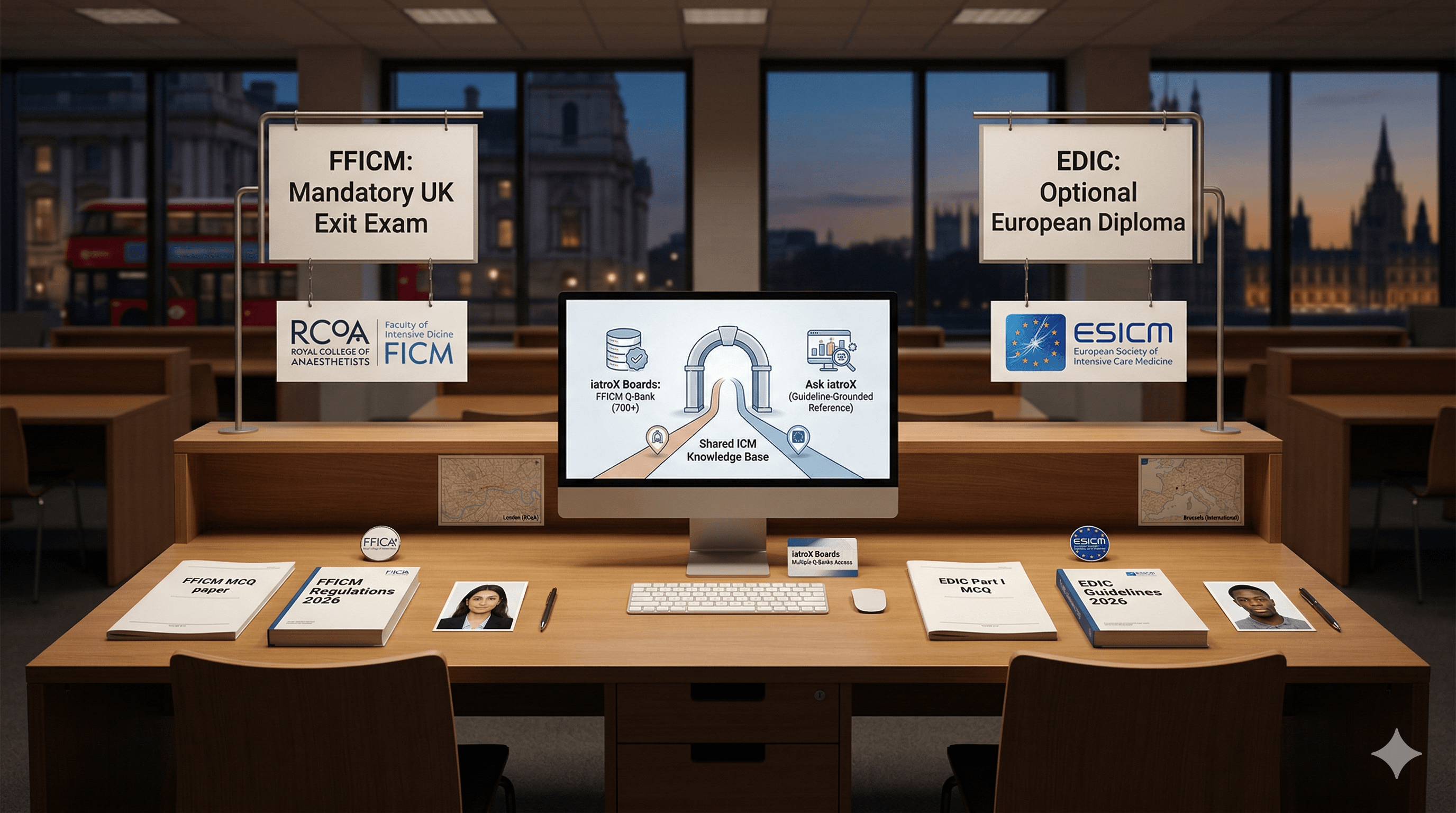
The FFICM (Fellowship of the Faculty of Intensive Care Medicine) and the EDIC (European Diploma in Intensive Care) are the two main postgraduate examinations in intensive care medicine available to UK-based trainees. They are not equivalent, and choosing between them — or deciding to sit both — depends on your career trajectory and where you plan to practise.
FFICM
Purpose: The FFICM is the mandatory exit exam for CCT in Intensive Care Medicine in the UK. You must pass it to complete training and become a consultant intensivist in the NHS.
Format: Three components — MCQ (130 SBAs, 3 hours, remote), OSCE (13 stations, face-to-face at RCoA London), and SOE (4 stations, face-to-face at RCoA London). MCQ must be passed first; OSCE and SOE taken together at first sitting.
Cost: MCQ £510, OSCE £355, SOE £320 (combined OSCE/SOE £635). Total: approximately £1,145.
Recognition: Required for CCT in ICM in the UK. Recognised by the GMC as part of the training pathway.
Standard: Set at the level of a consultant entering independent practice — the endpoint of ICM training.
EDIC
Purpose: The EDIC is a pan-European qualification in intensive care medicine, administered by the European Society of Intensive Care Medicine (ESICM). It is a mark of competence and professional development but is not a mandatory training requirement in any European country.
Format: Two parts. EDIC Part I is a written MCQ examination (100 questions). EDIC Part II is an oral examination with clinical scenarios and data interpretation. Both can be sat internationally.
Cost: Varies by ESICM membership status and location. Generally lower total cost than FFICM.
Recognition: Recognised across Europe as evidence of ICM competence. Not a substitute for national exit examinations (including FFICM in the UK). Valued for academic credentials and international career mobility.
Standard: Set at the level of an intensivist completing specialist training — broadly comparable to FFICM.
How to Choose
If you are training in the UK toward CCT in ICM: The FFICM is mandatory. There is no choice. The EDIC is optional and supplementary.
If you want international recognition alongside your FFICM: Consider sitting the EDIC in addition. It strengthens your CV for international positions, academic roles, and fellowship applications. Many UK trainees sit EDIC Part I during their training and Part II after FFICM, as the knowledge overlaps substantially.
If you are an international doctor considering UK practice: The FFICM is what UK employers recognise. The EDIC alone does not substitute for FFICM in the UK training pathway.
If you are training in a European country: The EDIC may be more relevant to your national training requirements. Check your country's specific requirements.
Using iatroX for Both Exams
The clinical knowledge tested in both exams overlaps significantly — ICM is ICM regardless of which examining body sets the paper. The iatroX FFICM Q-Bank with 700+ curriculum-mapped questions serves candidates preparing for either exam, and Ask iatroX provides the guideline-grounded clinical reference that both exams expect. A single subscription at iatroX Boards provides access to multiple Q-banks — so preparing for FFICM simultaneously builds the knowledge base for EDIC.