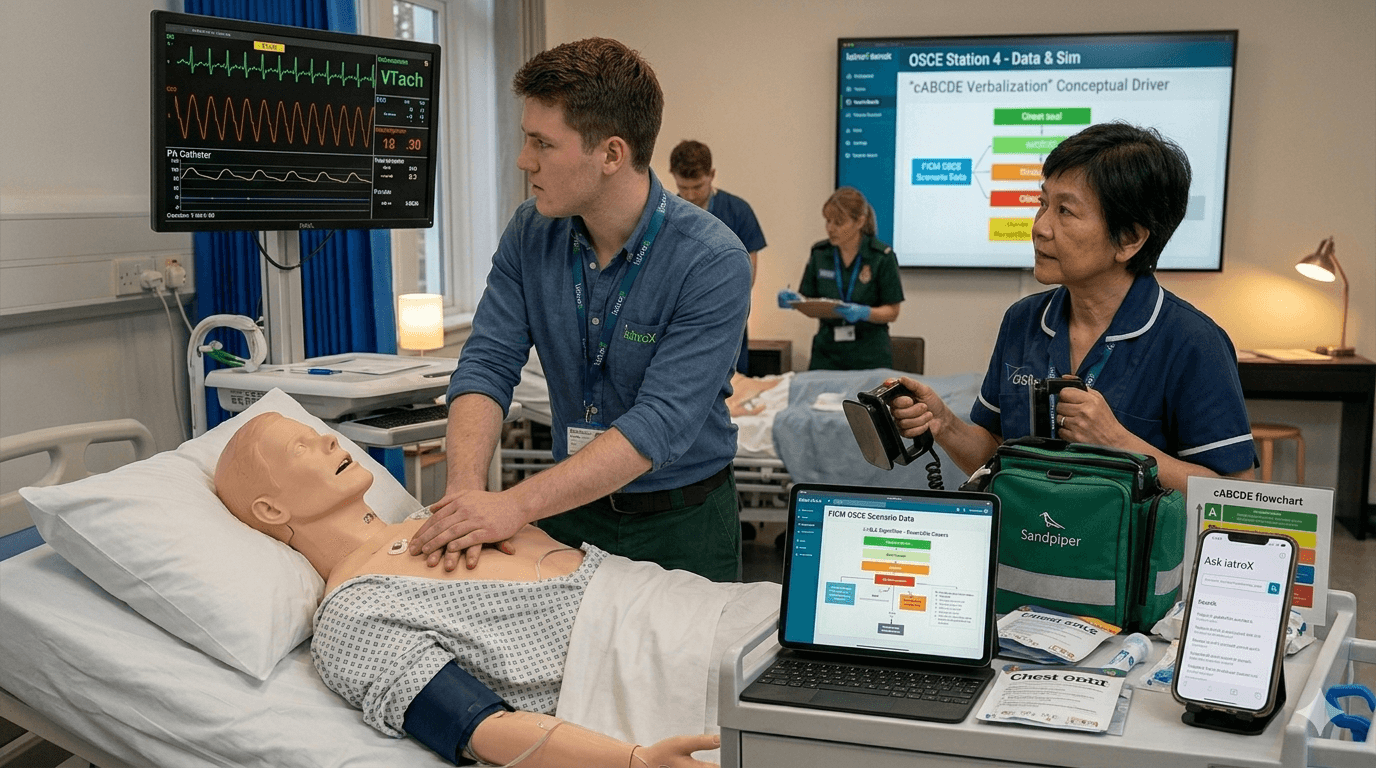
The FFICM OSCE is not a knowledge test — the MCQ already tested that. It is a competence test: can you interpret data under pressure, manage equipment practically, lead a resuscitation, and communicate with patients and families at consultant level? Each domain requires specific preparation techniques that go beyond reading textbooks.
Data Interpretation Masterclass
Data stations present clinical information — ECGs, blood gases, haemodynamic data, imaging, laboratory results — and ask you to interpret it in context.
ECG interpretation in 7 minutes. Use a systematic approach every time: rate, rhythm, axis, P waves, PR interval, QRS width, ST segment, T waves, QT interval. State findings clearly. Give the clinical interpretation (not just "ST elevation" but "acute anterior STEMI — consider primary PCI"). Relate to the clinical scenario provided.
High-yield ECG patterns for FFICM: ventricular tachycardia (monomorphic, polymorphic, torsades), complete heart block, hyperkalaemia changes (peaked T waves, widened QRS, sine wave), pericarditis (widespread saddle-shaped ST elevation), Brugada pattern, paced rhythms.
Blood gas interpretation. Step through the systematic approach: pH (acidosis/alkalosis), respiratory component (pCO2), metabolic component (HCO3/base excess), compensation (partial/full), anion gap, lactate. Give the clinical interpretation in context. A blood gas is never interpreted in isolation — the clinical scenario determines its significance.
Haemodynamic data. Arterial waveforms, CVP traces, cardiac output numbers, echo findings. State the parameters, identify the abnormalities, and give the clinical interpretation. If you are not fluent in haemodynamic data interpretation, spend time during clinical shifts reviewing real patient data with your consultant.
Radiology. Systematic CXR interpretation (ABCDE approach: Airway, Breathing, Cardiac, Diaphragm, Everything else). CT interpretation focused on the key findings relevant to the clinical scenario. You are not expected to be a radiologist — you are expected to identify the critical findings that change management.
Simulation Station Masterclass
Simulation stations test your ability to manage clinical emergencies in real time — typically using mannequins and simulated scenarios.
Verbalise everything. The examiners mark what you say, not what you do silently. State your assessment findings out loud ("the patient is in pulseless VT"), announce your interventions ("I am defibrillating at 200 joules"), and communicate your reasoning ("the rhythm has not changed, I am continuing CPR and giving adrenaline 1mg IV").
Follow algorithms but think beyond them. Know the ALS algorithms automatically — but also demonstrate the thinking that goes beyond the algorithm. What are the reversible causes? What is the likely aetiology in this specific patient? What would you do differently if the standard approach is not working?
Lead the team. Simulation stations often include simulated team members. Delegate tasks clearly. Assign roles. Use closed-loop communication ("Can you draw up 1mg adrenaline IV please?" → "Drawing up 1mg adrenaline IV" → "Thank you, please administer now"). This demonstrates leadership and teamwork — both OSCE marking criteria.
Manage your time. Seven minutes is short for a resuscitation scenario. Start acting immediately after reading the prompt. Do not spend 2 minutes asking preliminary questions when the mannequin is in cardiac arrest.
Communication Station Masterclass
Communication stations test your ability to have difficult conversations at consultant level — breaking bad news, discussing withdrawal of treatment, organ donation conversations, capacity assessments, and family updates.
Use SPIKES for breaking bad news. Setting (ensure privacy, sit down, appropriate environment). Perception (what does the family already know?). Invitation (how much do they want to know?). Knowledge (deliver the information clearly, in plain language, in small chunks). Emotions (pause after delivering the news, respond to the emotional reaction before continuing). Summary/Strategy (outline next steps, answer questions, offer support).
Pace yourself. Candidates rush communication stations because they feel they need to "cover everything." You do not. The examiners are marking the quality of communication, not the quantity. It is better to handle one part of the conversation with genuine empathy, clear language, and shared understanding than to rush through the entire conversation script-style.
Ask before telling. "What have you been told so far?" before you deliver information. "What questions do you have?" before you move to the next point. "How are you feeling about this?" to acknowledge emotions. These questions demonstrate patient-centred communication and score highly.
Acknowledge uncertainty honestly. "We do not know for certain yet, but based on what we have seen so far..." is more appropriate than false reassurance or premature certainty. ICU families deserve honesty.
Preparation Resources
The clinical knowledge underpinning every OSCE domain is built through the iatroX FFICM Q-Bank — 700+ curriculum-mapped questions with adaptive spaced repetition. Ask iatroX provides instant reference for management protocols and clinical guidelines during preparation and clinical shifts. Brainstorm develops the structured clinical reasoning that every OSCE station demands.
The OSCE-specific skills — interpreting data under pressure, leading simulations, communicating with families — require practice beyond the Q-bank. Use peer practice, simulation sessions, prep courses, and the FICM's published example videos. The knowledge and the skills together produce the performance the OSCE rewards.