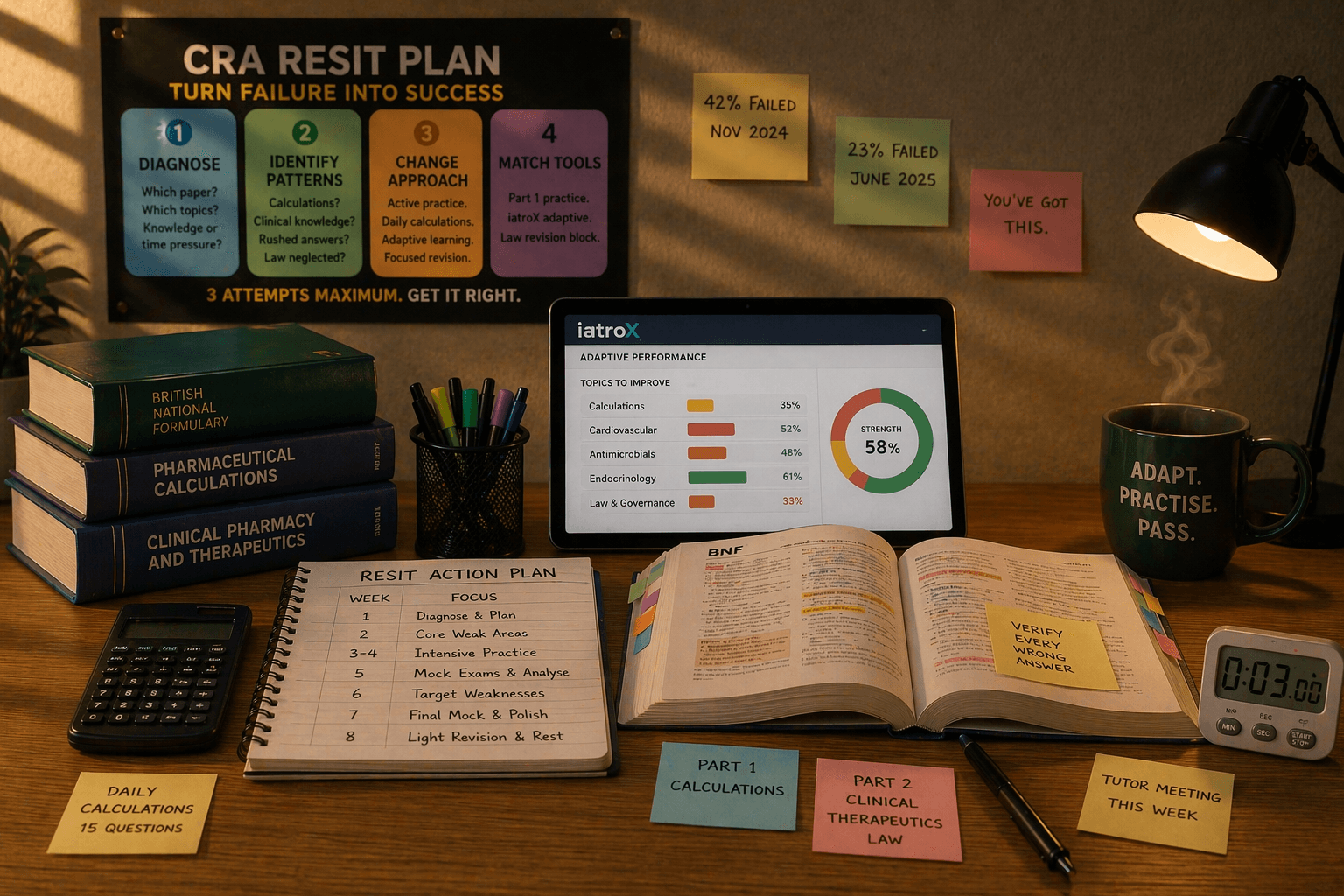
The failure rates are real: 42% failed in November 2024, 23% in June 2025. With three attempts maximum, a failed first attempt is serious — but recoverable with the right approach.
Step 1: Diagnose. Which paper failed — Part 1, Part 2, or both? Which content areas were weakest? Was the failure about knowledge gaps, time pressure, or calculation errors?
Step 2: Common patterns. Passing Part 2 but failing Part 1 calculations (most common). Broad clinical knowledge gaps across Part 2 therapeutics. Time pressure leading to rushed answers. Law/governance neglect.
Step 3: Change your approach. If you used passive BNF reading, switch to active Q-bank practice. If you neglected calculations, make them a daily priority. If you used only one platform, add an adaptive tool. Repeating the same strategy expects a different result.
Step 4: Tool matching. Calculations → dedicated Part 1 resources + daily timed practice. Clinical → iatroX adaptive quiz targeting weak therapeutics. Law → focused law revision block.
Attempt limits: Three attempts maximum. After three failures, foundation training ends without registration. This is high stakes. Get it right.
Support: Speak to your designated tutor. Consider changing revision tools. The cost of a new platform subscription is trivial compared to the cost of a third failed attempt.
iatroX's adaptive engine diagnoses exactly which therapeutic areas need work — essential for a resit candidate who cannot afford to repeat the same mistakes.