Introduction
The term "AI for diagnosis" is often used loosely, but for clinicians, precision matters. There is a world of difference between an experimental tool designed to expand your thinking on a rare case and a regulated platform built for daily NHS decision support.
This article compares two prominent tools that are often confused: DxGPT and iatroX Brainstorm. While both use AI to support clinical reasoning, they perform fundamentally different "jobs," operate under different regulatory frameworks, and should be used in different ways. Understanding this distinction is key to using AI safely in 2026.
Define the two jobs
Job 1: DDx expansion (DxGPT-style)
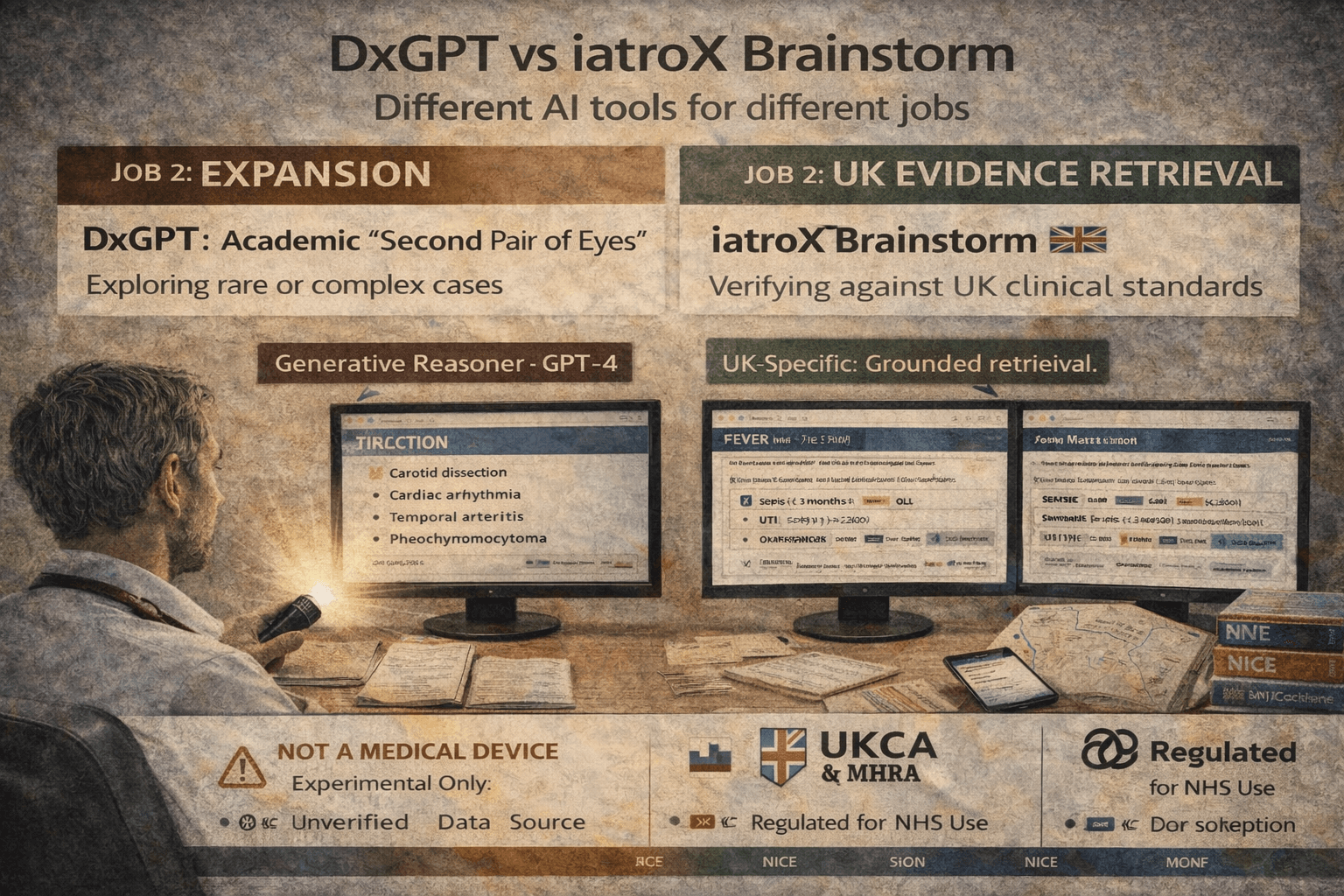
DxGPT is a "generative reasoner." It is built on GPT-4 and is designed to take a clinical vignette—often complex or rare—and generate a ranked list of potential diagnoses.
- The Goal: To break cognitive bias (anchoring or premature closure) by suggesting possibilities you might not have considered. It is an "idea generator."
- The Mechanism: It uses the vast, but unverified, training data of a large language model to find patterns.
Job 2: UK evidence retrieval + structured reasoning + learning loop (iatroX)
iatroX is a "grounded retrieval engine." It is designed for the UK clinician who needs to verify a decision against national standards.
- The Goal: To provide a structured, safe path from "symptom" to "guideline-compliant plan."
- The Mechanism:
- Brainstorm: Generates a differential diagnosis structure, but flags "don't miss" conditions based on UK red-flag criteria.
- Retrieval: Where applicable, a response can link to relevant NICE or CKS guidance or a product-specific SmPC on eMC. Users should inspect the citation rather than assuming that every suggestion has a matching source.
- Learning Loop: Allows you to turn that clinical query into a CPD log or an adaptive quiz question for future retention.
What each is best used for
DxGPT: the "academic" second pair of eyes
Use DxGPT when you are truly stuck on a "zebra"—a rare or complex presentation where standard guidelines don't fit.
- Best for: Complex case reflection, academic meetings, or retrospective review of difficult cases.
- Not for: Routine ward work or prescribing decisions.
iatroX: the "daily driver" for safe practice
Use iatroX when you need to act safely and efficiently within the NHS system.
- Best for:
- The "Monday Morning" GP Clinic: "What is the referral criteria for 2-week-wait LGI?"
- The Ward Round: "What is the first-line antibiotic for HAP in a penicillin-allergic patient?"
- Education: "Help me structure a management plan for new AF for my portfolio."
- Why: It bridges the gap between "thinking about a diagnosis" and "finding the policy that governs it."
Governance contrast: the critical safety difference
This is the single most important distinction for UK clinicians.
DxGPT: “Not a medical device”
DxGPT explicitly states in its disclaimers that it is not a medical device and is for informational/research purposes only. It operates in a regulatory grey area common to many generative AI experiments. Using it for direct patient care decisions involves taking on significant personal professional risk.
iatroX: UKCA & MHRA registered
iatroX has taken the route of formal compliance. It declares itself as a UKCA-marked Class I Medical Device, registered with the MHRA for informational and educational use.
- What this means: It has a clinical safety management system (DCB0129). It has a clear "intended use" statement. It is built to be a professional tool, not just a tech demo.
The clear take: use both, but don’t confuse categories
You can use both tools, but you must not confuse their roles.
- Use DxGPT as a searchlight in the dark. When you are lost in a complex case and need lateral thinking, it shines a light on possibilities you missed.
- Use iatroX as your compass and map. When you know where you need to go (or have a likely diagnosis), it guides you there safely using the "map" of UK national guidance, ensuring you stay on the path of best practice.
Don't navigate with a searchlight. Don't brainstorm with a map. Use the right tool for the job.