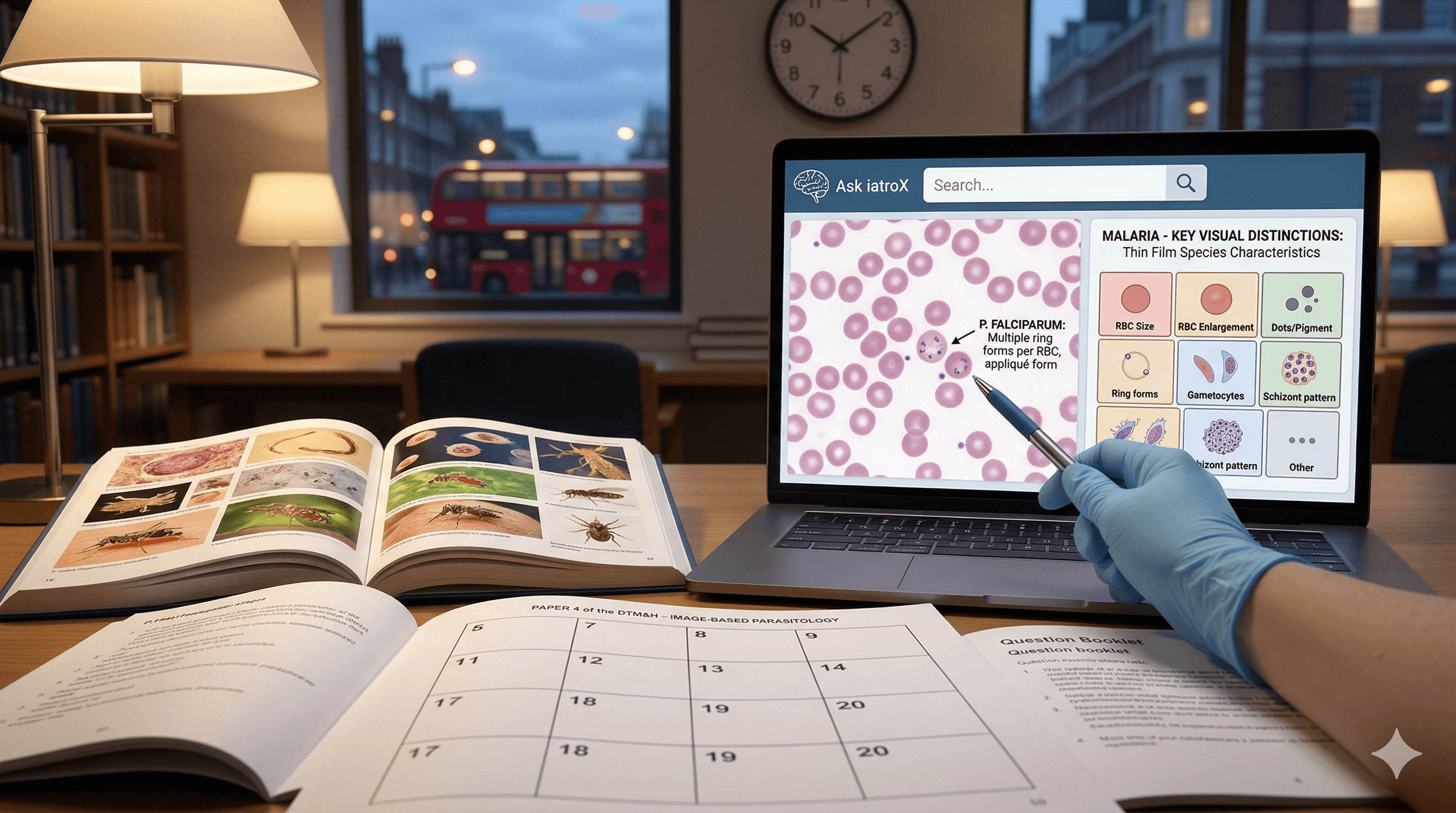
Paper 4 of the DTM&H presents 50 images in 90 minutes. Each image shows a parasite, arthropod, or vector — photographed from a blood film, stool preparation, tissue section, or as a whole organism. You must identify it, describe its clinical significance, and answer associated questions. 3 marks per image, 150 marks total.
This paper separates candidates who have looked at parasites from those who have read about them. Reading that Schistosoma mansoni eggs have a lateral spine is different from recognising that spine in a photograph of a stool preparation under 40x magnification.
The Systematic Identification Approach
For blood films: Is it a thin film or thick film? Thin films preserve red cell morphology and allow species identification; thick films concentrate parasites for detection. Identify the parasite category: malaria (ring forms, trophozoites, schizonts, gametocytes), trypanosomes (trypomastigotes — note size, kinetoplast position), microfilariae (note sheath presence, nuclear column pattern, tail nuclei), Babesia (small ring forms, no pigment — distinguish from P. falciparum).
For stool preparations: What preparation technique was used (direct wet mount, concentration, stained preparation)? Identify egg morphology — size (measure against known reference), shape, shell features (thick/thin, operculated/non-operculated), internal contents (embryo development stage), and any distinctive features (spines, plugs, hooks).
For arthropods: What class is it (insect, arachnid, crustacean)? For insects: how many wings, wing venation, body shape, mouthparts, antennae. For mosquitoes: resting position (Anopheles at angle, Culex/Aedes parallel), palp length relative to proboscis, wing spotting.
High-Yield Organism Identification Guide
Malaria thin film recognition:
P. falciparum: small ring forms, often multiple infections per RBC, accole forms (appliqué — ring touching the cell membrane), no enlarged RBCs, crescent-shaped gametocytes (banana-shaped). RBCs normal size.
P. vivax: enlarged RBCs with Schüffner's dots, larger ring forms than P. falciparum, amoeboid trophozoites, RBCs enlarged 1.5-2x normal.
P. ovale: oval-shaped enlarged RBCs with fimbriated (ragged) edges, Schüffner's dots, compact trophozoites.
P. malariae: normal-sized RBCs, band-form trophozoites (stretching across the cell), rosette schizonts (daisy-head pattern with 6-12 merozoites).
P. knowlesi: resembles P. malariae on thin film but with higher parasitaemia. Band forms present. Distinguished primarily by clinical context (Southeast Asia, macaque exposure) and PCR.
Helminth eggs — the essential comparison:
Ascaris lumbricoides fertile egg: oval, thick mammillated (bumpy) shell, brown, 45-75 μm. Infertile egg: elongated, thinner shell, variable shape.
Trichuris trichiura: barrel-shaped, bipolar mucus plugs, brown, 50-55 μm.
Hookworm (Ancylostoma/Necator): oval, thin shell, 2-8 cell stage embryo, 55-75 μm. Cannot distinguish species from egg alone.
Schistosoma mansoni: oval, prominent lateral spine, 115-175 μm. S. haematobium: oval, terminal spine, 110-170 μm (found in urine, not stool). S. japonicum: round, small vestigial lateral spine (often barely visible), 70-100 μm.
Enterobius vermicularis: asymmetric (flattened on one side, D-shaped), thin shell, contains larva, 50-60 μm. Usually detected by perianal tape, not stool examination.
Arthropod vectors — visual recognition:
Anopheles mosquito: rests at 45° angle to surface, palps as long as proboscis (female), spotted wings.
Aedes mosquito: black with white stripe markings on legs and body, rests parallel to surface.
Tsetse fly (Glossina): hatchet cell pattern in wing venation, proboscis projects forward, wings fold scissors-like at rest.
Sandfly (Phlebotomus): small, hairy, wings held in V-shape at rest.
Study Technique
Minimum 30 hours of image-based practice. Use your course microscopy sessions, CDC DPDx database, parasitology atlases, and the iatroX DTM&H Q-Bank parasitology questions. Every hour spent looking at images translates directly into marks on Paper 4.
Create comparison sheets. For each category (helminth eggs, protozoa, arthropods), create a visual comparison chart with the key distinguishing features side by side. The exam tests your ability to distinguish between similar-looking organisms — and the comparison chart makes those distinctions explicit.
Test yourself under time pressure. Less than 2 minutes per image in the exam. Quick identification, structured answer, move on. Hesitation costs marks on images you could have answered correctly later.
Ask iatroX provides instant reference for any organism's clinical significance, treatment, and epidemiology — extending your parasitology learning beyond identification into the associated knowledge the exam questions test.