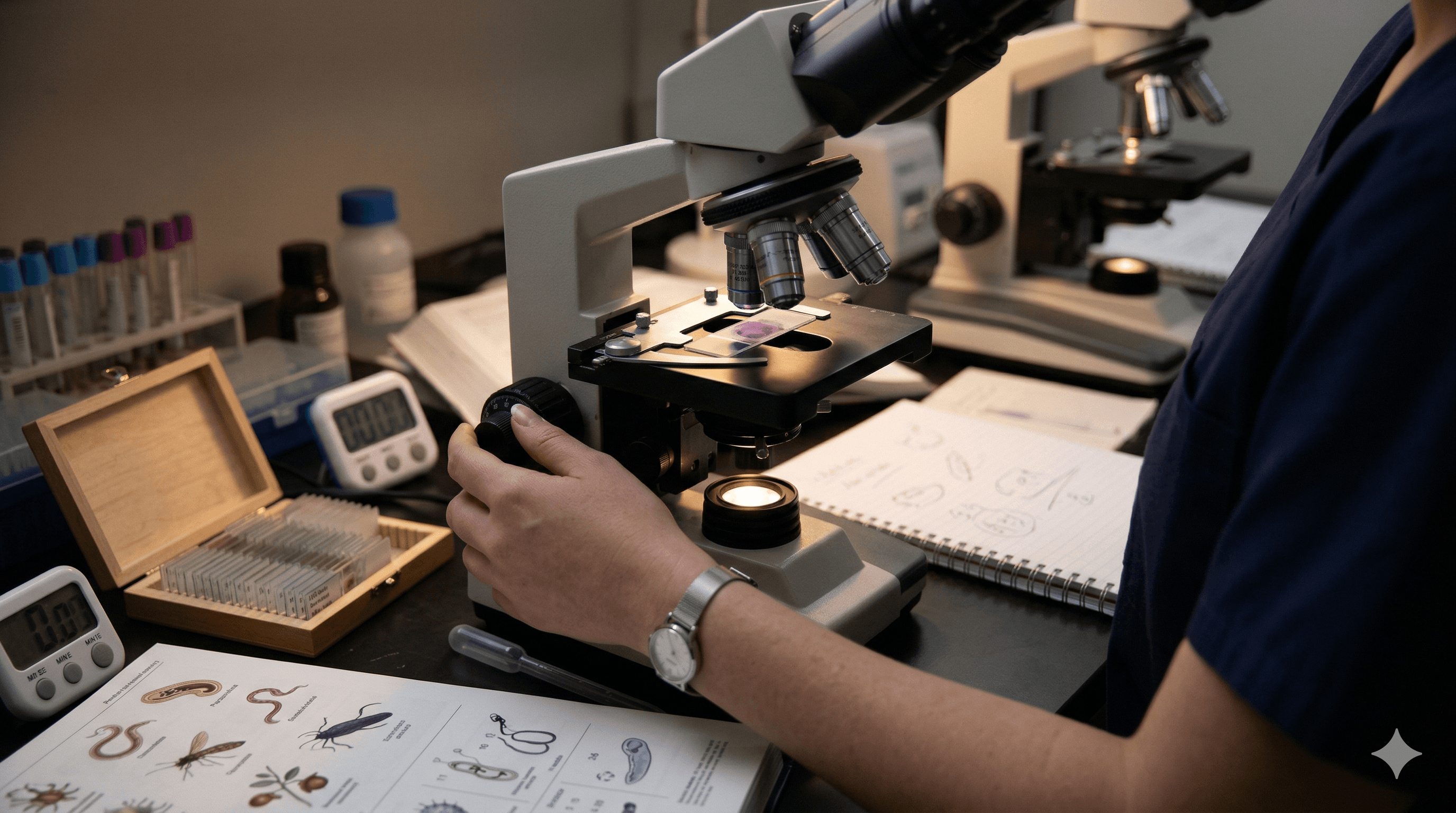
Paper 4 is the DTM&H's signature component: 50 images of parasites, arthropods, and vectors, each with short-answer questions worth 3 marks. Total: 150 marks in 90 minutes — less than 2 minutes per image. The images include blood film photographs, stool microscopy, tissue sections, whole organisms, and vector photographs.
This paper rewards candidates who have spent time looking at parasites. There is no shortcut — textbook descriptions are insufficient for visual identification under exam pressure. You need image-based practice.
The Identification Approach
For every image, apply a systematic approach.
Step 1: What type of specimen is this? Blood film (thin or thick), stool preparation (wet mount, concentration, stained), urine sediment, tissue section, whole organism, arthropod photograph.
Step 2: What are the key morphological features? Size (relative to surrounding cells), shape, internal structures (nuclei, organelles, inclusions), staining characteristics, and any distinctive features (chromatin pattern, cytoplasmic granules, egg shell features, larval morphology).
Step 3: What is the organism? Based on the morphological features, identify the genus and species where possible. State the key features that support your identification.
Step 4: Answer the associated questions. These typically ask for identification, clinical significance (what disease does it cause?), vector (how is it transmitted?), geographic distribution, and management.
The High-Yield Organisms
These organisms appear with the highest frequency across DTM&H SAQ papers.
Malaria species. Plasmodium falciparum, P. vivax, P. ovale, P. malariae, P. knowlesi. You must distinguish between species on thin blood film. Key features: ring forms (P. falciparum — small, multiple infections per RBC, accole forms), enlarged RBCs with Schuffner's dots (P. vivax, P. ovale), band forms (P. malariae). Thick film for detection; thin film for speciation.
Helminth eggs in stool. Ascaris lumbricoides (fertile and infertile — different morphology), Trichuris trichiura (barrel-shaped with bipolar plugs), hookworm (Ancylostoma/Necator — thin-shelled, segmented embryo), Schistosoma mansoni (lateral spine), S. haematobium (terminal spine), S. japonicum (small, vestigial spine), Strongyloides stercoralis (larva, not egg — rhabditiform), Enterobius vermicularis (flattened on one side, D-shaped).
Protozoa in stool. Entamoeba histolytica (trophozoites with ingested RBCs), Giardia lamblia (pear-shaped trophozoites, face-like appearance), Cryptosporidium (acid-fast oocysts on modified ZN stain).
Arthropods and vectors. Anopheles vs Culex vs Aedes mosquitoes (resting position, palp length, egg morphology), tsetse fly (Glossina — hatchet cell wing venation), sandfly (Phlebotomus/Lutzomyia — hairy, V-shaped wing position at rest), blackfly (Simulium — hunchback appearance), triatomine bugs (reduviid — "kissing bugs"), ticks (hard ticks vs soft ticks), fleas (laterally flattened), lice (dorso-ventrally flattened), and mites (Sarcoptes scabiei).
Tissue parasites. Leishmania amastigotes (intracellular within macrophages), Trypanosoma (trypomastigotes in blood film — T. brucei, T. cruzi), microfilariae (Wuchereria bancrofti, Brugia malayi, Loa loa, Onchocerca volvulus — distinguish by sheath presence, nuclear column, tail nuclei).
Study Technique
Spend at least 30-40 hours on image-based parasitology during your preparation. This is not optional. Use your course microscopy sessions intensively — examine every slide, note every feature, and practise identification under time pressure.
Build a personal image library. Photograph slides during your course practicals (if permitted). Use online parasitology image databases (CDC DPDx, Atlas of Medical Parasitology). The iatroX DTM&H Q-Bank includes parasitology questions that test image recognition alongside clinical knowledge.
Learn the distinguishing features, not just the names. The exam tests whether you can identify organisms from morphology, not whether you can list their names. For every organism, know the 2-3 features that distinguish it from similar-looking organisms.
Practise under timed conditions. Less than 2 minutes per image. Quick identification, structured answer, move on. Deliberating for 5 minutes on one image costs you time for three other images.
Ask iatroX provides instant reference for parasite biology, clinical significance, and treatment — useful when Q-bank explanations leave gaps or when you encounter an unfamiliar organism during study.