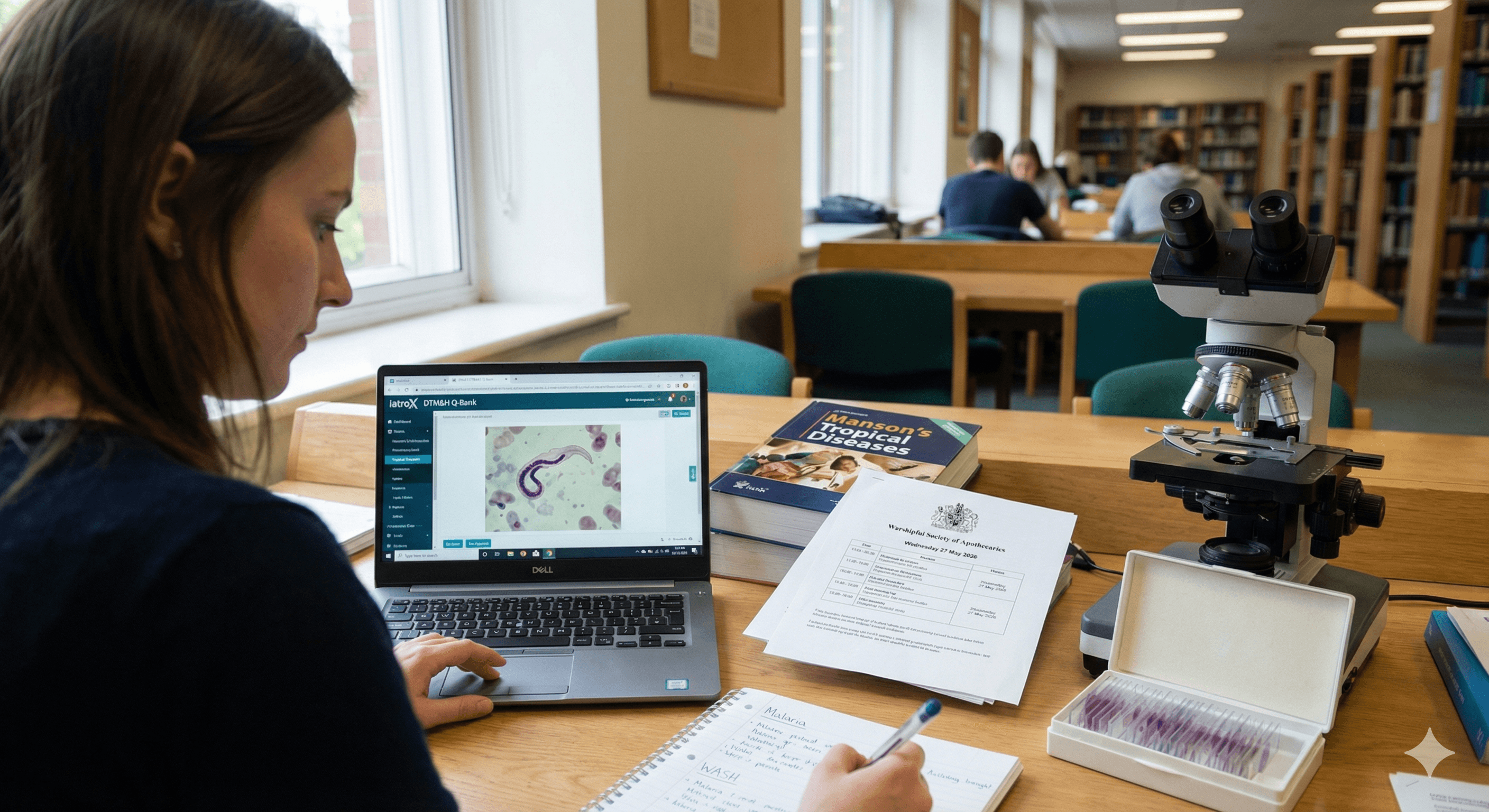
The Diploma in Tropical Medicine and Hygiene is one of the oldest and most respected postgraduate qualifications in global health. From 2024, its administration transferred from the Royal College of Physicians to the Worshipful Society of Apothecaries — bringing a new online delivery format, updated regulations, and revised administrative processes. The clinical content remains rooted in the same rigorous standard, but the exam experience has changed.
This guide covers everything you need to know about the new format.
The Four Papers
The DTM&H examination consists of four papers, all sat on the same day, online with remote invigilation. The 2026 exam takes place on Wednesday 27 May 2026 (09:30-17:30 GMT). Fee: £570.
Papers 1 and 2 — MCQ Papers (Clinical Tropical Medicine). Two multiple-choice papers covering the breadth of clinical tropical medicine: infectious diseases, parasitology, epidemiology, diagnosis, treatment, and clinical management. These papers test the 60% of the curriculum dedicated to clinical tropical medicine.
Paper 3 — SSQ Paper (Preventive Medicine & International Public Health). 1 hour. 10 short-answer/essay questions; candidates must answer exactly 5 (and indicate which 5). Each question is worth 20 marks; 100 marks total. Previously called the Short Essay Question (SEQ) paper. Covers the 25% of the curriculum dedicated to preventive medicine, public health, WASH, health systems, epidemiology, and global health policy.
Paper 4 — SAQ Paper (Diagnostic Parasitology & Medical Entomology). 1.5 hours. 50 images of parasites or arthropods with associated short-answer questions. Each question is worth 3 marks; 150 marks total. This is the paper that candidates either love or fear — it tests visual identification of parasites, vectors, and arthropods from microscopy images, photographs, and diagrams.
Scoring and Pass Criteria
All papers are marked and pass marks set using the Angoff method. To pass overall, candidates must achieve the combined pass mark across all four papers. There is a compensation rule: if you achieve the overall pass mark but fail one component (and that component is not below 40% of its pass mark), you can still pass overall. This compensatory mechanism applies to one component only.
If you fail the examination, all papers must be retaken — individual paper passes do not carry forward. The whole examination must be completed within 5 years of the first attempt.
Approved Courses
You must complete an approved course before sitting the exam. The recognised courses include LSHTM (London School of Hygiene & Tropical Medicine) — full-time, 3 months, London. Widely considered the gold standard; includes extensive laboratory parasitology. LSTM (Liverpool School of Tropical Medicine) — full-time, 3 months, Liverpool. Strong clinical focus with hospital tropical medicine exposure. University of Glasgow — part-time online, approximately 6 months (September-May). Designed for working doctors. Includes face-to-face laboratory sessions at international centres. University of Sheffield — part-time, designed for busy clinicians. Shares tutorials with Glasgow. MSF Global Health & Humanitarian Medicine (GHHM) — UK and South Asia courses. Humanitarian medicine focus alongside tropical medicine. Various ASTMH-approved international courses (Nagasaki, Bangkok, etc.).
Each course has a minimum requirement of 12 hours microscopy/practical parasitology teaching. This is essential — Paper 4 tests visual identification skills that cannot be learned from textbooks alone.
How to Prepare
For the MCQ papers: iatroX offers a DTM&H curriculum-mapped question bank with over 600 questions, accessible through a single subscription that provides access to multiple Q-banks. The questions cover clinical tropical medicine, parasitology, preventive medicine, and public health with adaptive spaced repetition targeting your weakest areas. Use this daily throughout your course — the spaced repetition ensures material from the start of the course is retained through to the May exam.
For the SSQ paper: Practise essay writing under timed conditions. Each answer should be structured (introduction, key points, conclusion), evidence-referenced, and concise — you have 12 minutes per question. The topics tested are broad: WASH, immunisation programmes, health systems strengthening, disease control programmes, maternal and child health, NCDs in tropical settings, and epidemiological methods.
For the SAQ parasitology paper: There is no substitute for microscopy hours. Practise identifying parasites from slides, images, and photographs. Learn the key morphological features that distinguish similar-looking organisms. The iatroX DTM&H Q-Bank includes parasitology questions, and Ask iatroX provides instant reference for parasite identification and management.
General reference: Ask iatroX provides clinical reference for tropical medicine management pathways — useful during your course and during the revision period.
Key Dates for 2026
Application opens: check the Apothecaries website. Application closes: Tuesday 10 March 2026. Exam date: Wednesday 27 May 2026 (online). Fee: £570.