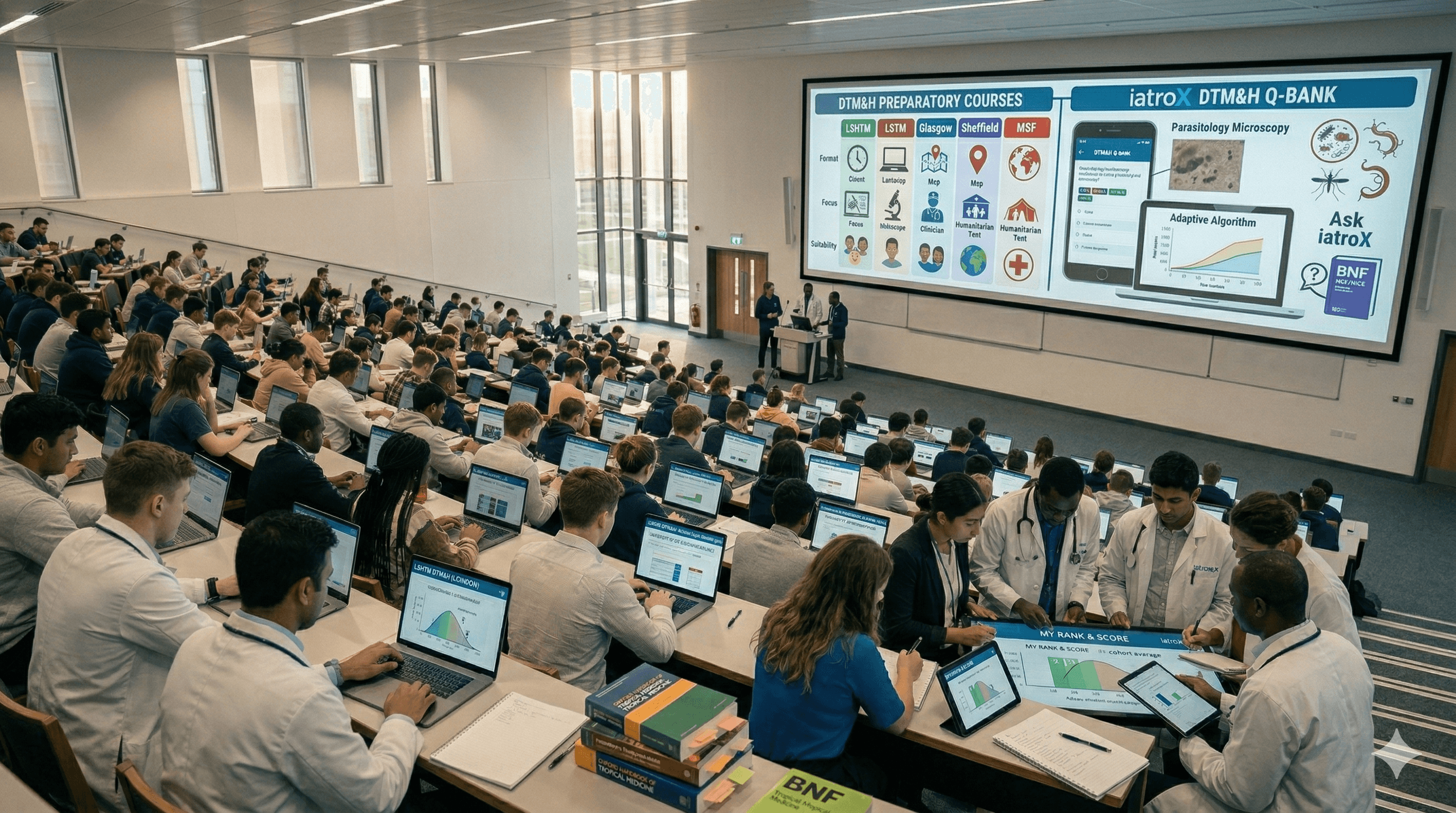
Choosing the right DTM&H preparatory course is one of the most consequential decisions in your tropical medicine journey. The courses range from 3-month full-time immersive programmes to 6-month part-time online courses designed for working doctors. Each prepares you for the same exam, but the learning experience, networking opportunities, and practical exposure differ significantly.
LSHTM (London School of Hygiene & Tropical Medicine)
Format: Full-time, 3 months (approximately January-March). London.
Strengths: The most prestigious DTM&H course globally. Unparalleled access to world-leading tropical medicine academics and researchers. Extensive laboratory parasitology — you will examine more slides than on any other course. Strong clinical tropical medicine teaching with access to the Hospital for Tropical Diseases. The LSHTM network is globally valuable for careers in tropical and global health.
Considerations: Requires 3 months away from clinical work. London living costs are high. The pace is intense — full-time study with laboratory sessions, lectures, and clinical attachments.
Best for: Doctors planning careers in tropical medicine, global health research, or work in endemic countries. Those who can take 3 months of protected study time.
LSTM (Liverpool School of Tropical Medicine)
Format: Full-time, 3 months (approximately January-March). Liverpool.
Strengths: The oldest tropical medicine institution in the world (founded 1898). Strong clinical focus with access to the Liverpool School's clinical facilities. Excellent laboratory parasitology and entomology teaching. Lower cost of living than London. Strong alumni network particularly in sub-Saharan Africa and South Asia.
Considerations: Same 3-month commitment as LSHTM. Full-time attendance required.
Best for: Doctors planning tropical medicine careers with a clinical focus. Those who want immersive training at a historically significant institution.
University of Glasgow
Format: Part-time online, approximately 6 months (September-May). Core content delivered online on demand. Fortnightly live tutorials (shared with Sheffield). Face-to-face laboratory sessions at international partner centres (Glasgow, Malawi, Malaysia, Indonesia, South Africa, India, Netherlands).
Strengths: Designed for working doctors who cannot take 3 months off. Maximum flexibility — content available on demand, tutorials in the evening (UK time), recorded for later viewing. International laboratory partnerships provide microscopy training across multiple continents. Collaborative tutorials with Sheffield strengthen the peer learning experience.
Considerations: Requires significant self-discipline — 6 months of part-time study alongside clinical work is demanding. The laboratory sessions are concentrated into 2-3 day blocks at partner institutions, which requires travel planning.
Cost: Course fee approximately £1,670 (2025/26). Exam fee (£570) additional. Competitive scholarships available.
Best for: Working doctors who need flexibility. International doctors who can access a nearby partner institution for laboratory sessions. Those who learn well independently with regular tutorial support.
University of Sheffield
Format: Part-time. Shares tutorials with Glasgow. Face-to-face teaching days including clinical microscopy at the Royal Hallamshire Hospital.
Strengths: Close collaboration with Glasgow course. Access to Sheffield Travel Clinic for clinical observation. Strong microscopy training during face-to-face sessions.
Considerations: Currently only open to UK-based and South Africa-based applicants.
Best for: UK-based working doctors who want a Sheffield base with Glasgow collaboration.
MSF Global Health & Humanitarian Medicine (GHHM)
Format: Varies — UK course and South Asia course available. Combines tropical medicine with humanitarian medicine focus.
Strengths: Unique humanitarian medicine perspective. Directly relevant for doctors planning MSF or similar humanitarian deployments. Covers conflict medicine, disaster response, and resource-limited healthcare alongside tropical medicine. MSF's operational experience informs the teaching.
Considerations: The humanitarian focus means less depth in some pure tropical medicine topics compared to LSHTM or LSTM. This is a feature for some candidates and a limitation for others.
Best for: Doctors planning humanitarian careers. Those who want tropical medicine qualification combined with humanitarian preparedness.
How to Choose
If you can take 3 months off and want the deepest clinical and laboratory training: LSHTM or LSTM. These are the gold standard full-time courses.
If you are working and need flexibility: Glasgow (with or without Sheffield). Designed for busy doctors with on-demand content and evening tutorials.
If you want humanitarian medicine alongside tropical medicine: MSF GHHM.
Regardless of Course
Your exam preparation should supplement your course teaching. The iatroX DTM&H Q-Bank with 600+ curriculum-mapped questions provides adaptive spaced repetition that ensures material from the start of your course is retained through to the May exam — solving the fundamental problem of 6-month courses where early content fades before exam day. Ask iatroX provides instant clinical reference throughout your course and revision period. A single subscription at iatroX Boards gives you access to the DTM&H Q-Bank alongside other specialty Q-banks.