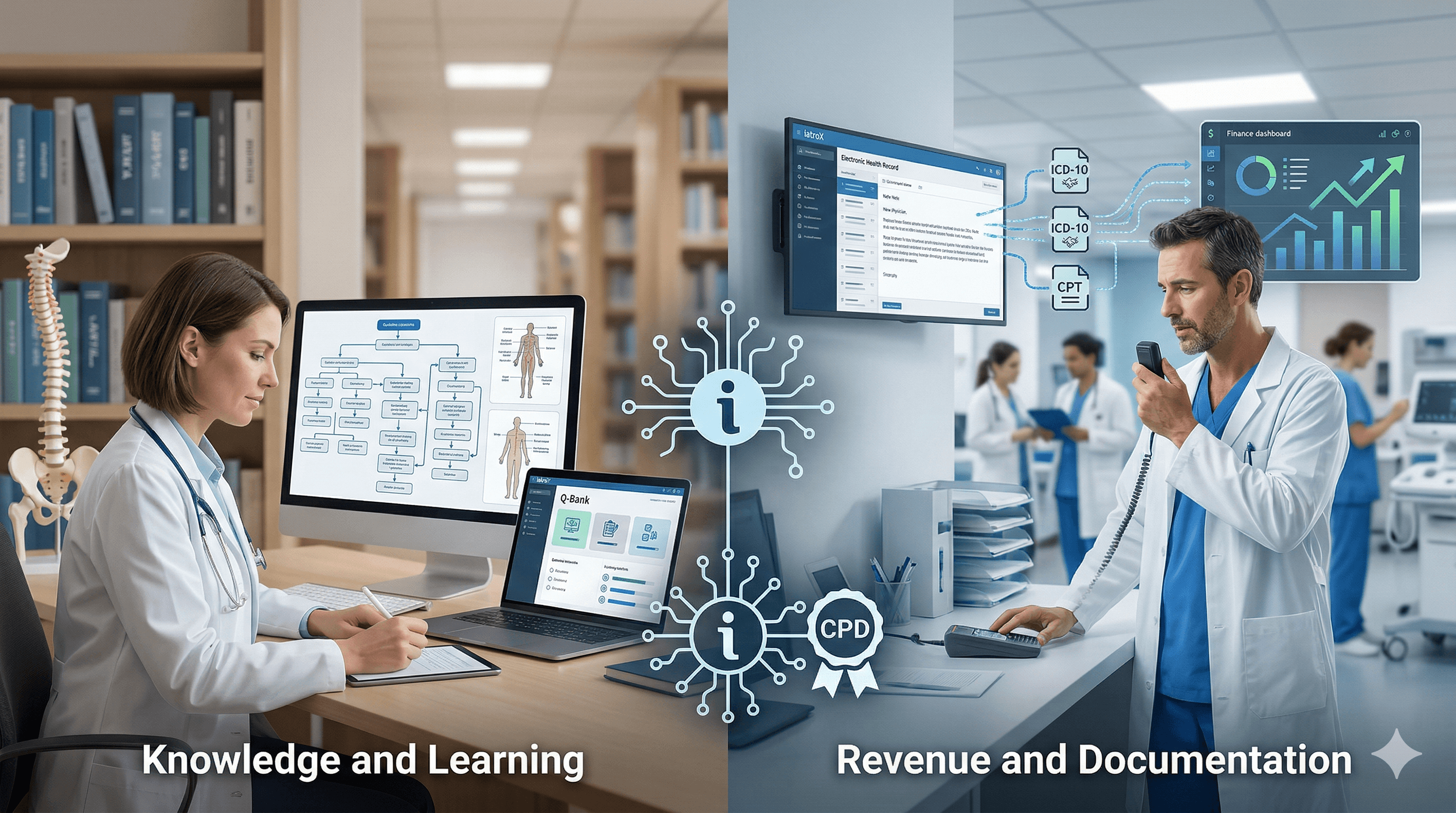
In 2024, the pitch was simple: "Our AI saves you time." In 2025, it became: "Our AI writes your notes." In 2026, the pitch has shifted again — and this time, the shift is existential for companies that do not adapt.
The new pitch is: "Our AI pays for itself."
OpenEvidence launched Coding Intelligence on March 26, 2026 — automatic ICD-10, E/M, and CPT suggestions that connect clinical documentation directly to reimbursement. Heidi has expanded from a pure scribe into Evidence, Source Control, Comms, and a dedicated hardware device (Heidi Remote). Dragon Copilot blends ambient documentation with ICD-10 specificity suggestions and partner apps spanning revenue cycle and decision support. Abridge explicitly foregrounds billable AI-generated notes and prior authorisation via Availity. Ambience Healthcare speaks the language of chart-aware coding and enterprise infrastructure.
The pattern is unmistakable. Every major clinical AI platform is developing a revenue story.
Why "Saves Time" Is No Longer Enough
Time savings are valuable but difficult to monetise directly. A clinician who saves 30 minutes per day on documentation gains quality of life — but the practice's revenue does not increase. The CFO who approves the AI subscription needs a harder ROI case than "our doctors go home earlier."
Revenue capture is different. If the AI identifies missed billing codes worth $X per encounter, and the clinician sees Y encounters per day, the ROI calculation is concrete and the tool justifies its own cost. This is why Coding Intelligence, Tali's billing agent, and Dragon Copilot's coding features are not incremental improvements — they are business model transformations.
The clinical AI tools that connect documentation to revenue have a fundamentally stronger subscription justification than those that connect documentation to time savings alone.
What This Means for Pure Evidence and Learning Tools
If you are a clinical AI company whose product is "search our curated medical content and get a good answer," the 2026 landscape is challenging. The platforms that started as evidence tools (OpenEvidence) are adding revenue features. The platforms that started as scribes (Abridge, Freed, Heidi) are adding evidence features. And the platforms (Dragon Copilot) are adding both.
The pure-play evidence tool — the clinical reference platform that only retrieves and explains — needs a different sustainability story. It cannot compete on revenue capture because that requires EHR integration, billing data, and coding logic that evidence tools do not have. It can compete on three other axes: depth of source authority (the quality and provenance of the underlying evidence), breadth of learning and education features (tools that build knowledge, not just retrieve it), and community and professional development integration (CPD, reflection, career-stage support).
Where iatroX's Model Works
iatroX does not have a revenue-capture feature. It does not generate billing codes. It does not integrate with claims workflows. And it does not need to — because its value proposition operates on a different axis.
iatroX's model is: free, guideline-grounded clinical reference combined with adaptive learning, clinical reasoning, and professional development. The sustainability comes from being the UK's most trusted AI-powered clinical knowledge platform — the tool that clinicians use every day for guideline retrieval, exam preparation, and CPD — rather than from capturing a share of each encounter's billing value.
This is a legitimate model. CKS and NHS e-Learning for Healthcare are free, while other medicines-information services may be publicly accessible or institutionally supported. These resources sustain themselves through institutional support, regulatory mandate, and professional necessity. A clinical knowledge platform that becomes similarly indispensable — used daily by clinicians, trainees, and students for the knowledge that underpins their practice — does not need a revenue-capture feature to survive. It needs to be the best at what it does.
Ask iatroX provides UK-guideline-grounded answers faster than any alternative. The Q-Bank builds and maintains clinical knowledge more effectively than passive reference. Brainstorm supports clinical reasoning in ways that billing tools cannot. And the CPD module turns clinical practice into documented professional development.
These are not revenue features. They are knowledge features. And in a market where every other platform is racing to own the billing layer, a platform that doubles down on the knowledge layer occupies a distinctive and defensible position.
The UK Exception
The revenue-capture convergence is primarily a US phenomenon — driven by fee-for-service billing, CPT coding complexity, and the financial incentive to optimise reimbursement per encounter. In the UK, where general practice operates under GMS/PMS contracts and revenue is driven by capitation, QOF, and Enhanced Services rather than per-encounter billing, the revenue-capture model is less immediately applicable.
UK clinicians need knowledge tools more than billing tools. They need fast guideline retrieval for the 10-minute consultation, structured learning for exam preparation, and CPD integration for revalidation. These are exactly what iatroX provides.
Conclusion
In 2026, the clinical AI market is dividing into platforms with a revenue story and platforms with a knowledge story. The revenue platforms — OpenEvidence, Abridge, Dragon Copilot, Tali — are connecting documentation to billing and will dominate the US enterprise market. The knowledge platforms — including iatroX — are connecting clinical questions to guideline-grounded answers, learning, and professional development, and will dominate the educational, UK-specific, and professional-development segments.
Both models work. Both serve clinicians. The question is not which is better — it is which serves your specific needs. If you need coding and revenue capture: the revenue platforms are winning. If you need knowledge, learning, and UK guideline grounding: iatroX is the answer.