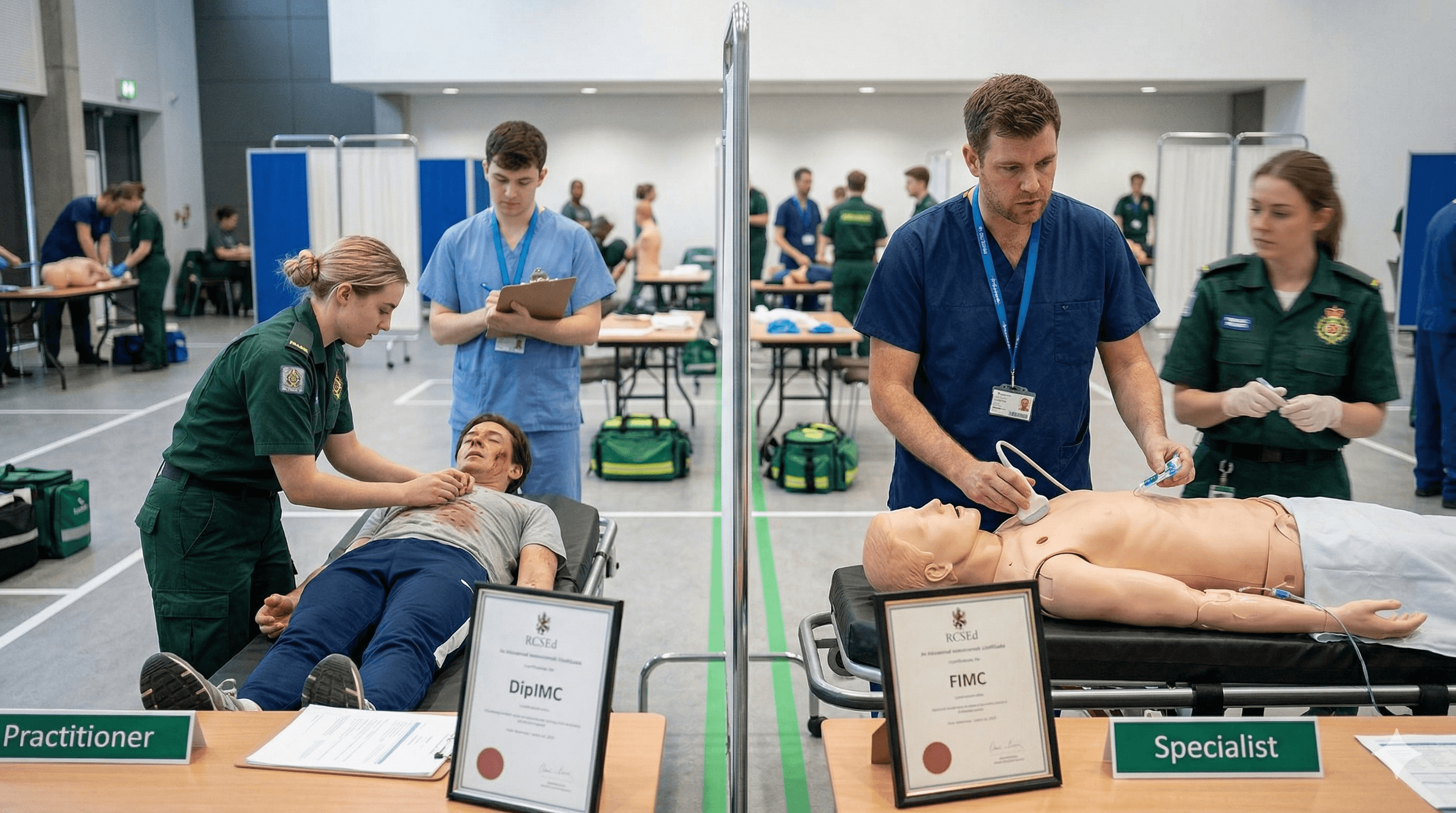
The Faculty of Pre-Hospital Care of the Royal College of Surgeons of Edinburgh awards two examination-based qualifications: the Diploma in Immediate Medical Care (DipIMC) and the Fellowship in Immediate Medical Care (FIMC). They are different levels of the same specialty and serve different career stages.
DipIMC (Diploma Level)
Purpose: Tests the knowledge and skills of practitioners who provide pre-hospital emergency care. Designed for doctors, paramedics, and nurses at any stage of their career who want to demonstrate competence in immediate medical care.
Level: Practitioner level. The standard is that of a competent pre-hospital care provider — not a specialist, but someone who can safely and effectively manage pre-hospital emergencies.
Format: Part A — 180 SBA questions (3 hours). Part B — 14-station OSPE (12 x 8 min + 2 x 16 min). Held at RCSEd Edinburgh.
Eligibility: Open to doctors, paramedics, and nurses. No pre-hospital experience is formally required (though it is strongly recommended). Application must be endorsed by a FPHC Regional Examinations Advisor or PHEM Training Programme Director.
Career value: Recognised across UK ambulance services, air ambulance organisations, BASICS schemes, and military medical services. Desirable criteria on many paramedic and PHEM applications. Demonstrates commitment to pre-hospital care at a nationally recognised standard.
FIMC (Fellowship Level)
Purpose: Tests specialist-level knowledge and skills in pre-hospital emergency medicine. Designed for doctors in or completing PHEM sub-specialty training.
Level: Specialist level. The standard is that of a consultant-level PHEM practitioner — significantly higher than the DipIMC.
Format: Part A — Written paper (SBA format). Part B — OSPE with more complex scenarios at a higher clinical standard. Held at RCSEd Edinburgh.
Eligibility: Typically requires completion of or progression through PHEM sub-specialty training. More restrictive eligibility than DipIMC.
Career value: Required or strongly desirable for consultant PHEM appointments. Demonstrates specialist competence in pre-hospital emergency medicine.
How to Choose
If you are a paramedic or nurse wanting to demonstrate pre-hospital competence: DipIMC. The Fellowship is typically for doctors in PHEM training.
If you are a doctor early in your career considering PHEM: DipIMC first. It strengthens your PHEM training application and builds the foundation the FIMC later tests at a higher level.
If you are a doctor in PHEM sub-specialty training: FIMC. This is the specialist qualification your training programme expects.
If you want both: Many PHEM trainees sit the DipIMC early in training and the FIMC later. The knowledge builds cumulatively.
Preparation for Either
The clinical knowledge base for both qualifications overlaps substantially — the FIMC tests the same domains at a higher level. The iatroX DipIMC Q-Bank with 700+ curriculum-mapped questions provides the foundation for both exams. A single subscription at iatroX Boards gives access to multiple Q-banks, making it efficient for candidates progressing through multiple pre-hospital care qualifications.