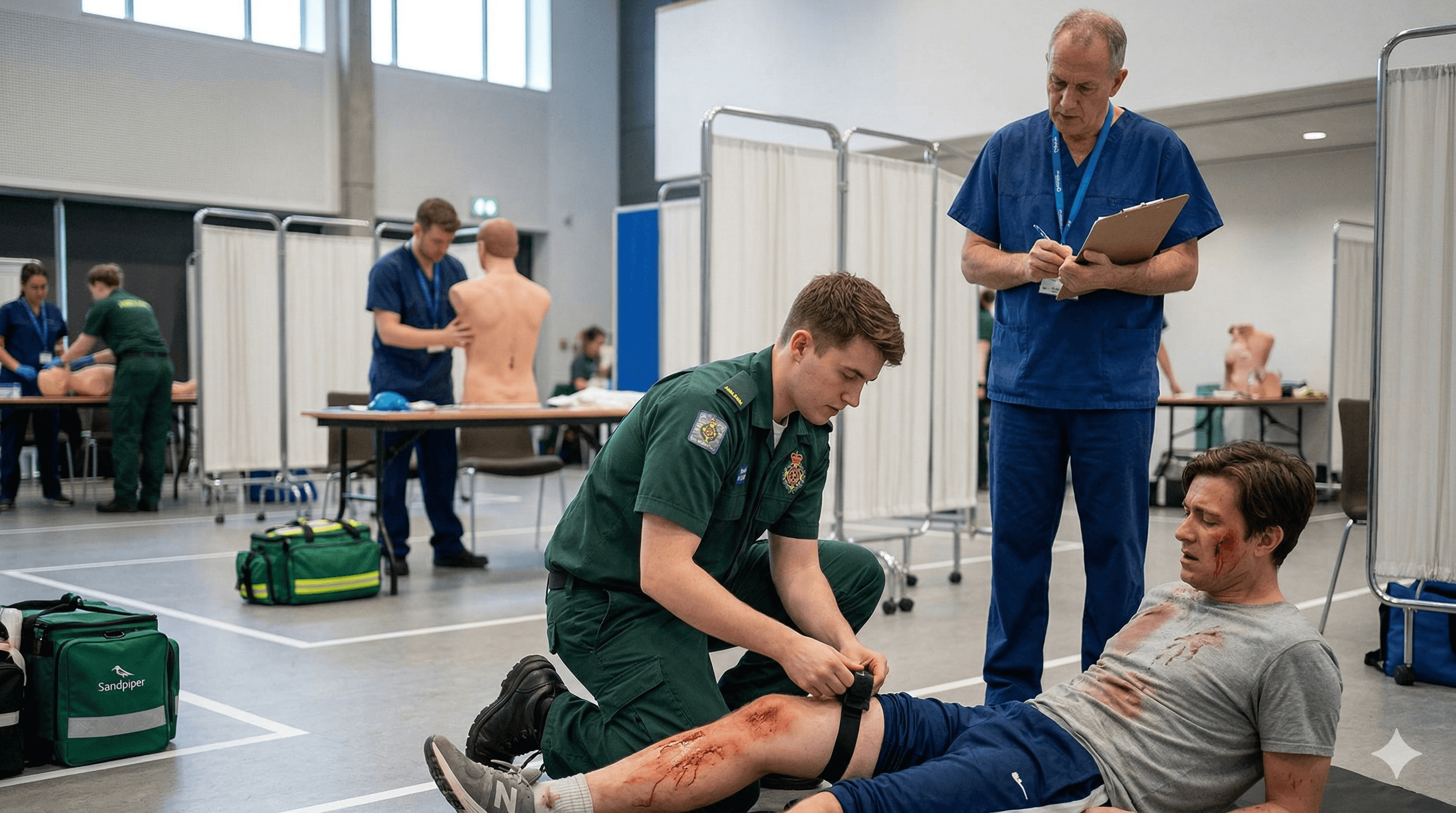
The DipIMC OSPE is a formal, high-fidelity practical examination held at the Royal College of Surgeons of Edinburgh. Fourteen stations. Twelve at 8 minutes. Two extended stations at 16 minutes. Live actors playing casualties and bystanders. Mannequins for invasive procedures. A Sandpiper bag with standard pre-hospital equipment. Examiners with structured mark sheets.
The atmosphere is intense. You are lined up with your peers, walked into the examination hall, and rotated through stations on bell signals. No names, no professional grades — everyone is equal. A consultant and a paramedic meet the same standard.
Station Types
Trauma scenarios. The bread and butter of the DipIMC OSPE. You arrive at a scene with a traumatised patient (actor or mannequin). You must perform a structured cABCDE assessment, identify injuries, manage life-threatening problems (catastrophic haemorrhage, tension pneumothorax, flail chest, pelvic fracture), and communicate your findings and plan. The <C>ABCDE approach must be automatic — practise it until you can do it in your sleep.
Medical emergencies. Pre-hospital management of medical conditions: cardiac arrest, anaphylaxis, seizures, diabetic emergencies, acute asthma, chest pain, stroke. The management follows UK resuscitation council and NICE guidelines, adapted to the pre-hospital setting — no CT scanner, no blood bank, limited pharmacology. The question is: what can you do now, in the field, with what you have?
Obstetric emergencies. Cord prolapse, shoulder dystocia, breech delivery, postpartum haemorrhage, pre-eclampsia. These stations test whether you can manage obstetric emergencies in environments where obstetric teams are not immediately available. Understand normal birth physiology, recognise complications, and know the immediate management for each.
Paediatric emergencies. Febrile child, paediatric cardiac arrest, non-accidental injury recognition, newborn resuscitation. Know age-appropriate drug doses, equipment sizes, and the specific physiological differences that make paediatric emergencies different from adult management.
Major incident management. METHANE reporting, triage (triage sieve and triage sort), CSCATTT framework, command and control principles. You may be asked to perform triage on multiple simulated casualties, deliver a METHANE report, or manage the medical aspects of a major incident scene.
Equipment and procedures. Thoracostomy, cricothyroidotomy (on mannequin), tourniquet application, pelvic binder application, IO access, chest seal application. Know the indications, contraindications, and technique for each. Handle the equipment before the exam — the Sandpiper bag is no longer provided for familiarisation beforehand, so practise with equivalent equipment during clinical shifts.
Communication and scene management. These stations test non-technical skills: communicating with a distressed bystander, handing over to the receiving hospital team, managing a scene with multiple agencies, breaking bad news in a pre-hospital setting. Structure, clarity, and empathy are all marked.
The Extended Stations (16 Minutes)
The two extended stations allow for more complex scenarios — typically involving a full patient encounter from scene arrival through assessment, management, packaging, and handover. These test the complete pre-hospital workflow rather than a single skill in isolation. Time management within the 16 minutes is critical — do not spend 12 minutes on assessment and leave 4 minutes for management and handover.
Preparation Strategy
Practise cABCDE until it is reflex. Every trauma station starts here. If you hesitate on your primary survey, you lose time and marks.
Handle equipment regularly. The OSPE tests practical familiarity. If you have not applied a pelvic binder under time pressure, the exam is not the time to learn.
Simulate full scenarios with peers. Set up mock OSPE stations with colleagues — one plays the patient, one plays the examiner with a mark sheet, one is the candidate. Rotate roles. Give structured feedback.
Learn the FPHC Faculty Statements. At least one station has been directly based on a Faculty Statement in recent diets. They are the officially endorsed positions on pre-hospital care topics.
Know your major incident frameworks. METHANE, CSCATTT, triage sieve, triage sort, NARU command and control. These are testable and frequently tested.
The clinical knowledge underpinning every OSPE station can be built through the iatroX DipIMC Q-Bank — 700+ curriculum-mapped questions with adaptive spaced repetition. Ask iatroX provides instant clinical reference during study for any management pathway you are unsure about.