The DipIMC is profession-blind. The examiner does not know — and does not care — whether you are a paramedic, a doctor, or a nurse. The mark sheet is the same for everyone. The standard is the same.
Yet historically, there has been a pass rate gap between medical and paramedic candidates. This is not because paramedics are less capable — it is because the exam tests certain knowledge domains that medical training covers in depth and paramedic training covers more briefly. Understanding these specific gaps allows paramedic candidates to close them with targeted preparation.
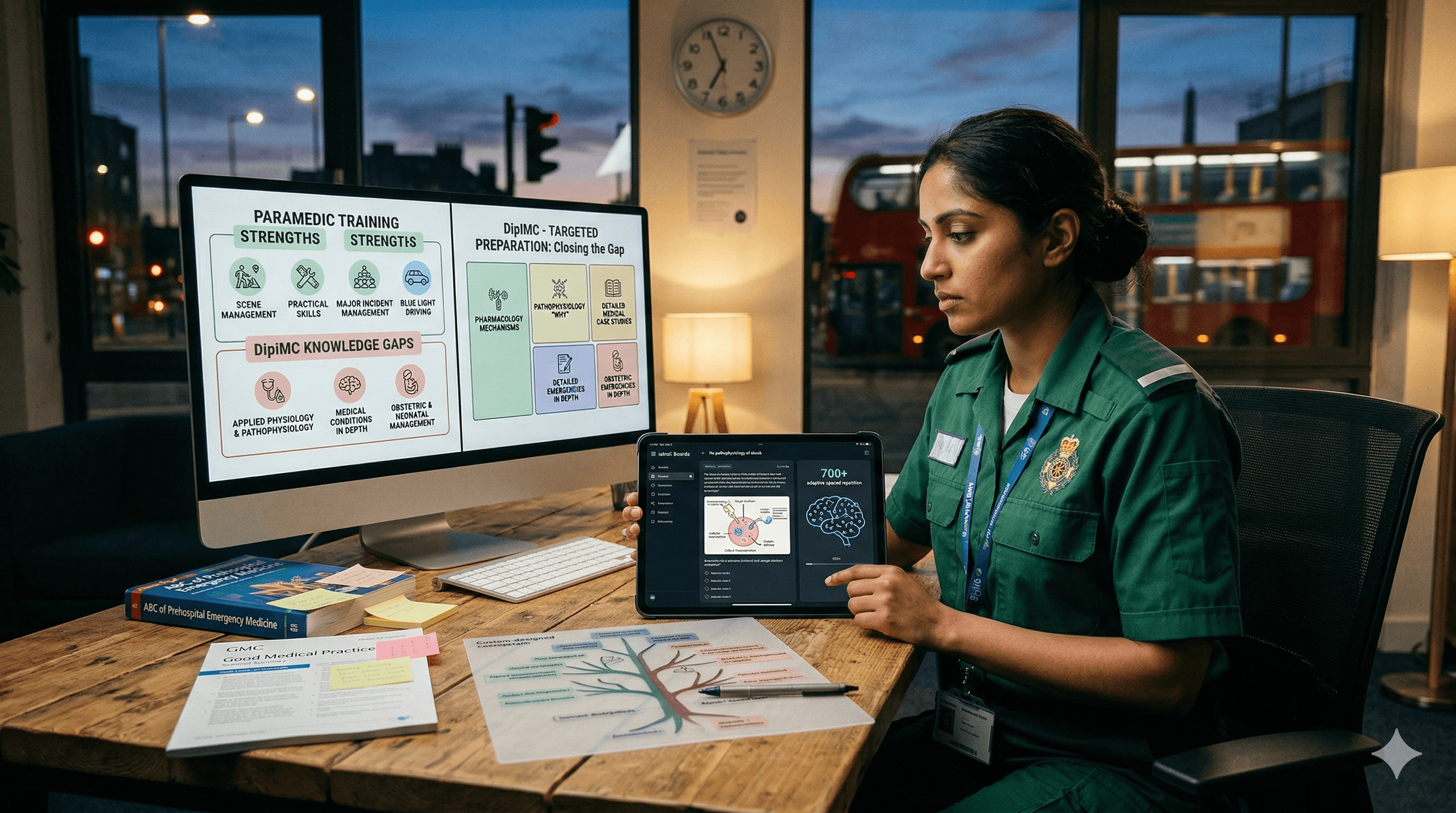
Where Paramedics Are Strong
Scene management. Paramedics operate at scenes daily. Dynamic risk assessment, scene safety, extrication, packaging, working with fire and police — this is second nature. Doctor candidates often struggle with the practical realities of scene management that paramedics handle routinely.
Practical skills. IV access, IO insertion, tourniquet application, airway management in challenging environments — paramedics practise these skills constantly in real clinical settings.
Major incident management. Ambulance service training covers METHANE, CSCATTT, triage, and command and control comprehensively. Paramedic candidates are typically well-prepared for major incident stations.
Blue light driving and operational knowledge. Questions about response categories, driving regulations, and ambulance service operations are straightforward for paramedics but unfamiliar for many doctor candidates.
Where the Gap Typically Exists
Clinical pharmacology. The DipIMC SBA paper tests pharmacology in depth — drug mechanisms, interactions, dose calculations, and pharmacokinetics. Paramedic training covers a more limited formulary than medical school. Paramedic candidates should invest specific study time in the pharmacology of drugs used in pre-hospital care and emergency medicine: anaesthetics, analgesics, cardiac drugs, antimicrobials, and obstetric drugs.
Applied physiology and pathophysiology. Questions about the underlying physiology of shock, respiratory failure, neurological injury, and metabolic disturbance test mechanism-level understanding. Paramedic training focuses on recognition and management; the DipIMC also tests the "why" behind the management. Understanding the physiological basis makes the clinical management more logical and memorable.
Medical conditions in depth. The SBA paper includes detailed questions about medical conditions (cardiology, respiratory, neurology, endocrine) that go beyond the standard paramedic curriculum. Conditions like aortic dissection, subarachnoid haemorrhage, adrenal crisis, and thyrotoxic storm are tested in pre-hospital context.
Obstetric and neonatal management in depth. While paramedic training covers normal delivery and basic complications, the DipIMC tests obstetric emergencies in greater depth — including pharmacological management (magnesium sulfate, oxytocin, misoprostol) and neonatal resuscitation beyond basic life support.
How to Close the Gap
Use the iatroX DipIMC Q-Bank daily from the start of your preparation. The adaptive spaced repetition algorithm will identify your specific weak areas — which for paramedic candidates are typically pharmacology, pathophysiology, and detailed medical conditions — and target them automatically. Over 700 curriculum-mapped questions cover the full breadth the exam tests.
Invest specifically in pharmacology. Learn the mechanisms, not just the indications. When you administer adrenaline in anaphylaxis, understand why it works (alpha-1 vasoconstriction, beta-1 chronotropy, beta-2 bronchodilation). This depth is what the SBA paper tests.
Read the ABC of Prehospital Emergency Medicine with attention to the pathophysiology sections, not just the management algorithms. The "why" behind each management step is testable.
Use Ask iatroX to verify clinical knowledge against UK guidelines — particularly for medical conditions where your clinical exposure may be limited. The instant guideline reference builds the depth that the SBA paper demands.
Pair with a doctor study partner for OSPE practice. You bring scene management expertise; they bring clinical depth. The exchange benefits both.
The DipIMC pass rate gap is closable. It requires targeted investment in the specific areas where paramedic training is thinner — pharmacology, pathophysiology, and detailed medical management. The adaptive tools at iatroX Boards identify these gaps automatically and help you close them systematically.