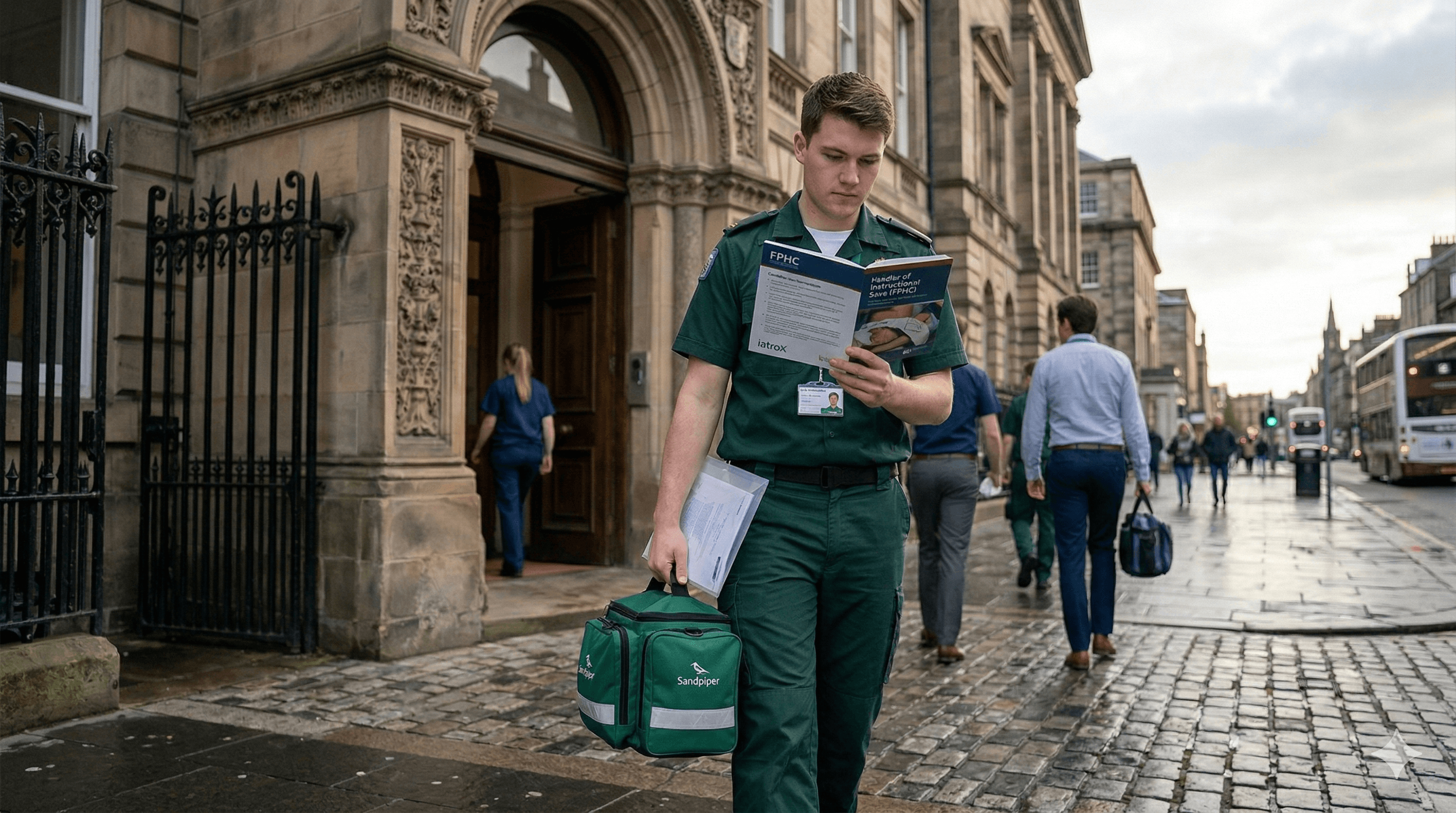
The DipIMC is held at the Royal College of Surgeons of Edinburgh on Nicolson Street — a beautiful, historic building that adds gravity to an already high-stakes day. Knowing what to expect eliminates unnecessary anxiety and lets you focus on the exam itself.
Written Paper Day
What to bring: Valid photo ID matching your application. Admission notice (emailed by RCSEd). A watch (analogue — smart watches are not permitted). Water bottle. Snacks for before/after. No phones, smart watches, or electronic devices in the exam hall.
What to wear: Smart casual is appropriate for the written paper. You will be sitting at a desk for 3 hours — comfort matters. The exam hall in Edinburgh can be variable in temperature, so layers are advisable.
The day: Arrive at the RCSEd at least 30 minutes before the scheduled start. Sign in at reception, present ID, and receive your candidate number. Store phones and belongings securely. You will be directed to the exam hall. The paper is 180 SBA questions in 3 hours — 1 minute per question. No scheduled breaks; you can request a toilet break but the clock does not stop.
The written paper can also be sat in Birmingham for a limited number of candidates — check availability when booking.
OSPE Day
What to bring: Same ID and admission notice. Comfortable, professional clothing suitable for simulating patient care. A stethoscope is useful but not always required (the station brief will specify).
What to wear: The regulations state "comfortable clothing suitable for simulating patient care" — T-shirts and jeans are explicitly not acceptable. Smart clinical attire is appropriate: smart trousers or chinos, a collared shirt or clinical-appropriate top, comfortable shoes that allow you to kneel (you will be on the floor with casualties). Clothing that identifies your profession or grade is not permitted — no flight suits, no epaulettes, no ID badges.
The day: The OSPE runs over several days during exam week. Your individual OSPE will be one day — typically 2-3 hours including waiting time. You arrive, sign in, surrender your phone, and receive your candidate number badge. You are lined up with your cohort and walked into the examination hall.
You rotate through 14 stations on bell signals. Each station has 1 minute reading time outside (read the brief carefully — it tells you the scenario, any available equipment, and what is expected) followed by 8 minutes (or 16 minutes for extended stations) inside.
Inside the station: at least one examiner with a mark sheet, a standardised patient (actor) or mannequin, and a Sandpiper bag with pre-hospital equipment. If you need a piece of equipment you cannot find, tell the examiner what you want and they will direct you.
Edinburgh Logistics
Accommodation: Book early, especially for the January diet (Edinburgh winter can limit availability). Stay within walking distance of the RCSEd (Nicolson Street, near the university area). Hotels on South Bridge, George IV Bridge, or in the Grassmarket are convenient.
Travel: Edinburgh is well-served by rail (Waverley station is 10 minutes' walk from the RCSEd) and air (Edinburgh Airport with tram connection to the city centre). Arrive the day before the exam — do not risk travel delays on exam morning.
Food: The RCSEd area has numerous cafes and restaurants. Eat well the evening before. Have breakfast. Bring water and snacks. You will need energy for the OSPE.
The Final Advice
The building is impressive. The OSPE is formal. The examiners are professional but not hostile — they want you to pass. Treat every station independently — a bad station does not contaminate the next one. Reset between stations. Trust your preparation. And remember that every candidate in that lineup — regardless of their profession or experience — is meeting the same standard. You belong there.