Executive summary
The path from an innovative digital health idea to a successfully adopted tool in the UK's NHS is now paved with a mandatory and increasingly complex assurance stack. The NHS Digital Technology Assessment Criteria (DTAC) has become the baseline for procurement, the MHRA’s AI Airlock provides a crucial sandbox for novel AI as a Medical Device (AIaMD), and NICE’s Early Value Assessment (EVA) pathway is shaping how new evidence is generated. This has created a surge in demand for specialist advisory and delivery partners who can navigate this landscape.
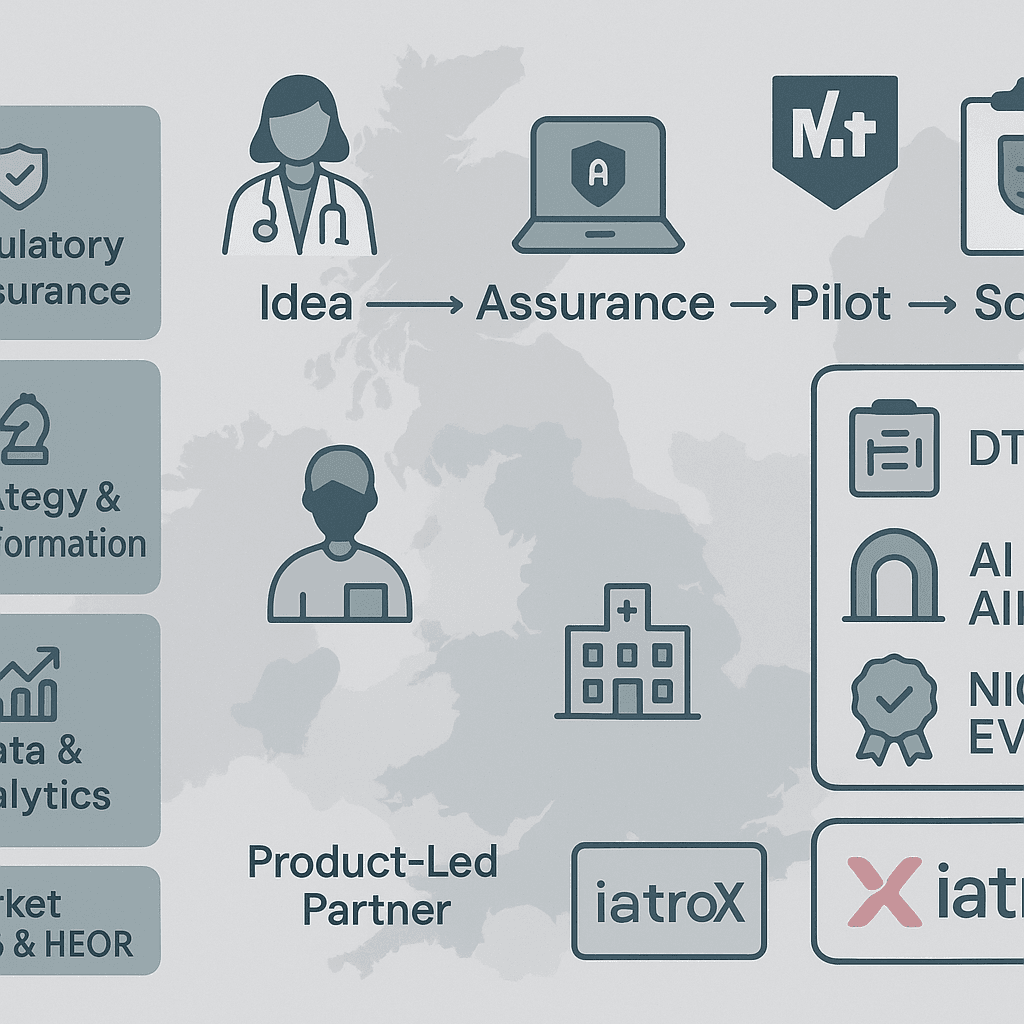
These firms typically fall into four key buckets: (1) regulatory & assurance, (2) strategy & transformation for NHS providers, (3) data & analytics, and (4) market access & health economics for vendors. This guide provides a practical map of this new ecosystem, profiling a selection of firms—from specialists like Curistica and Safehand to large-scale delivery partners like BJSS (CGI)—and explains how to choose the right partner to help you build and deploy digital health tools safely and effectively.
Why advisory is booming: the UK assurance & adoption gap
- The procurement baseline: The DTAC is now the front-door check for NHS buyers. Any digital tool, from a patient-facing app to a clinical AI, is expected to have a complete and credible DTAC pack ready at the point of procurement (NHS Transformation Directorate).
- Regulatory novelty: For cutting-edge AI that functions as a medical device, the MHRA’s AI Airlock provides a supervised sandbox to de-risk evidence generation and clarify regulatory requirements before a wide-scale rollout (GOV.UK).
- Fast-track evidence: The NICE EVA pathway allows for the conditional, time-limited adoption of promising digital and medtech tools where the evidence base is still maturing, but requires a robust plan for real-world data collection (NICE). This combination of requirements means that both NHS organisations and technology vendors increasingly need specialist navigators who speak the languages of clinical safety, regulation, and delivery.
Capability map: four jobs to be done
A) Regulatory, safety & assurance This involves preparing DTAC readiness packs, authoring DCB 0129/0160 clinical safety cases, navigating the UKCA/MHRA route-to-market for medical devices, and scoping evidence plans for NICE.
- Typical partners: Safehand (specialising in DCB 0129/0160 compliance), Hardian Health (focused on SaMD/AIaMD regulation and NICE ESF).
B) Strategy & transformation (provider-side) This focuses on helping NHS organisations with their digital strategy, optimising patient flow and capacity, and managing large-scale change like an EPR implementation.
- Typical partners: Ethical Healthcare, Channel 3 Consulting, TPXimpact.
C) Data & analytics This covers the technical work of integrating with national infrastructure like the Federated Data Platform (FDP) and FHIR, as well as data engineering, modelling, and building business intelligence dashboards.
- Typical partners: Edge Health, Methods Analytics.
D) Market access & health economics (HEOR) (vendor-side) This helps vendors build their evidence strategy, navigate pricing and reimbursement, and facilitate engagement with NICE.
- Typical partners: Mtech Access / Petauri Evidence (a recognised NICE META facilitating organisation).
Product-led partners (AI implementation) This is a new category where vendors bring both a compliant platform and advisory support. For example, iatroX offers a UKCA-marked, MHRA-registered clinical AI tool with UK guideline grounding, which can be deployed alongside consulting teams to ensure a safe and effective AI rollout.
Who’s who: exemplar firms & what they’re known for
- Curistica: A clinical innovation consultancy known for its work on AI education and adoption programmes for clinical teams.
- Safehand: A specialist consultancy focused on DCB 0129 (for manufacturers) and DCB 0160 (for deployments) clinical safety compliance and training.
- Hardian Health: A regulatory strategy firm with deep expertise in SaMD/AIaMD, helping companies navigate the CE, UKCA, and FDA pathways and interpret the NICE ESF.
- Ethical Healthcare: An NHS-born digital transformation consultancy with a strong "from the NHS, for the NHS" ethos.
- Channel 3 Consulting: A well-established firm focused on large-scale NHS digital change, particularly in patient flow and pathway improvement.
- Edge Health & Methods Analytics: Respected health analytics and data engineering firms with a track record of NHS case work.
- Mtech Access (Petauri Evidence): A market access and HEOR consultancy, recognised as a NICE META facilitating organisation.
- BJSS (now part of CGI) & TPXimpact: Large-scale digital delivery partners known for working on major national services like the NHS App, e-RS, and Spine.
How to brief and buy: a due-diligence checklist
- Map your need to the four capability buckets above. Are you buying assurance, transformation, data, or market access expertise?
- Ask for proof against the UK frameworks. Request example DCB 0129/0160 safety cases, evidence of navigating NICE EVA, and a clear understanding of the AI Airlock process.
- Check interoperability fluency. Your partner must be fluent in FHIR, CDS Hooks, SMART on FHIR, and the governance of the Federated Data Platform.
- Insist on an outcome-based Statement of Works. Define the deliverable (e.g., a passed DTAC, a completed safety case, a measurable reduction in patient waiting times) and avoid open-ended, input-based contracts.
- Confirm governance artefacts. Your contract should include the delivery of a DPIA, clear clinical safety ownership, and audit trails for any AI deployments.
What “good” looks like in delivery
- National-scale digital delivery: Look for partners with a track record of delivering on major national programmes, as evidenced by contract awards and case studies (e.g., BJSS supporting the NHS App).
- Analytics in the NHS: Look for firms that publish their data-engineering and modelling insights, using this as a proxy for their technical bench strength (e.g., Edge Health).
- Market access depth: Look for formal recognition, such as Mtech Access's status as a NICE META facilitating organisation.
- Education & change: Look for partners who address the "human factor" of adoption with credible training programmes (e.g., Curistica's AI training).
- AI product partners: Look for platforms with existing UKCA/MHRA credentials and a UK-guideline knowledge base (e.g., iatroX) when you need a product-plus-adoption combination.
Common Pitfalls—and How to Avoid Them
- Buying “advice without adoption.” Your contract should include delivery squads or clear pathways to implementing the advice in-workflow.
- Fuzzy compliance. Ask for DTAC artefacts, DCB safety case examples, and evidence of navigating NICE EVA or the AI Airlock upfront. A vague answer is a red flag.
- Under-specifying data needs. Ensure that FHIR profiles, data-quality plans, and IG governance are fully costed at the outset of any data-heavy project.
FAQs
- Is advisory different from systems integration?
- Often, yes. Boutique advisory firms tend to specialise in areas like assurance, health economics, or analytics. Large systems integrators are typically responsible for delivering the major national services. Many successful programmes blend both.
- Do I need to go through a NICE EVA?
- If your technology is promising but your evidence base is still maturing, the NICE Early Value Assessment pathway can be a pragmatic and effective route to conditional adoption in the NHS. It's best to work with partners who have experience navigating the NICE ESF and META processes.
- Where does iatroX fit into this ecosystem?
- As a UKCA-marked clinical AI platform, iatroX acts as a product-led partner. You can deploy our compliant tool with the support of your chosen advisory partner to ensure a provenance-first approach to AI use and adoption.