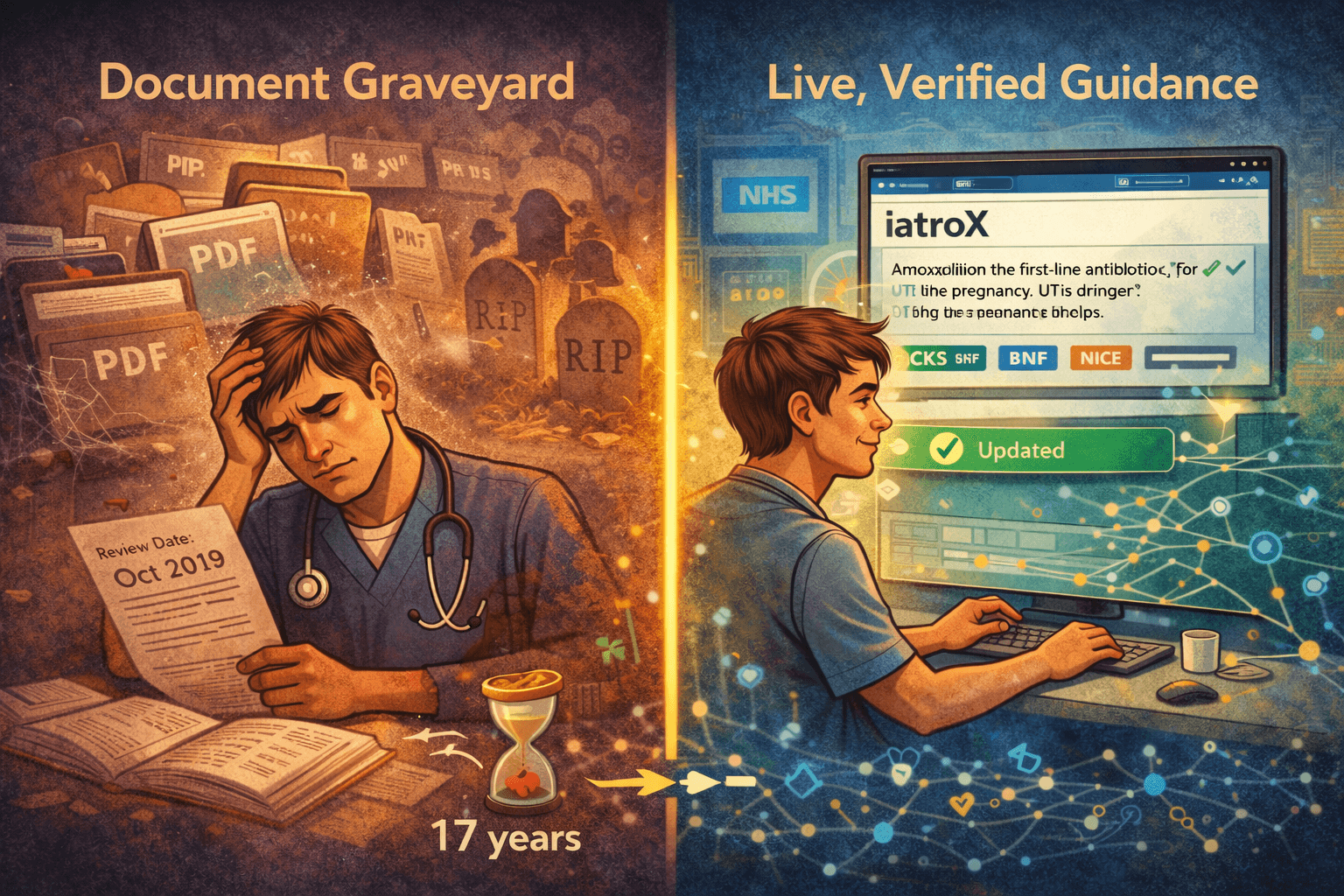
You are on call. The patient in front of you has a complex presentation that sits in the grey area of your specialty knowledge. You know a guideline exists. You go to the intranet. You search. You find a PDF in a nested folder. You open it.
The header reads: “Review Date: October 2019.”
This is the reality for thousands of clinicians across the UK every day. The risk in modern medicine isn’t just a lack of knowledge; it is the latency and findability of that knowledge. The right answer exists, but it is trapped in a “document graveyard.” In 2025, the PDF is no longer a safety net; it is a bottleneck.
1. The “latency problem”: why speed matters clinically
The 17-year gap (and what it really means)
In health services research, a widely cited estimate suggests it can take approximately 17 years for research evidence to translate into routine clinical practice. While this figure—originating from studies by Balas, Boren, and Morris—is a simplified average and varies significantly by specialty and intervention type, it serves as a stark metric for the inertia of medical knowledge transfer.
In a digital era, a lag measured in decades is unacceptable. This latency is not just an academic frustration; it represents a tangible gap between what we know works and what patients actually receive.
Why latency is unsafe
When guidelines are static documents, they decay from the moment they are published.
- Clinical risk: Outdated thresholds for intervention, superseded contraindications, or obsolete dosing regimens remain in circulation long after the evidence has moved on.
- Operational risk: Clinicians waste valuable time cross-referencing local policies against national updates to see which takes precedence.
- Human factors: “Search fatigue” sets in. When the official route to knowledge is high-friction, clinicians revert to reliance on memory or informal “corridor consultations,” where bias and error creep in.
2. The “death of the PDF”: why document-centric medicine breaks at scale
PDFs are not knowledge—they’re snapshots
The PDF is a digital emulation of paper. It is designed for printing, not for computing. In a dynamic healthcare environment, the document-centric model fails because it lacks:
- Version control: Is this file on my desktop the latest version, or is there a newer one on the portal?
- Interoperability: A PDF cannot "talk" to an electronic health record (EHR) to trigger a safety alert.
- Granularity: You cannot search for a specific recommendation code; you have to read the whole document to find the relevant paragraph.
The NHS is shifting toward interoperability
The direction of travel for NHS England is clear: the future is API-first. Just as data exchange is moving toward FHIR standards to make patient records liquid across boundaries, clinical knowledge must move toward computable, structured formats. The emergence of Clinical Decision Support (CDS) APIs suggests a future where guidance is not read, but called by systems at the point of care.
3. The “living evidence” model: guidelines as a stream
What are “living guidelines”?
A living guideline is not a static document updated every five years. It is a knowledge resource that is updated as soon as relevant new evidence becomes available, supported by continuous evidence surveillance. It shifts the concept of a guideline from a "book" to a "stream."
This is not hypothetical: the infrastructure exists today
- NICE: The National Institute for Health and Care Excellence has established principles for supporting "digital living guideline recommendations." We have already seen this in action with high-velocity topics like the COVID-19 rapid guidelines, demonstrating that continuous evidence surveillance is possible at a national level.
- Global context: The World Health Organization (WHO) utilizes platforms like MAGICapp to publish living guidelines, allowing clinicians to see the evidence and recommendation strength update in real-time.
Epistemology change: knowledge as a state
This represents a profound shift in how we view medical knowledge.
- In the PDF era: Knowledge is an object (a file you download).
- In the living era: Knowledge is a state (the current best recommendation, retrieved live).
The clinician no longer "goes to find the book"; the system retrieves the current state of the evidence at the point of care.
4. The role of iatroX: an “intelligence layer” for verified guidance
Positioning statement
iatroX is not a search engine; it is an intelligence layer that retrieves the current, verified guidance state with traceable provenance—so clinicians spend less time hunting and more time practising.
Intelligence layer vs. traditional search
- The Library Model (Traditional Search): You type a query. You get a list of documents. You have to open them, check the dates, read the text, and synthesise the answer yourself. Ranking is based on SEO, not clinical correctness.
- The Stream Model (iatroX): You ask a clinical question. The system queries a curated, gated corpus of trusted UK sources (NICE, CKS, SIGN, SmPC/emc). It returns a structured answer rooted in specific passages from those documents, complete with provenance links.
Concrete product moments
- The 30-second answer: A GP asks about the first-line antibiotic for a pregnant patient with a UTI. Instead of opening the BNF, CKS, and a local formulary tab, iatroX retrieves the specific synthesis of these sources with citations.
- Change detection: When a NICE guideline updates, the static PDF on a desktop becomes dangerous. A dynamic retrieval system reflects the updated state immediately because it pulls from the live source, not a cached file.
5. The takeaway: the shift from “Library” to “Stream”
The transition from static documents to dynamic intelligence is inevitable.
- Library Model: “Go find the book.” (Document hunting).
- Stream Model: “The validated answer is delivered to you.” (Dynamic retrieval).
For UK clinicians, this shift offers a future with less unwarranted variation, less wasted administrative time, and more defensible, evidence-based reasoning. It aligns clinical practice with the broader NHS strategy of embedded, interoperable decision support.
Call to action
Stop relying on "Folder 3, Sub-folder B" on the intranet. Try iatroX for your common clinical workflows—whether it's checking anticoagulation thresholds or antibiotic choices—and experience the difference between searching for a document and retrieving an answer.
Evidence & credibility
The 17-year gap: nuance matters While the "17-year gap" (Morris et al., 2011) is a powerful statistic, it is not a universal law. In some fields, translation is faster; in others, slower. However, it remains the defining metric for the "implementation gap" that digital tools must solve.
Living guidelines are real From NICE's digital principles to the WHO's use of MAGICapp, the infrastructure for dynamic guidance is already live. This is not futurology; it is the current standard for high-performance health systems.
The infrastructure trend The NHS commitment to FHIR standards and Clinical Decision Support (CDS) frameworks confirms that the future of knowledge is structured, computable, and integrated.
Frequently Asked Questions
What are living clinical guidelines? Living guidelines are recommendations that are updated continuously as new evidence emerges, rather than waiting for a fixed review period (e.g., every 5 years).
Is the 17-year research-to-practice gap real? It is a widely recognised average derived from health services research, illustrating the significant delay between the publication of new evidence and its routine adoption in patient care.
How does dynamic retrieval differ from search? Search gives you a list of documents you must read and verify. Dynamic retrieval extracts the specific answer and context from within those documents, presenting the information you need immediately.
How can clinicians ensure guidance is up to date? By using tools that pull from live, maintained repositories (like the NICE API or curated knowledge bases) rather than relying on downloaded PDFs or printed cheat sheets which expire the moment they are saved.