Introduction
The Clinical and Professional Skills Assessment (CPSA) is the practical component of the UKMLA. For many students, it is the most stressful part of finals. The anxiety often stems from a misconception: that you need to be a brilliant diagnostician to pass.
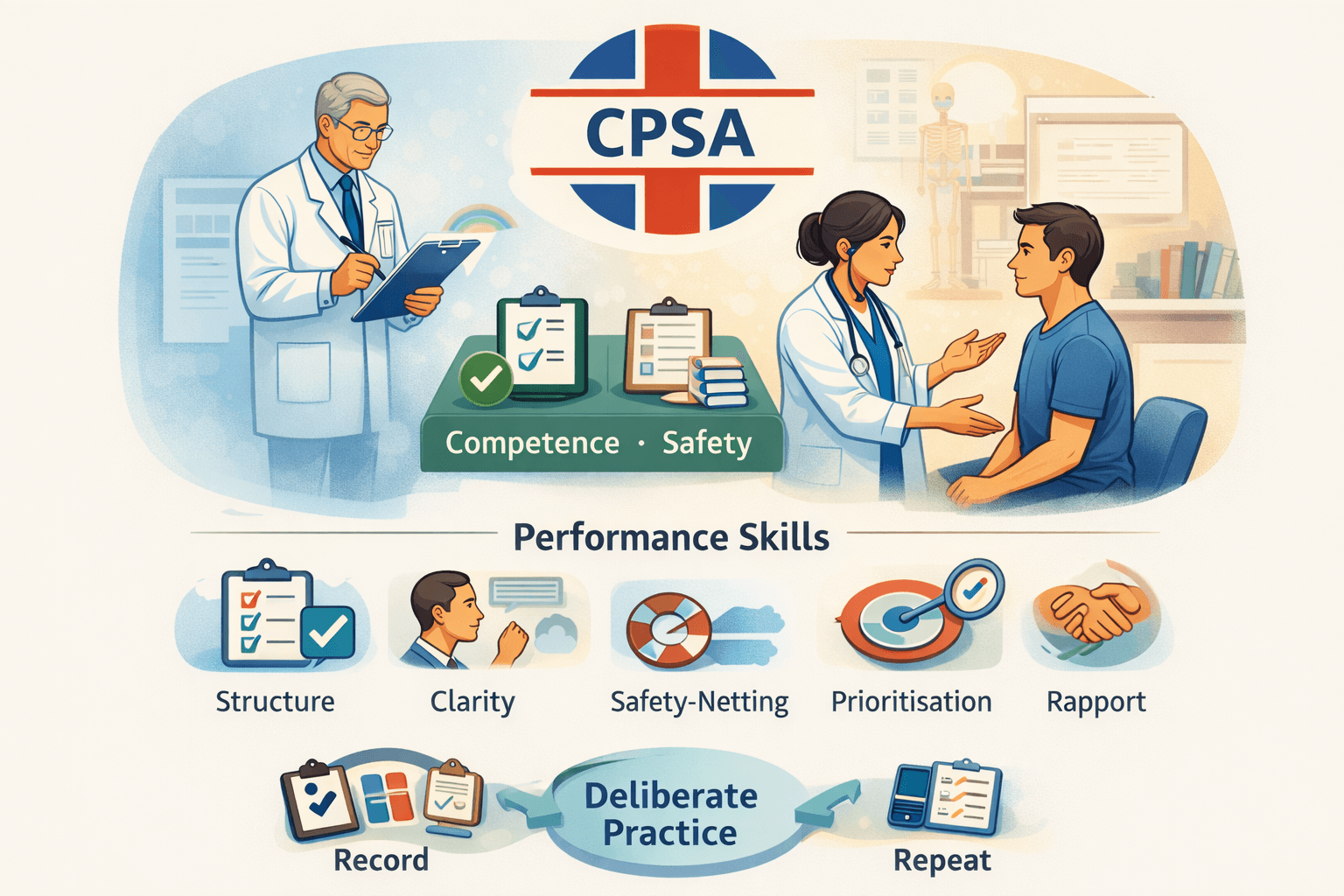
In reality, the CPSA is a performance exam. Examiners are not looking for brilliance; they are looking for competence, safety, and structure. This guide breaks down the core behaviours that score marks, provides a proven consultation template, and shows you how to build a deliberate practice loop that works.
CPSA in one paragraph
The CPSA is the clinical skills component of the UK Medical Licensing Assessment (UKMLA). It assesses your ability to perform the practical tasks of a doctor—history taking, examination, procedure, and explanation—in a simulated environment. It is delivered by your medical school but follows the national GMC MLA Content Map (Medical Schools Council).
What examiners reward (performance fundamentals)
Stop trying to memorise obscure signs and focus on the "domains" that appear on every mark sheet.
- Structure: Can you move through the consultation logically, or do you jump around? A messy history suggests a messy mind.
- Clarity: Do you speak in plain English? Do you signpost ("I'm now going to ask about...")?
- Safety-Netting: This is a major differentiator. Do you tell the patient exactly what to watch out for and when to return?
- Prioritisation: Can you identify the most urgent problem and address it first?
- Rapport: Do you listen? Do you acknowledge the patient's ideas, concerns, and expectations (ICE)?
The “12-minute consultation template”
For every station involving a patient interaction, use this skeleton. It keeps you on time and ensures you hit the scoring domains.
- Opening (1 min): Introduction, ID check, and the "Golden Minute" (let them speak).
- Agenda (30s): "What are the main things you want to cover today?"
- Focused Data Gathering (4-5 mins): History of Presenting Complaint (SOCRATES), Red Flags, ICE, and a focused Examination.
- Explanation (2-3 mins): "Based on what you've told me..." (Diagnosis/Differential). Avoid jargon. Check understanding ("chunk and check").
- Shared Plan (2 mins): "Here are our options..." Agree on a management plan.
- Safety Net & Close (1 min): "If X happens, come back immediately. Do you have any questions?"
Deliberate practice loop
Practising "badly" reinforces bad habits. Use this loop to improve:
- Record: Film or audio-record yourself doing a station.
- Feedback: Watch/listen back immediately. Compare your performance against a formal mark scheme (e.g., from Geeky Medics). Ideally, have a peer critique you.
- Repeat: Do the same station again immediately, implementing the feedback. This is where the learning happens.
CPSA practice circuit
- Micro-Circuits (Weeks 1-4): Run 2–3 stations in a row with a study partner, twice a week. Focus on "drilling" specific skills (e.g., "Just the history").
- Full Circuits (Weeks 5-8): Simulate exam conditions. Run 8+ stations back-to-back to build stamina and stress management.
Resource options (neutral)
You need a "skills gym"—a bank of stations to practise.
- Geeky Medics: The industry standard for free, high-quality station guides and checklists.
- OSCEstop: Excellent for concise notes and station banks.
- Medical School Resources: Don't ignore the mock stations provided by your own university; they are often the closest to your local exam style.
Where iatroX fits
iatroX is not an OSCE station bank. Its value is in the "post-practice" learning loop.
- Knowledge Gaps: You do a station on "Breathlessness" and realise you don't know the differential for a PE vs Pneumothorax.
- The Fix: Use iatroX Ask to quickly retrieve the NICE CKS summary or Brainstorm the differential.
- The Retention: Add that clinical pearl to your iatroX Quiz queue so you don't forget it before the real exam. It keeps your learning loop in one place.
FAQs
How early should I start CPSA practice? Start practising clinical skills from the beginning of your final year. Consistent, low-intensity practice (1-2 stations a week) is far better than a last-minute cram.
How do I structure feedback sessions? Be ruthless but kind. Use the "Pendulum" method: "What went well?" first, then "What would you do differently next time?" Always link feedback to specific domains in the mark scheme (e.g., "You missed the red flag question about weight loss").