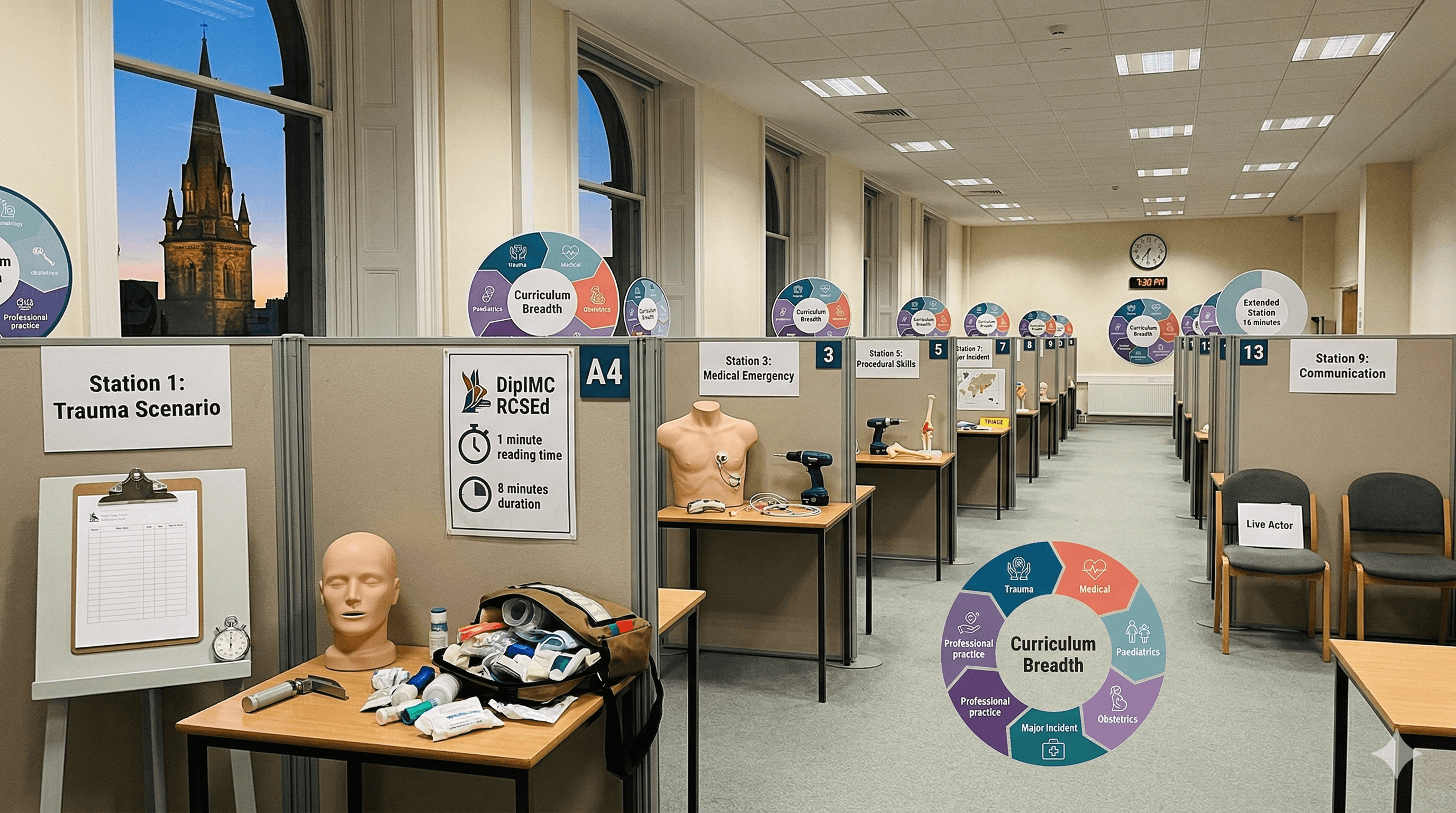
The Diploma in Immediate Medical Care (DipIMC RCSEd) is the benchmark pre-hospital care qualification in the UK. Administered by the Faculty of Pre-Hospital Care of the Royal College of Surgeons of Edinburgh, it tests the knowledge, technical skills, and non-technical skills of practitioners who provide pre-hospital emergency care — whether you are a doctor, paramedic, or nurse.
Unlike most postgraduate medical exams, the DipIMC is not profession-specific. Everyone sits the same exam at the same standard. A paramedic and a consultant anaesthetist answer the same questions and perform the same OSPE stations. This makes it uniquely challenging — and uniquely respected.
The Exam Format
Part A — Written Paper. 180 single best answer questions in 3 hours. Covers the full breadth of pre-hospital emergency medicine: trauma, medical emergencies, paediatrics, obstetrics, major incidents, scene management, pharmacology, and professional practice. The questions are clinically focused with a pre-hospital context — not hospital emergency medicine questions transplanted into a field setting.
Part B — OSPE (Objective Structured Practical Examination). 14 stations: 12 of 8 minutes duration and 2 extended stations of 16 minutes. Each station has 1 minute reading time outside. Stations include trauma scenarios, medical emergencies, procedural skills, major incident management, communication with patients/bystanders/crews, data interpretation, and equipment handling. The OSPE is held at the RCSEd in Edinburgh and uses live actors, mannequins, and a Sandpiper bag with standard pre-hospital equipment.
Both parts must be passed. They can be taken in either order and during the same diet. The exam runs twice a year (typically January and June/July). Fee: approximately £725-760.
Application
Applications are managed by the RCSEd Examinations Department. You must submit an application signed by a FPHC Regional Examinations Advisor or approved PHEM Training Programme Director. This is not just administrative — it confirms that you have the clinical background appropriate for the exam level. International candidates must adapt their clinical practice to UK standards for the exam.
A maximum of 4 attempts is permitted. If you pass one part but fail the other, the pass is valid for 3 subsequent available diets.
How to Prepare
The DipIMC syllabus is broad, and dedicated preparation resources have historically been scarce. This has changed.
Primary Q-Bank: iatroX offers a DipIMC curriculum-mapped question bank with over 700 questions, accessible through a single subscription that also provides access to multiple other Q-banks. The questions cover the full FPHC curriculum with adaptive spaced repetition targeting your weakest areas automatically. Guideline-grounded explanations ensure you learn the UK-standard management for every scenario.
Core textbook: "ABC of Prehospital Emergency Medicine" (Tim Nutbeam, Matthew Boylan) is the essential reference. Aligned to the DipIMC curriculum. Read it cover to cover.
FPHC Faculty Statements: These are officially endorsed positions on specific pre-hospital care topics. At least one OSPE station has been directly based on a Faculty Statement in recent diets. Read them all — they are available on the FPHC website.
Supplementary resources: PHEM podcasts (Tim Nutbeam and Clare Bosanko), St Emlyn's blog DipIMC posts, NARU Command and Control Guidance (for major incident management), and JRCALC guidelines (for paramedic candidates).
Clinical reference: Ask iatroX provides instant UK-guideline-grounded answers for clinical queries during study. The pre-hospital context differs from hospital practice, but the underlying clinical management (NICE, BNF, resuscitation council guidelines) is the same evidence base.
OSPE preparation: Practise with colleagues using simulated scenarios. Attend pre-hospital courses (GNAAS Pre-Hospital Obstetrics, ATACC, simulation courses). Handle the Sandpiper bag and its contents until every item is familiar. Practise your cABCDE approach under time pressure until it is automatic.
The 6-Month Timeline
Months 1-2: Read the ABC textbook systematically. Begin iatroX DipIMC Q-Bank daily (20-30 questions). Read all FPHC Faculty Statements.
Months 3-4: Increase Q-bank volume (30-50 questions daily). Begin OSPE practice with peers. Cover major incident management, paediatric and obstetric emergencies, and procedural skills.
Month 5: Mock written paper under timed conditions. OSPE simulation practice. Target weaknesses identified from mock and Q-bank data.
Month 6: Final mock. Light revision. Rest before exam. Travel to Edinburgh.
Post-Nominals
On passing, you are awarded DipIMC RCSEd. You must be a Member or Fellow in good standing with the FPHC to use the post-nominals. The Diploma is recognised across UK ambulance services, air ambulance organisations, and PHEM training programmes as evidence of pre-hospital care competence.